


FILTERED RESULTS
FILTERS
MCap $2.6T +0.7%24h Vol $93.7B +2.4%Fear & Greed 50/100Alts Index 37/100
BTC.D 58.4% 0%Stable.D 10.0% -0.1%ETH.D 11.4% +0.1%Others.D 20.2% 0%
STONK$0.2315+35.74%•MARSCOIN$0.1232+35.47%•DRV$0.2331+32.7%•ZCAT$0.1314+30.61%•BULLA$0.1071+27.95%•CASHCAT$0.2036+27%•KSM$4.624+24.8%•NEAR$3.062+21.01%•UNI$7.641+20.12%•GENIUS$0.3582+19.59%•
LSK$0.4594-41.49%•AKE$0.0213-23.22%•BTW$0.6826-11.15%•STABLE$0.0232-8.63%•CAP$0.0553-5.01%•SOSO$0.2962-4.3%•FF$0.1286-4.23%•PIEVERSE$1.147-2.33%•RAIN$0.0131-2.03%•ANTFUN$0.0885-1.87%•
•
·
·
FILTERED RESULTS
1,651 $BTC (126,789,647 USD) transferred from unknown wallet to #Kraken...
BlackRock Snaps Up $1B in Bitcoin While Grayscale Dumps
Crypto Liquidations Surge Past $260M as Bitcoin’s Price Touches $77K
“I Would Never Invest in XRP” — Singapore Investor Breaks Down Why He’s Avoiding the Ripple-Linked Token
461,928 $HYPE (38,120,882 USD) transferred from #FalconX to unknown wallet...
SEC Approves Trading of Tokenized Securities in the US Market
Real-world assets make up a substantial share of trading on Hyperliquid, with HIP-3
SEC Approves Trading of Tokenized Stocks on Automated Market Makers
461,928 $HYPE (38,116,262 USD) transferred from unknown wallet to #FalconX...
Bitwise CIO Remains Optimistic on Crypto Market Despite CLARITY Act Setback
828 $BTC (63,648,815 USD) transferred from unknown wallet to #Coinbase...
Is there any chance left to save the CLARITY Act?
Bitcoin Bounces as Markets Brace for the Fed’s Next Move
Vitalik Buterin Has a Different Take on AI Hackers and the Future of Cybersecurity
100,000,000 $XRP (129,539,147 USD) transferred from #Uphold to unknown wallet...
Fed Hikes Rates for First Time Since 2023 as Bitcoin Holds Near $76,000
Stani’s Aave “Uber plan” could turn everyday crypto savers into Washington’s worst political nightmare
Deutsche Bank Prepares for Bitcoin-Backed Lending Amid Regulatory Developments
Tom Lee Sees Bullish 12 Months as Wall Street Embraces Crypto
100,000,000 $XRP (129,572,382 USD) transferred from #Uphold to unknown wallet...
CFTC Issues No-Action Position for Passive Software Providers
Tom Lee Predicts Major Stock Rally in Q4 Amid Uncertain Crypto Market
Bloomberg Analyst: Bitcoin ETFs More Popular Among Young Investors, May See Greater Institutional Adoption in the Future
Coinbase CEO Highlights Need for Financial Infrastructure for AI Agents
SEC and CFTC to Develop Independent Crypto Regulations Following Senate Setback
Bitcoin’s Bull Index Falls to 30 Following Federal Reserve Rate Hike
JPMorgan Raises Concerns Over Regulatory Future for Crypto After CLARITY Act Vote
Solana Fundamentals Strengthen Despite Recent Price Setback
Blockchain Dead Drops Surge 440% as State-Linked Actors Expand Use
100,000,000 $XRP (129,636,949 USD) transferred from #Uphold to unknown wallet...
The SEC’s Innovation Exemption sets four key conditions for Tokenized Securities Venues (TSVs):1....
Circle Launches Arc Blockchain with $649 Million in USDC and $7 Million in EURC
Financial Data Giant S&P Global Moves Deeper Into Crypto With OpenZeppelin Deal
Bitcoin coils near $76.5K as US stocks rebound from Fed rate hike
US SEC Commissioner: Will Not Predetermine TSV or Liquidity Providers as "Exchanges" or "Dealers"
100,000,000 $XRP (129,686,601 USD) transferred from #Uphold to unknown wallet...
S&P Global to Acquire OpenZeppelin in Push Into Onchain Finance
Strategy (MSTR) Launches AI Forum Amidst Mixed Market Performance
SEC Introduces Innovation Exemption for Tokenized Stocks in the U.S.
100,000,000 $XRP (130,276,973 USD) transferred from #Uphold to unknown wallet...
Uniswap Founder Highlights SEC's Innovation Exemption for Decentralized Systems
Coinbase Launches Tokenized Stocks and Bonds, Aiming for Global Accessibility
Apollo Plans to Increase SoftBank Loan to $9 Billion to Support Its Investment in OpenAI
WisdomTree, MoonPay Expand Push Into Tokenized Fund Market
Bitcoin Life Introduces Regulated Bitcoin Insurance Bonds in the UK
Virtuals Protocol Launches Skill-Based Markets with Overcall Token on Robinhood Chain
1,720 $BTC (131,865,141 USD) transferred from Coinbase Institutional to unknown new...
Mintlify Report Reveals AI Agents Now Lead in Reading Company Documentation
Coinbase CEO Discusses Impact of Failed Clarity Act on Crypto Industry
SEC Commissioner Raises Concerns Over Extended Trading Hours in U.S. Stock Market
U.S. Senate Falls Short on Procedural Vote to Advance the Digital Asset Market Clarity Act
3,321 $BTC (254,613,131 USD) transferred from unknown wallet to unknown wallet...
AI-enabled fraud is rising fast – what the latest UK economic crime reports tell us
Expect Focus - Volume III, September 2026
Cardano’s Splash fix patches the exploit, but leaves 2.4M ADA missing and holders trapped
CFTC has issued a "no-action position" for software developers, saying that
5,000 $BTC (383,852,238 USD) transferred from unknown wallet to unknown wallet...
US Senate Rejects Clarity Act, Coinbase CEO Discusses Implications
Securitize's Market Cap on Avalanche Reaches $770 Million Amid Significant Growth
DeepLearning.AI Founder: Fear of AI Causing Human Extinction Is Pure Science Fiction
CFTC allows developers to build passive crypto derivatives software and...
Ethereum Price Eyes Breakout as Exchange Supply Falls—Can ETH Reach $3,000?
SEC’s ‘Innovation Exemption’ Excludes The Synthetic Tokens Fueling Crypto’s Stock Craze
XRP News: Garlinghouse Says XRP and Ripple’s Business Unaffected by Failed Clarity Act Vote
SpaceX Discussing Purchase of AI Model Data from Failed Startup
Trump-Backed ABTC Stock Jumps 9% as BTIG Sets $15 Target
XRP Open Interest Plunges 32% on Binance as Spot Sellers Beat Buyers
1,757 $BTC (134,944,910 USD) transferred from unknown wallet to Coinbase...
268,000,000 $USDC (268,214,400 USD) transferred from Coinbase Institutional to...
US bank lobby wants stablecoin holders to open an account before cashing out


The American Bankers Association is pressing US regulators to require anyone who buys or redeems a payment stablecoin directly with its issuer to open an account and complete customer identification.
For a holder coming from self-custody, that would turn a direct cash-out into an issuer-onboarding event.
The Blockchain Association accepts identity checks for direct primary-market account customers but says an optional one-off redemption or a redemption routed through another regulated intermediary should not automatically make the underlying holder an issuer customer.
The disagreement surfaced in comments on a joint federal proposal for stablecoin issuer customer identification programs, known as CIPs.
The Federal Reserve's public index lists the ABA comment as posted that day and the Blockchain Association comment as posted Aug. 24, alongside other R-1885 responses.
The agencies' eventual choice will determine whether asking an issuer for dollars always opens an account or whether some holders can redeem without establishing that relationship.
The proposal leaves the cash-out boundary unresolved
The June proposal would require permitted payment stablecoin issuers to operate a CIP for customers who open accounts. A CIP is the account-opening process used to collect and verify a customer's identifying information.
Directly issuing or redeeming payment stablecoins are among the activities the proposal says can establish an account. Token ownership alone is not enough, and a third-party transaction that interacts only with an issuer's smart contract would not automatically make every user an issuer customer.
A self-custody holder can acquire stablecoins through an exchange, a payment, or a peer-to-peer transfer without dealing with the issuer. The next step can take two forms: the holder can seek dollars directly from the issuer, or an exchange or other intermediary can aggregate tokens and redeem on its customers' behalf.
The agencies expressly ask whether a direct redemption by a holder with no prior issuer relationship creates an account. They do not answer that question in the proposal, leaving commenters to argue over who should complete the issuer's CIP and when.
The ABA's Aug. 21 letter recommends that anyone buying or redeeming a payment stablecoin directly with its issuer first open an account and be subject to the issuer's CIP.
Under that approach, a holder could not make a one-off direct redemption as an unidentified non-customer. The issuer would collect and verify the information needed to establish an account before returning dollars.
The ABA also argued that exchanges and other secondary-market service providers should face equivalent customer-identification regulation and examination. It framed the recommendation as a way to maintain comparable standards across stablecoin and conventional financial channels.
The Blockchain Association agrees that direct primary-market account customers should undergo issuer CIP. Its comment asks regulators to preserve an issuer's option to conduct a one-off redemption for a non-account holder without turning that transaction into account opening.
It also says that when another regulated intermediary presents stablecoins for redemption, that intermediary should be the issuer's customer. The exchange or service provider's downstream users should not automatically become customers of the issuer.
| Position | Identity trigger | Practical result |
|---|---|---|
| ABA | Every direct issuer purchase or redemption | The holder opens an issuer account and completes CIP before cashing out |
| Blockchain Association | A direct primary-market account relationship | An issuer can offer a one-off non-account redemption without automatically opening an account |
| Intermediary-routed redemption | Disputed | ABA seeks equivalent standards across channels; Blockchain Association treats the intermediary, rather than each underlying user, as the issuer's customer |
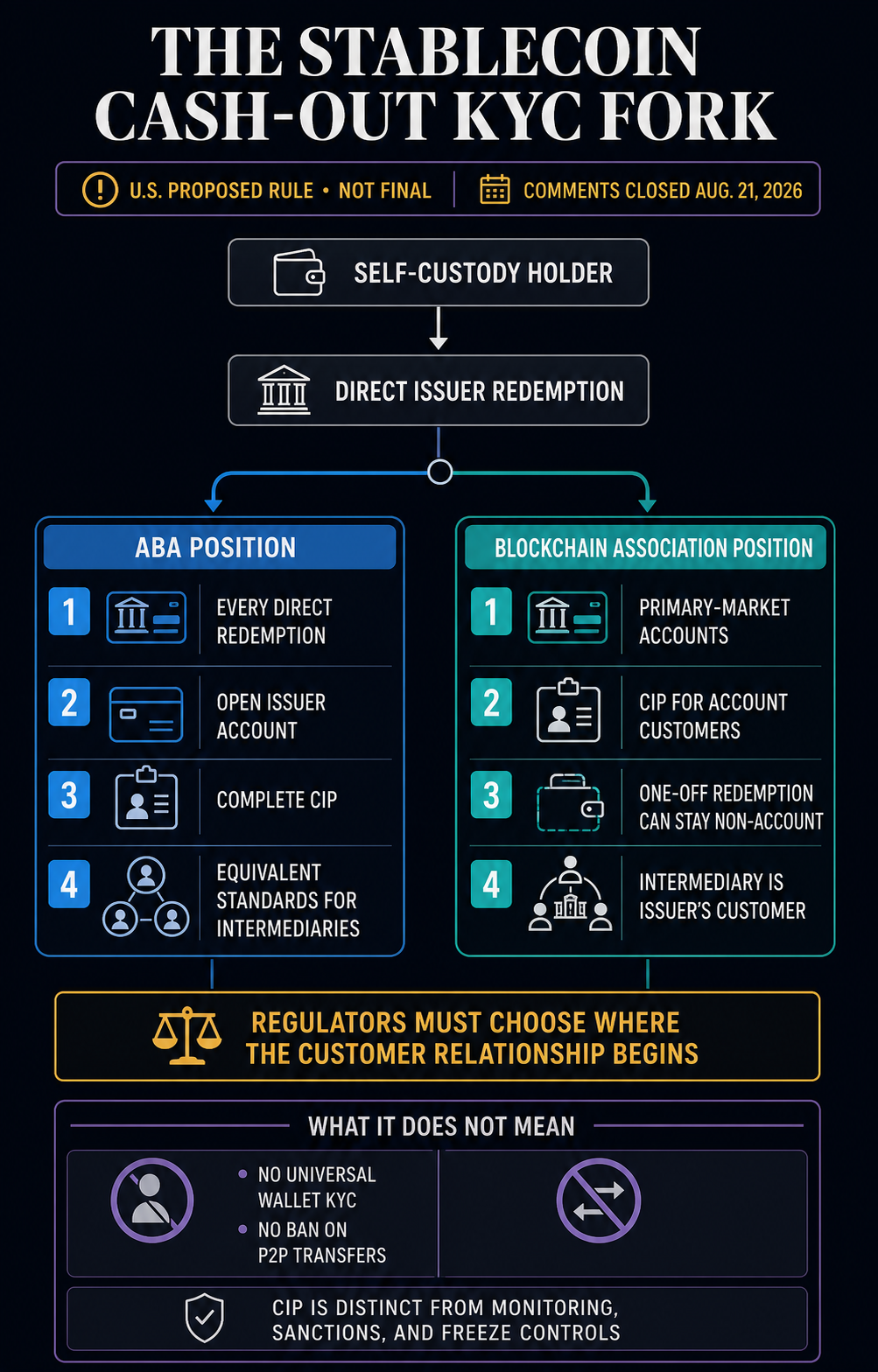
Both positions concern direct issuer service and regulated redemption channels.
Circle and Paxos already gate eligible US stablecoin redemptions
Direct issuer redemption is already account-based and identity-checked for eligible US customers under terms published by Circle and Paxos. Their policies illustrate existing controls but do not establish a universal industry practice or settle what federal law should require.
Circle's USDC terms route eligible direct US redemption through a Circle Mint account in good standing. Access to Circle Mint is limited to eligible users in supported jurisdictions and is governed by its user agreement, which requires account verification.
Paxos' stablecoin terms likewise make direct redemption available to fully verified, eligible account customers, subject to the company's stated controls.
A final rule that followed the ABA's approach could make account-opening CIP the federal floor whenever a permitted issuer offers direct redemption, rather than leaving room for another structure.
Circle's European policy shows that controlled redemption can take a different form. Under its MiCA redemption policy, eligible retail holders in the European Economic Area can use a dedicated form instead of the Circle Mint account product.
Circle still requires identity checks, transaction screening, freeze checks, and an eligible EEA bank account. The policy is a jurisdiction-specific contrast, not a description of the proposed US regime.
A separate April federal proposal addresses broader anti-money laundering and sanctions programs, including transaction monitoring and reporting, sanctions screening, and duties or powers to block, freeze, or reject activity.
Those controls may apply to transactions or wallet activity without defining every token holder as an issuer account customer. In the other direction, completing CIP at redemption establishes the account customer's identity.
The June proposal does seek comment on whether CIP obligations should extend further into secondary-market activity, so future expansion has not been ruled out.
For now, regulators are focused on the redemption boundary. The ABA would place the identity burden at the issuer every time a holder deals with it directly, while the Blockchain Association would keep issuer CIP tied to primary-market accounts and allow one-off or intermediary-routed cash-outs without automatically onboarding every underlying holder.
Until the agencies issue a final rule, both remain advocacy positions rather than binding law.
Source: CryptoSlate