


FILTERED RESULTS
FILTERS
MCap $2.7T 0%24h Vol $45.7B -1.4%Fear & Greed 61/100Alts Index 31/100
BTC.D 58.4% 0%Stable.D 10.0% 0%ETH.D 11.6% 0%Others.D 20.0% 0%
AI$0.3437+36.42%•UAI$0.7955+18.86%•ZRX$0.1118+11.42%•BTW$0.5531+10.54%•PENDLE$2.198+9.11%•QTUM$0.9453+7.67%•PYTH$0.0549+7.66%•CRO$0.0606+7.54%•USELESS$0.2328+7.39%•UNI$6.446+7.1%•
APEPE$0.00000133-20.5%•Q$0.0239-11.18%•RAY$1.537-6.93%•MNT$0.5529-4.93%•EGLD$4.389-4.79%•RAIN$0.0152-4.23%•PIEVERSE$1.198-3.85%•MORPHO$2.216-3.79%•XCN$0.00418035-3.66%•DASH$54.932-3.58%•
•
·
·
FILTERED RESULTS
Grayscale Seeks to Convert Litecoin Trust into ETF
193,362,000 $USDC (193,358,326 USD) transferred from Unknown Whale 1 to #Aave...
KLEA Crypto Daily: Saturday, September 12, 2026
Ripple Breaks Down Stablecoin Rules as Institutions Evaluate RLUSD
193,362,271 $USDC (193,337,487 USD) transferred from #Aave to Unknown Whale 1...
UniCredit Weighs Crypto Custody and Brokerage, Hunts for a Technology Provider
Tether and Bitfinex investor Christopher Harborne donated £36 million ($48.7 million) to Reform UK,...
Zcash Mining Highly Profitable: Grayscale Says Rewards Beat Bitcoin 2x
BitMEX Co-Founder Ben Delo Gives Record £36M Donation to…
Uniswap Achieves $70.6 Billion in Monthly Trading Volume, Outpacing Competitors
Thailand’s stablecoin proposal would block transfers to other people’s wallets
Bitcoin Struggles to Surpass $80,000 Amid Heavy Selling Pressure
CryptoQuant said bitcoin's outlook remains bullish, but it needs to clear resistance
$1.2 Trillion DOGE Giveaway to Every American? Here’s the Jaw-Dropping Proposal From Dogecoin Co-Founder
An IVF Company Bought 146,432 XRP Last Year, Then Sold It All
Why Hyperliquid is Rallying and Why Bitwise CIO Predicts the Market to Hit $200 Trillion
OpenAI IPO won't happen this year, says Sam Altman
Bitcoin Suisse plans to cut up to half its Swiss jobs as it shifts work abroad
India’s Demat 2.0 Could Change Bond Tokenization: Here’s How It Works
Bitcoin’s $80,000 ceiling looks fragile after stocks shrugged off near-5% Treasury yields
1,019,424 $SOL (103,362,185 USD) transferred from unknown wallet to unknown wallet...
Polymarket Gives Bitcoin Price a 64% Chance of Reaching $80K This Month
1,089,087 $SOL (110,402,103 USD) transferred from unknown wallet to unknown wallet...
Revolut Exposes Customer Data in Phishing Attack
Top Trending Coins (Today) 1. PONS 2. STONK 3. PUMP 4. PENGU 5. LAPTOP 6. AI 7. UNI 8. BTC 9. JUP...
The biggest vulnerability in your Bitcoin wallet might be the shipping label
X Layer's xStocks Achieves Nearly $100 Million Market Cap in Three Months
Inside Solana’s Staking Giants and the Mystery Whales With Billions
Revolut disclosed sensitive customer data after an unauthorized third party sent
Revolut says customer KYC and Bitcoin transaction data exposed after...
Teucrium 2x Short Daily XRP ETF Launch Delayed to October 2026
Why Bitcoin initially held its gain as rate traders put September hike odds at 85%
Coinbase's Tokenized SpaceX Stock Achieves $6.6 Million in Daily Trading Volume
Nigel Farage’s Reform UK lands $97 million donations from two crypto billionaires in 24 hours
Anthropic CEO calls for AI race to slow down. Musk and OpenAI's Altman agrees
Goldman Sachs Flips to a Rate Hike as Bitcoin’s Price Stalls Under $80,000
Why Ripple (XRP)? 21Shares Highlights 4 Reasons Investors Should Take Notice
Stablecoins make sending money easy until someone needs to spend it
Crypto Billionaires Delo and Harborne Donate Record £72M to Reform UK in 48 Hours
Hey Wallet Shuts Down, Urging Solana Users to Migrate Assets
Pump.fun Launches Holder Rewards, Phases Out Cashback Mode
solana-BASED hey_wallet IS SUNSETTING ITS PRODUCTS ...
Revolut Leaks Passports, Bitcoin Transaction Histories to Fake Government Request
Bitcoin’s 24% Rally Hit a Wall: CryptoQuant Reveals What Comes Next
This Bitcoin Election Strategy Has Worked 3 Times: Here’s When It Says to Buy BTC
Maharashtra Moves to Tokenize Its Power Grid to Fund New Infrastructure
The challenge for AI agents is deciding who pays for automated errors
XRP’s 30% monthly rebound meets a $4.6 million liquidity trial inside XRPL’s $1.1 billion stablecoin boom
250,000,000 $USDC (249,992,750 USD) minted at USDC Treasury...
ZEC Price Eyes $1,500 as Mining Profitability Surges
Deep in Mexico’s Jungle, Police Found 300 Crypto Miners Humming
Coinbase Faces €170,874 Dutch Lawsuit Threat Over Account…
Crypto billionaires Ben Delo and Christopher Harborne each donated £36 million ($48.7
North Korea reportedly uses foreign remote workers and crypto-paid proxies to infiltrate US...
User Complaints Surge Over OpenAI's GPT-6 Astra Performance
Ether ETFs Gain $216M as Bitcoin ETFs Extend 4-Day Outflow Streak
Asset Managers Advocate for Bitcoin as Bond Replacement in AI-Focused Portfolios
Ripple Targets $13 Trillion Corporate Treasury Market with RLUSD Stablecoin
GPT-6 Astra Users Say OpenAI's Newest Model Got Dumber. It Happened Before, Too
Ripple stablecoin chief sees $13 trillion corporate treasury opportunity for RLUSD
Ditching bonds for bitcoin: How crypto can tackle the AI-heavy portfolio dilemma
Revolut tricked into handing hackers the passports and Bitcoin histories of wealthy customers
White House Crypto Adviser: Legislative Window for Clarity Act Is Closing, Key Procedural Vote Set...
Farage’s Reform UK gets biggest donation ever from crypto billionaire: Reports
AAVE Price Eyes $160 After V4 Deposits Top $900M
Crypto Billionaires Hand Reform UK $97M in Record Donations
Solana Mobile Discloses Security Incident at Third-Party Email Service Provider Brevo Affecting Its Account
solanamobile DISCLOSES THAT ITS THIRD-PARTY MARKETING PROVIDER, BREVO, EXPERIENCED A SECURITY...
Solana Mobile Issues Phishing Warning Following Brevo Security Breach
Solana’s “million-payments-a-second” AI system can leave sellers unpaid even after they deliver


A customer using a Solana payment channel can stop buying AI services before the channel has finished paying for them. If the operator goes silent in between, the customer needs a way to recover the remaining deposit, while the merchant needs its last bill to reach the blockchain before the recovery window closes.
That division of risk sits behind Solana Foundation’s Sept. 3 payment-channel announcement, which reported more than one million payments per second through a proxy using 100,000 unique wallets. The system lets agents spend against a prepaid ceiling through signed messages, reducing the need for a separate blockchain transaction for every delivery.
The customer funds the channel, the merchant supplies the service, and the operator runs the payment process. Each finances a different part of the interval between authorization and collection: customer deposits, operator advances of SOL for fees and refundable account rent, and merchant service awaiting on-chain payment.
A warning in the Foundation-linked benchmark template makes that interval consequential: restarting its default in-memory store can forfeit vouchers accepted but not yet settled.
The benchmark template reports about 1.09 million verified vouchers per second on a 128-core AVX-512 host during a sustained 10-minute run. It measures the payment gate returning a response without an upstream service. The result does not measure a million AI completions or independently settled mainnet transactions each second.
The gateway checks a signature and advances the channel’s cumulative spending record off-chain. That arrangement lets many small authorizations share the cost of on-chain operations. But the template says a deployment with durable session storage must be benchmarked separately because a durable write becomes part of the request path.
For a merchant, that distinction connects speed to recoverability. A fast acceptance record is useful for deciding whether to serve the next request. A surviving voucher is needed to support collection after a restart. The headline throughput figure does not establish the performance of both together.
The Foundation said Alibaba Cloud API endpoints were live at launch, and the program repository lists a mainnet deployment. The benchmark describes a test workload rather than measured commercial demand.
A refund has two routes
A payment channel starts with the customer depositing a ceiling into escrow held by the on-chain program. The program controls the balance and enforces its payment rules. Spending authorizations accumulate against that deposit, and closure provides a route back for the portion not recorded as settled.
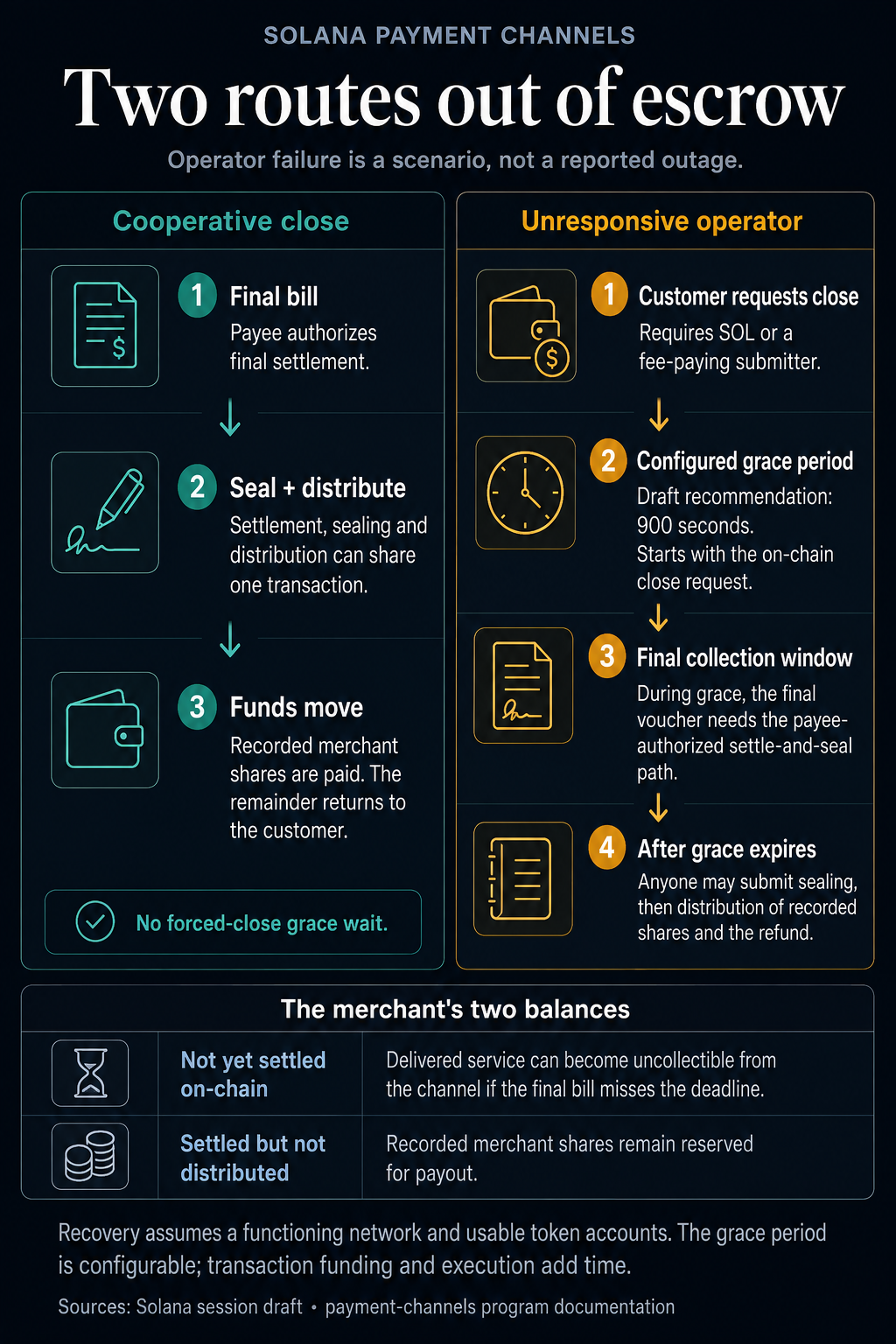
When both sides cooperate, the designated payee, whose signature authorizes final closure, can submit final settlement, seal the channel and distribute the funds in a single transaction. Sealing freezes the settled total; distribution transfers the tokens. Merchant payout and customer refund can land together without a forced-close grace wait.
The September 3 session draft, a work-in-progress specification, describes the alternative for an unresponsive server: the customer requests forced close and starts a grace period. It recommends 900 seconds, or 15 minutes, configured per channel. The clock starts when the request is recorded on-chain, not when the customer first notices a stalled service.
In a sponsored stablecoin session, the operator pays normal fees and rent. A customer holding no SOL must therefore obtain SOL or a fee-paying submitter to initiate escape if that operator is unavailable. Permissionless recovery allows another party to help; a replacement submitter still has to be available and willing to pay the transaction fees.
After grace expires, anyone can submit the sealing instruction. The customer can then withdraw the deposit minus the on-chain settled amount. Alternatively, anyone can submit a distribution transaction that pays recorded merchant shares and the pending refund, using the payout split committed in the public opening transaction.
These recovery paths assume a functioning network and usable token accounts. The program documentation warns that an issuer-frozen escrow can block transfers and that distribution can redirect an unusable beneficiary or refund account’s share to the treasury. Those are separate limits on recovery, even when no operator signature is needed.
For the customer, practical delay includes arranging and landing the transactions as well as the configured timer. The fee burden depends on who submits them. The 15-minute recommendation describes one possible protocol wait; the per-authorization benchmark cost measures a different operation.
The merchant’s collection window narrows
The merchant’s position depends on which record its bill has reached. An off-chain voucher, an amount recorded as settled on-chain, and tokens already distributed to a recipient are three different things.
The current settlement implementation lets anyone present a valid voucher while the channel remains open. Once the payer requests close, that ordinary instruction stops accepting new settlement. During grace, the final voucher must instead pass through the payee-authorized settle-and-seal path described in the state-machine rules.
During grace, the payee has time to record its final bill. A third party able to pay transaction fees cannot necessarily replace a missing payee signature. Keeping a copy of the voucher helps only if the authorized settlement path can still use it before the deadline.
If delivered service never reaches the final on-chain settlement total before the deadline, it can become uncollectible from that channel. Once the channel is sealed, the customer’s refund is calculated against the recorded total, not an operator’s later reconstruction of what should have been billed.
Already-settled merchant funds have a different outcome. They remain reserved for distribution after sealing, subject to the required token accounts being usable. The customer’s refund does not include those recorded merchant shares. Operator failure therefore does not imply that every unpaid merchant balance disappears.
A missing payout transaction can therefore be completed through permissionless distribution once the channel is sealed, with usable accounts and a funded transaction. A missing final on-chain settlement is harder: after forced close begins, adding it requires a valid voucher and the payee-authorized path before grace expires.
The session draft offers two signing arrangements. In client mode, the customer controls the voucher-signing key; this is the default when the challenge omits a mode. In operator mode, the customer presents a reusable bearer proof and the operator signs the spending vouchers.
The escrow ceiling bounds settlement in either mode. The signing choice determines who creates the payment authorization. The published material does not establish a single live grace period or signing mode for every Alibaba or pay.sh channel, so the customer’s and merchant’s exposure depends on their particular channel terms.
The operator’s separate financing cost
There is also a separate operator financing cost. The instruction reference allows the drained channel account’s refundable SOL rent to remain committed until a 1,500-slot opening window has passed. That timer concerns account deallocation. Customer token refunds and merchant token payouts proceed independently of that rent timer.
For operators, durable voucher records and timely settlement address different problems: preserving the bill and getting it recognized on-chain. Distribution then completes payment. More frequent settlement can reduce the service value waiting to enter the record, while earlier distribution reduces the time recorded proceeds remain in escrow.
For customers, smaller committed balances reduce the money tied to a session, but the ability to exit still depends on the channel’s timer and access to a funded transaction submitter. The merchant, meanwhile, needs a collection process that can survive a restart and operate within the close window.
Solana’s payment channels move repeated authorizations out of the blockchain’s immediate workload. The financing remains visible in three places: the customer’s deposit, the merchant’s service awaiting collection and the operator’s SOL advance. A useful measure of the system’s economics is how reliably those three balances reach their intended owners when the fast path stops.
Source: CryptoSlate