


FILTERED RESULTS
FILTERS
MCap $2.7T -0.5%24h Vol $88.5B -2.8%Fear & Greed 69/100Alts Index 24/100
BTC.D 58.6% 0%Stable.D 9.9% 0%ETH.D 11.5% 0%Others.D 20.0% 0%
BR$0.5368+74.14%•ZCAT$0.1237+41.96%•CAP$0.0646+36.02%•PONS$0.6148+13.72%•AI$0.3128+13.43%•龙虾$0.1577+11.38%•NPC$0.0230+10.51%•XLM$0.1941+7.03%•B$0.2260+5.96%•AKE$0.0158+5.81%•
LSK$0.3716-52.53%•BTW$0.6128-15.12%•FIL$0.8956-12.01%•STONK$0.2056-11.54%•FF$0.1265-11.28%•MINA$0.0803-11.2%•UAI$0.4453-9.92%•GLM$0.1157-7.03%•MET$0.2087-6.92%•ZRO$0.9665-6.44%•
•
·
·
FILTERED RESULTS
DeepSeek Harness Launches Official Desktop Version
Coinbase Shares Rise Following Senate Vote on Digital Asset Regulation
Trump Accepts Stricter Ethics Rules Ahead of Clarity Act's Make-or-Break Senate Vote
U.S. House panel shares crypto tax bill ahead of hearing later this week
Bitcoin slips to $77,800 as Senate Clarity Act vote nears and oil prices climb
CoinEx announced it will wind down operations after nine years. Withdrawals will remain
Coinbase Global Appoints Anthony Armstrong to Board of Directors
SlowMist: GitLab Fixes a Critical Vulnerability, Users Should Upgrade Immediately
CoinEx to Shut Down Operations by December 22, 2026
Doubao Second Generation Phone Utilizes Edge-Cloud Collaboration Technology
Samsung Electronics and SK Hynix Increase Third-Quarter Profit Forecasts
CoinEx Announces Closure After Nine Years of Operation
A Trader Profits $201,000 on STANDARD in One Hour
Algorand (ALGO)'s x402 Protocol Powers AI Payments and Agent Commerce
Democrats Draft CLARITY Act Counteroffer as Ethics Dispute Grows
Binance will cut around-the-clock trading in commodity TradFi perpetual contracts to a
Trader 0x6910 cashed out $201K on $STANDARD in just 1 hour.He spent 80 $ETH ($201K) to buy 1.14M...
Bitcoin Retreats Below $78,000 as US Regulatory Optimism Fades
XRP News: Ripple CEO Brad Garlinghouse Says CLARITY Act Trades ‘Weren’t Small’
Senate Democrats Reject Latest CLARITY Act Draft Hours Before Vote
Bitcoin Reserve Bill Heads to House Committee for Historic Vote
CoinEx said its decision to wind down the exchange business will not affect the normal operations...
Multicoin Capital deposited another 333,166 $HYPE ($26.73M) into #CoinbasePrime ~20 minutes...
UK Lords Defeat Government 194-138 Over Crypto Strategy
CoinEx to Shut Down After Nearly Nine Years as Crypto Slump, Compliance Costs BiteCoinEx said it...
BINANCE CURBS COMMODITY PERPS TO 24/5 TO MATCH TRADFI HOURS, EFFECTIVE SEPT 15, 21:00 UTC:...
Binance Limits Commodity Perpetual Futures Trading to Weekdays Only
Oracle Corporation Announces New Layoffs Amid Corporate Restructuring
Important News Last Night and This Morning (September 14 - September 15)
Most Crypto Sectors Rise, PayFi Sector Up Over 5%, BTC Briefly Breaks $79,000
Filecoin Anticipates 75% Decrease in New Supply of FIL After October
Ethereum and Base developers have stopped collaborating on a project to align two
Lummis Pushes Senate Democrats to Rally Behind Final CLARITY Draft
Bitcoin’s Post-Quantum Roadmap Takes Shape Around P2MR and SHRINCSProtocol Watch founder Christine...
Jack Dorsey Advocates for Open AI Development and Opposes Industry Restrictions
Binance Earn Launches ETF Wealth Management: One-Stop TradFi Asset Allocation for UsersBinance Earn ...
SEC Proposes Regulation Crypto Assets: Key Points For Crypto Asset Issuers And Market Participants
Ethereum builders face a choice between locking up too much cash or relying on trusted brokers
BlackRock's Digital Assets Chief to Address Bitcoin Treasuries Conference in New York City
Democrats reject Republican crypto Clarity Act draft bill over ethics...
Two wallets dormant for over a year deposit approximately $36.94 million in ETH to OKX
Two wallets that had been dormant for over a year (possibly belonging to the same whale) deposited...
U.S. Senate Negotiates Legislation for AI Companies' Duty of Care
South Korean Hedge Fund Calls for Samsung to Buy Back Preferred Shares
Solana Launches Transaction V1 Upgrade, Tripling Maximum Transaction Size
Balancer has published a proposal to wind down protocol and distribute its treasury
After @edeldotfinance joined the DTC Digital Asset Solutions Industry Working Group, $EDEL...
U.S. XRP Spot ETF Sees Net Inflow of $11.255 Million in a Single Day
Bitcoin Rally Stalls as Optimism About US Crypto Bill Wanes
What’s New in the Final CLARITY Act Ahead of the Senate Vote
Ark Invest Sells $64 Million in Crypto Holdings Amid Market Surge
US House of Representatives' Wednesday deliberation on crypto tax plan does not include how to tax mining and staking rewards
Cathie Wood's Ark Invest sold a bulk of its Coinbase, Circle, Bullish, and Bitmine
NEW: Senate Democrats are preparing a counteroffer to Republicans' latest version of Clarity
Shield AI in Talks for New Funding Round at Valuation of at Least $20 Billion
US prosecutors are seeking forfeiture of $61 million in cryptocurrency proceeds from
Alameda Research Transfers $9.47 Million SOL to Coinbase Prime, Remaining Holdings Valued at $270 Million
Democrats push back on GOP’s ‘final’ CLARITY offer with counterproposal: Politico
21Shares Builds XRP Case Around Utility, ETFs, and Fixed Supply
BTC Drops Below $78,000, Down 0.74% Intraday
Ethereum, Solana, and Base Dominate Euro Stablecoin Market
NVIDIA CEO Connects with Trump During AI Discussion at All-In Summit
XStocks Achieves $1 Billion in DEX Trading Volume Amid Tokenized Equity Surge
327,633 $HYPE (26,347,290 USD) transferred from #HyperCore to #Kinetiq...
185,000,000 $USDC (184,996,577 USD) transferred from Unknown Whale 1 to #Aave...
KLEA Crypto Daily: Monday, September 14, 2026
Tokenized Gold Market Reaches $5.1 Billion, Still Represents a Fraction of Total Gold Value
Privacy Coins Outrun Bitcoin as Market Rotates Into Zcash and Monero
Deadstock Secures $2.5 Million in Seed Funding for Trading Card Market Infrastructure
A new XRPL upgrade could concentrate XRP ownership inside banks instead of retail wallets


A proposed XRP Ledger (XRPL) upgrade could let banks and fintechs absorb XRP costs so customers never need to hold the token.
The Sponsor amendment, based on the XLS-68 Sponsored Fees and Reserves proposal, would let a company pay account reserves and transaction fees for another XRPL user while that customer retains control of their account and private keys.
For financial institutions, the change would remove one of the frictions involved in deploying products on the network: requiring every customer to acquire and manage XRP before interacting with tokenized assets, payments or other applications.
Jazzi Cooper, Ripple’s head of product, said the feature is designed so a sponsor such as a bank, issuer or platform can cover those costs on behalf of users. That could allow consumer-facing applications and institutional platforms to keep the underlying XRP mechanics largely out of the customer experience.
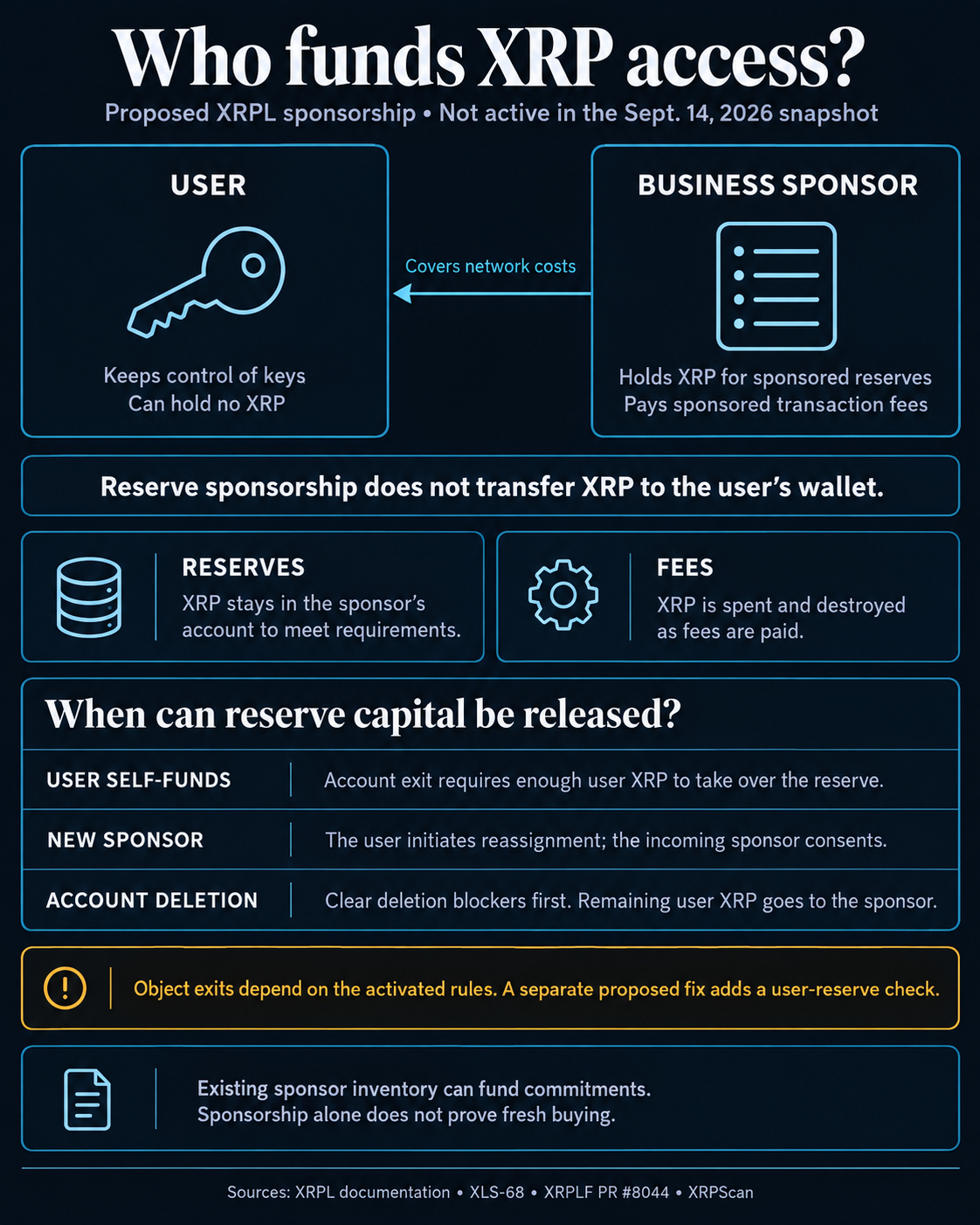
The trade-off moves to the sponsor’s balance sheet. Account reserves would still need to be covered in XRP, while transaction fees would continue to be paid in the token and destroyed when transactions settle. Businesses could therefore become the XRP holders supporting customers who themselves own none.
The proposal remains some distance from activation. As of press time, XRPScan data showed only six validators supporting the amendment, short of the 29-validator threshold, with no activation date scheduled.
Banks could become the XRP holders behind their customers
The structure would alter who carries the capital requirement without eliminating it.
XRPL currently requires a base reserve of 1 XRP per account and 0.2 XRP per standard owner-reserve unit, though validators can change those parameters. Under sponsorship, the XRP allocated to a user’s reserve would remain in the sponsor’s account while the ledger records which party is responsible for the obligation.
A business sponsoring 1,000 otherwise empty customer accounts would therefore carry roughly 1,000 XRP of additional base-reserve requirements alongside its own reserve, using current parameters. If those customers instead funded their accounts themselves, the same 1,000 XRP requirement would be distributed among them.
That distinction could become significant if banks, payment companies or tokenization platforms deploy XRPL products to millions of customers.
A firm serving 1 million users could theoretically carry about 1 million XRP of base-account reserve obligations under current requirements, before accounting for trust lines, token-related objects, optional sponsorship relationships, and transaction fees. The actual total would depend heavily on the service design.
Optional Sponsorship ledger entries can add another layer. Those entries allow businesses to establish prefunded sponsorship relationships rather than signing every subsidized transaction individually, but each also consumes reserve capacity.
The arrangement means wider XRPL adoption would not necessarily create an equivalent number of new retail XRP holders. A bank could onboard a large customer base while purchasing and managing XRP centrally, effectively concentrating the network’s reserve requirements among a smaller group of institutional sponsors.
That structure could make XRP easier to integrate into products where banks prefer customers to see only the asset or service they use, such as tokenized deposits, bonds, or money-market instruments.
Ctrl Alt, which has worked on the sponsorship proposal alongside Ripple and XRPL developers, has described the model as a way for institutions to manage XRP requirements internally while customers interact with tokenized assets without acquiring XRP themselves.
Easier onboarding creates a balance-sheet commitment
The same design introduces a capital-management problem for sponsors.
An XRP reserve remains committed while the sponsored account or ledger object still depends on it. A company cannot necessarily assume that the XRP becomes available immediately when a customer stops actively using its service.
Under the proposed SponsorshipTransfer mechanism, a sponsorship can be ended or reassigned, but account sponsorship carries conditions. A beneficiary taking over its own reserve needs enough XRP to satisfy the requirement.
That creates a complication for the very users the feature is intended to support. A customer who never acquired XRP may be unable to take over the reserve when a bank wants to stop sponsoring the account.
The sponsor could transfer enough XRP to the customer to cover the shortfall, but doing so would create a separate cost. The customer could also arrange for another sponsor to assume the obligation, with the incoming sponsor’s consent.
Account deletion offers another exit when applicable. Once relevant blockers are cleared, a sponsored account can be deleted and the reserve obligation released, with remaining account XRP directed as specified under the proposed rules.
Object sponsorship adds further uncertainty. A code change merged into XRPL’s development branch in August adds reserve checks when certain sponsorships end, but that behavior is gated behind the separate fixCleanup3_4_0 amendment. Its eventual mainnet status will determine how freely some reserve commitments can be unwound.
Those mechanics mean banks considering sponsorship would need to model more than the initial cost of acquiring XRP. They would also need to estimate customer churn, average reserve requirements, transaction-fee consumption and how much XRP could remain committed to inactive but still-open accounts.
The demand question comes after activation
The proposal could create a new institutional use for XRP without establishing how much fresh buying would follow.
An existing XRP holder could allocate tokens already on its balance sheet to sponsored customers without purchasing additional supply. New market demand would depend on the gap between that inventory and the reserve and fee commitments the institution chooses to assume.
That makes the eventual deployment data more important than the headline reserve formula. The number of sponsored accounts, sponsor balances, transaction volumes and reserve units tied to tokenized assets would reveal whether businesses are accumulating XRP to support the service or primarily recycling existing holdings.
The first hurdle remains validator approval.
If the Sponsor amendment gains sufficient support and clears the required activation period, banks and platforms would then have to decide whether removing XRP from their customer experience is worth carrying the token themselves.
For companies planning large-scale tokenized-asset products, that calculation could ultimately turn XRP from something every customer has to manage into an infrastructure cost concentrated on the institution’s own balance sheet.
Source: CryptoSlate