


FILTERED RESULTS
FILTERS
MCap $2.7T -0.7%24h Vol $89.6B -1.6%Fear & Greed 69/100Alts Index 24/100
BTC.D 58.5% -0.1%Stable.D 10.0% +0.1%ETH.D 11.4% -0.1%Others.D 20.1% +0.1%
BR$0.5368+74.14%•ZCAT$0.1237+41.96%•CAP$0.0637+33.63%•PONS$0.6301+18.61%•FF$0.1649+15.56%•AI$0.3128+13.43%•龙虾$0.1577+11.38%•NPC$0.0230+10.51%•XCN$0.00425901+6.79%•PENDLE$2.378+6.65%•
LSK$0.3662-59.32%•BTW$0.6128-15.12%•STONK$0.2056-11.54%•MARSCOIN$0.0847-11.49%•UAI$0.4453-9.92%•ZRO$0.9612-8.98%•FIL$0.8914-8.97%•EDGE$0.6010-7.94%•MINA$0.0810-7.74%•ETHFI$0.6173-7.37%•
•
·
·
FILTERED RESULTS
US Seeks to Forfeit $61M in Crypto Tied to Sanctioned Iranian Oil Sales
500,000,000 $CRO (28,657,500 USD) transferred from #CryptoCom to unknown wallet...
Nvidia and Palantir Restrict Anthropic AI Use Over Data…
Tom Lee’s BitMine Adds 27,180 ETH Worth About $68 Million
A Fake Tesco Casino Is Still Live and Ranking First on Google
Address's CL Long Position Unrealized Profit of $1.258 Million Becomes Hyperliquid's Highest Profit Account for This Asset
XRP Ledger is one vote away from starting its next big payments upgrade
Strategy prioritizes $950 million STRC buyback over expanding its Bitcoin treasury
BlackRock Invests $1 Billion in Bitcoin Amid Grayscale Outflows
BlackRock IBIT Accumulates $1.08 Billion in BTC Over Past 20 Days
Crypto Market News: Jack Dorsey Files for a Bitcoin Bank, Zcash Tops $1,200, and Pepeto’s Presale Runs Out of Room
Ethereum, Polkadot, or Pepeto: Best Crypto to Buy Now as Bitmine Adds $69M of ETH and Pepeto’s Stage Nears Full?
U.S. spot Bitcoin ETFs recorded $160 million in net inflows on Sept. 14, according to SoSoValue,...
CLARITY Act odds fall to 16% as key Democrats counter GOP’s ‘final’ offer
How Everyday Savers Can Accidentally End Up With AI-Heavy Portfolios
CoinEx Announces Shutdown After 9 Years, Withdrawals Open Until December 22, 2026
The #LazarusGroup hackers sold 911 $ETH ($2.28M) at an average price of $2,499 over the past 2...
U.S. DOJ seeks $61 million in what it calls Iran's crypto-laundered black market oil sales
USDC.e and WETH are now live on Neo X via Transporter, powered by Chainlink CCIP. Users can bridge...
Less Than 10 Billionaires Have Actually Kept Their Promise to Give Away Their Fortune
Binance to Support Cash Dividend Distribution for TSMC and Salesforce via bStocks
Binance Will Support the Taiwan Semiconductor Manufacturing Company Limited (TSM) and Salesforce (CR...
Bitcoin Is Holding Firm, Ethereum Is Pulling In Money: Here’s What Crypto Positioning Shows
Uniswap's StablePair Hook Becomes Top Volume Pool on Ethereum
CoinEx Shuts Down After 9 Years: Users Have Until December 22 to Withdraw Funds
Oracle Layoffs Put India on Alert After 21,000 Jobs Were Cut
CoinEx to Wind Down Operations by December, Citing Market Downturn and Compliance Costs
Changpeng Zhao: Looking forward to seeing someone make 'immortal fruit flies' on BNB Chain
Kyrgyzstan Central Bank Taps Certik for CBDC Oversight
Solana transactions just got more than 3 times bigger, giving an edge over Ethereum
Poland's Orlen Loses $400 Million in Failed Oil Trade with Venezuela
Spot bitcoin ETFs returned to net inflows on Monday, attracting $160 million. This came
Social Security COLA Could Raise Average Checks to $2,008 in 2027
Bank Groups Say CLARITY Act’s Stablecoin Circuit Breaker Is ‘Not a Safeguard at All’
Will the CLARITY Act Pass the Senate Today?
Democrats send counteroffer to Republicans over Clarity Act provisions
CLARITY Act Odds Slide to 18% as Banks and State AGs Push Back
Robinhood Chain Ecosystem Token STANDARD Achieves $40 Million Market Value Post-Launch
Uniswap Monthly Trading Volume Surpasses $70B, Exceeding…
Thailand SEC Proposes 5 Million Baht Daily Stablecoin…
Vivek Ramaswamy’s Strive Buys 469 BTC for $37 Million as…
Arthur Hayes: Japan's Capital Repatriation Could Become a Catalyst for Global Capital...
Coinbase-backed Base just exposed the uncomfortable truth about Ethereum’s L2s
CoinEx stated that its reserve ratio exceeds 100%, with all user assets fully backed by reserves...
TrueMoney Partners with Fireblocks to Launch THBT Digital Wallet in Thailand
Garlinghouse Backs Bessent’s CLARITY Act Case Ahead of Senate Vote
DeepSeek Harness Launches Official Desktop Version
Coinbase Shares Rise Following Senate Vote on Digital Asset Regulation
Trump Accepts Stricter Ethics Rules Ahead of Clarity Act's Make-or-Break Senate Vote
U.S. House panel shares crypto tax bill ahead of hearing later this week
Bitcoin slips to $77,800 as Senate Clarity Act vote nears and oil prices climb
CoinEx announced it will wind down operations after nine years. Withdrawals will remain
Coinbase Global Appoints Anthony Armstrong to Board of Directors
SlowMist: GitLab Fixes a Critical Vulnerability, Users Should Upgrade Immediately
CoinEx to Shut Down Operations by December 22, 2026
Doubao Second Generation Phone Utilizes Edge-Cloud Collaboration Technology
Samsung Electronics and SK Hynix Increase Third-Quarter Profit Forecasts
CoinEx Announces Closure After Nine Years of Operation
A Trader Profits $201,000 on STANDARD in One Hour
Algorand (ALGO)'s x402 Protocol Powers AI Payments and Agent Commerce
Democrats Draft CLARITY Act Counteroffer as Ethics Dispute Grows
Binance will cut around-the-clock trading in commodity TradFi perpetual contracts to a
Trader 0x6910 cashed out $201K on $STANDARD in just 1 hour.He spent 80 $ETH ($201K) to buy 1.14M...
Bitcoin Retreats Below $78,000 as US Regulatory Optimism Fades
XRP News: Ripple CEO Brad Garlinghouse Says CLARITY Act Trades ‘Weren’t Small’
Senate Democrats Reject Latest CLARITY Act Draft Hours Before Vote
Bitcoin Reserve Bill Heads to House Committee for Historic Vote
CoinEx said its decision to wind down the exchange business will not affect the normal operations...
Multicoin Capital deposited another 333,166 $HYPE ($26.73M) into #CoinbasePrime ~20 minutes...
Ethereum builders face a choice between locking up too much cash or relying on trusted brokers


In a Sept. 8-11 Lido discussion, Commit-Boost contributor Jason Vranek argued that builders funding protocol-backed payments face costs from idle Ethereum, failed delivery, and offers they wanted to cancel.
Those costs could make trusted connections more competitive. Meanwhile, Titan Builder said it expects validators to continue reaching it through relays that organize auctions and handle publication.
An operator’s configuration helps determine which block-payment opportunities its validators can consider. For builders, the same settings help determine access to those validators.
As of Sept. 13, Ethereum.org lists Glamsterdam as testing on devnets, with mainnet expected in the fourth quarter of 2026 and no confirmed date. Lido contributors are discussing a proposed direction ahead of a future DAO vote.
Glamsterdam’s technical purpose remains distinct from those market choices. Separating consensus work from execution processing gives validators more time for heavy work, whether operators continue using relays or not.
Transaction-inclusion guarantees belong to another part of the roadmap. The Ethereum Foundation’s Sept. 7 priorities identify fork-choice enforced inclusion lists (FOCIL) as a Hegotá headliner.
That planned mechanism would let validators impose inclusion requirements on builders’ blocks.
What the payment guarantee covers
Enshrined proposer-builder separation (ePBS) formalizes the exchange between a validator proposing a block and the builder assembling its transactions.
In the proposed EIP-7732 design, which remains under Review, the proposer includes a builder’s signed commitment in its consensus block, and the execution payload containing the transactions follows separately.
The design accommodates two payment forms. A collateral-backed payment draws on Ethereum the builder has deposited into the protocol, and a trusted payment depends on the builder honoring a promise through another payment route.
That trusted payment can still be an ordinary on-chain Ethereum transfer.
The current consensus specification checks the builder’s available balance and records the collateral-backed amount as a pending payment to the designated fee recipient. Settlement uses withdrawals to the execution layer, while the recipient receives an execution-layer payment, rather than a direct increase in the validator’s effective staking balance.
For a timely proposer whose block receives the required support, the guarantee can survive the builder’s failure to deliver the committed payload.
The design also protects a builder when a proposer withholds the beacon block containing its commitment and reveals it late.
That risk allocation is the economic hinge. A proposer can protect against missing payloads, while the builder takes on exposure to paying without successfully delivering its block. Choosing a trusted payment leaves the proposer dependent on the counterparty’s promise.
Vranek’s Sept. 11 explanation identifies three potential costs. A builder must maintain ETH reserves inside the protocol to fund its payments, it must be able to cover unusually valuable blocks, and a committed payment can remain due when delivery fails, or the builder would have preferred to cancel its offer, subject to the protocol’s payment conditions.
Those costs could affect the amount a builder is willing to pay for the same block-building opportunity. Capital held in reserves to secure payments cannot simultaneously serve another use, while exposure to payment without successful delivery can also make a builder less willing to commit its maximum payment.
A trusted arrangement could reduce those costs and leave more room to pay the proposer. Whether that produces a higher payment for a proposer depends on the amounts available and the counterparty’s performance.
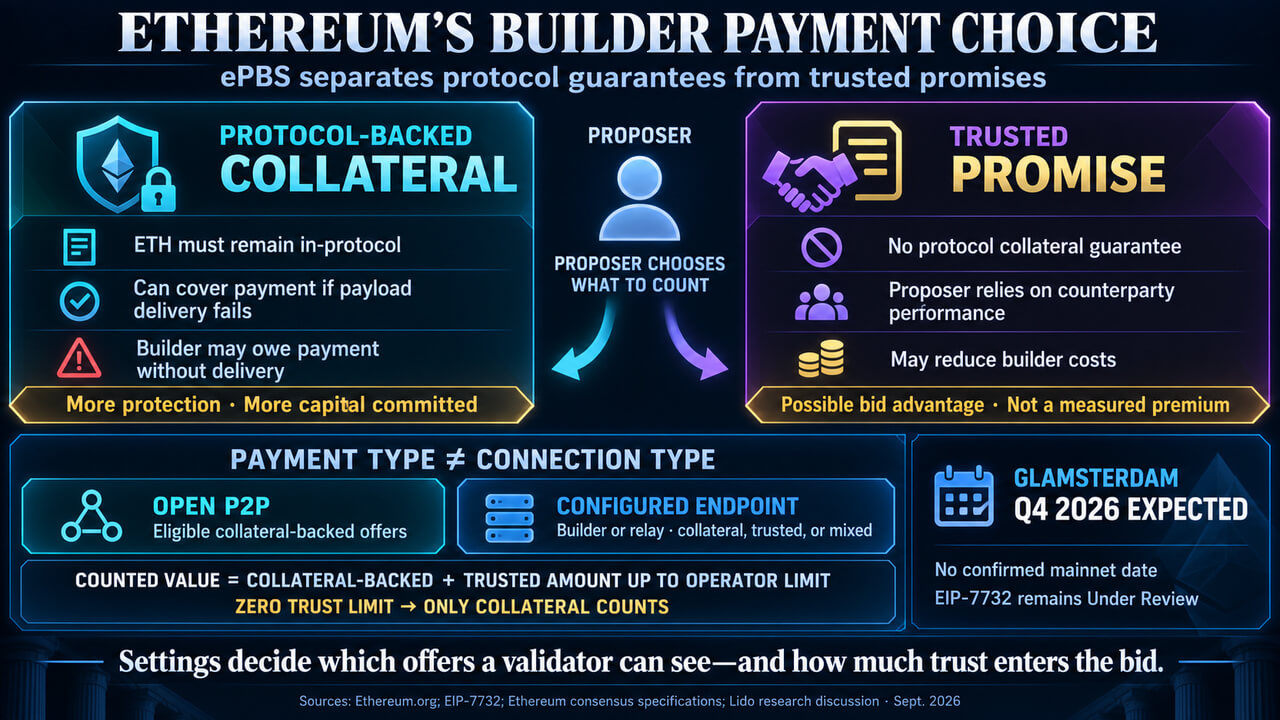
The distinction between a possible advantage and a measured premium also shapes Mike Neuder’s August analysis. He predicts that established trust between proposers, builders and relays will persist, but labels his market expectations conjectures.
In a subsequent reply, he says he expects the block-building market to remain largely unaffected, rather than necessarily become worse.
Open bidding and relay connections can coexist
Lido’s initial Aug. 22 direction divided offers by payment type: accept eligible collateral-backed offers broadly, while restricting trusted offers to a governance-approved allowlist.
Vranek’s Sept. 3 response proposed open peer-to-peer offers alongside configured builder or relay endpoints. Payment and connectivity are separate choices. Under the gossip specification, peer-to-peer offers have no trusted payment component. A configured connection can carry collateral-backed payments, trusted payments, or a mixture.
An open route lets an eligible builder reach validators without each operator first adding its endpoint, while a configured route can connect to a relay serving several builders.
Titan contributor George said on Sept. 8 that Titan does not plan to open its own direct proposer endpoint and expects validators to keep connecting through relays. He argued that relays can preserve a common auction, manage payload publication and reduce the burden of maintaining individual builder relationships.
His concern was that a builder with private access to a proposer could also watch the public relay auction and gain a last look at competing offers. In that situation, a relay offering shared access could help preserve competition.
The open bidding route also has advocates. Responding to Neuder, Justin Traglia argued that builders could register additional identities and improve connectivity to compete for proposers without configured connections.
He acknowledged latency disadvantages and the extra stake needed for additional identities. His argument leaves room for competition outside configured relationships, even if those relationships remain popular.
Even after an operator chooses its offer sources, it must decide how to value payment promises.
The builder specification lets a proposer set a maximum trusted payment to count from each builder. It values an offer by adding the collateral-backed amount to the trusted component, counted only up to that limit.
A zero limit leaves only the collateral-backed portion contributing to valuation, making trust a practical selection rule. A builder may offer a payment that the proposer’s settings don't count in full, while counting a trusted promise in full means relying on that builder to deliver.
What Ethereum operators can measure
Operators also need an accurate record of their choices. In the Sept. 8 Lido discussion, Stakely’s Paco asked that compliance be assessed against offers the proposing node observed. He also called for consistent offer sources and settings across backup nodes, plus a local-building fallback.
Paco warned that differences in offer handling across clients could increase incident-management costs and encourage operators to run fewer client types. Gabriella_S’s Sept. 9 response supported considering logging of observed offers and keeping that diversity risk in scope.
These remain policy and implementation questions under discussion.
The next meaningful evidence will come from the policy Lido puts forward, the offer-handling clients implement, and the payments available under those configurations.
An open route can broaden access, and protocol-backed settlement can reduce reliance on payment promises. A possible payment advantage for trusted arrangements will depend on how builders price that protection and which opportunities operators allow their validators to see.
Source: CryptoSlate