


FILTERED RESULTS
FILTERS
MCap $2.7T +0.1%24h Vol $54.4B -51%Fear & Greed 63/100Alts Index 35/100
BTC.D 58.3% -0.1%Stable.D 10.0% 0%ETH.D 11.6% +0.1%Others.D 20.1% 0%
AI$0.3437+36.42%•PROM$6.000+19.18%•UAI$0.7955+18.86%•BTW$0.5531+10.54%•ZRX$0.1088+8.73%•PENDLE$2.198+8.56%•WLFI$0.0572+7.74%•ETHFI$0.7436+7.57%•JTO$0.4523+6.62%•PYTH$0.0548+6.47%•
APEPE$0.00000133-20.5%•MET$0.2303-13.33%•Q$0.0239-11.18%•HNT$0.4786-7.68%•NEAR$2.370-7.42%•CASHCAT$0.1702-7.13%•AERO$0.5665-4.93%•LIT$4.304-4.62%•RAIN$0.0152-4.23%•FF$0.1493-4.07%•
•
·
·
FILTERED RESULTS
Goldman Sachs Flips to a Rate Hike as Bitcoin’s Price Stalls Under $80,000
Why Ripple (XRP)? 21Shares Highlights 4 Reasons Investors Should Take Notice
Stablecoins make sending money easy until someone needs to spend it
Crypto Billionaires Delo and Harborne Donate Record £72M to Reform UK in 48 Hours
Hey Wallet Shuts Down, Urging Solana Users to Migrate Assets
Pump.fun Launches Holder Rewards, Phases Out Cashback Mode
solana-BASED hey_wallet IS SUNSETTING ITS PRODUCTS ...
Revolut Leaks Passports, Bitcoin Transaction Histories to Fake Government Request
Bitcoin’s 24% Rally Hit a Wall: CryptoQuant Reveals What Comes Next
This Bitcoin Election Strategy Has Worked 3 Times: Here’s When It Says to Buy BTC
Maharashtra Moves to Tokenize Its Power Grid to Fund New Infrastructure
The challenge for AI agents is deciding who pays for automated errors
XRP’s 30% monthly rebound meets a $4.6 million liquidity trial inside XRPL’s $1.1 billion stablecoin boom
250,000,000 $USDC (249,992,750 USD) minted at USDC Treasury...
ZEC Price Eyes $1,500 as Mining Profitability Surges
Deep in Mexico’s Jungle, Police Found 300 Crypto Miners Humming
Coinbase Faces €170,874 Dutch Lawsuit Threat Over Account…
Crypto billionaires Ben Delo and Christopher Harborne each donated £36 million ($48.7
North Korea reportedly uses foreign remote workers and crypto-paid proxies to infiltrate US...
User Complaints Surge Over OpenAI's GPT-6 Astra Performance
Ether ETFs Gain $216M as Bitcoin ETFs Extend 4-Day Outflow Streak
Asset Managers Advocate for Bitcoin as Bond Replacement in AI-Focused Portfolios
Ripple Targets $13 Trillion Corporate Treasury Market with RLUSD Stablecoin
GPT-6 Astra Users Say OpenAI's Newest Model Got Dumber. It Happened Before, Too
Ripple stablecoin chief sees $13 trillion corporate treasury opportunity for RLUSD
Ditching bonds for bitcoin: How crypto can tackle the AI-heavy portfolio dilemma
Revolut tricked into handing hackers the passports and Bitcoin histories of wealthy customers
White House Crypto Adviser: Legislative Window for Clarity Act Is Closing, Key Procedural Vote Set...
Farage’s Reform UK gets biggest donation ever from crypto billionaire: Reports
AAVE Price Eyes $160 After V4 Deposits Top $900M
Crypto Billionaires Hand Reform UK $97M in Record Donations
Solana Mobile Discloses Security Incident at Third-Party Email Service Provider Brevo Affecting Its Account
solanamobile DISCLOSES THAT ITS THIRD-PARTY MARKETING PROVIDER, BREVO, EXPERIENCED A SECURITY...
Solana Mobile Issues Phishing Warning Following Brevo Security Breach
CFTC Investigates Polymarket for Suspected Insider Trading
HYPE Price Eyes $100 After $28.8M Whale Accumulation
Revolut Leaks Customer Data to Hackers Posing as State Agency
Morgan Stanley Initiates Coverage on Coinbase with 'Neutral' Rating and $250 Price Target
GTA Mod Adds Flock Cameras—And Lets Players Destroy Them
Nasdaq and Boerse Stuttgart Want the EU's Tokenisation Cap Gone
XRP Ledger just quietly activated critical foundation for its upcoming new lending protocol
Community Banks Urged to Adopt Digital Payments and Stablecoins
solana CO-FOUNDER toly CALLS RobinhoodCrypto’S L2 MODEL A SHIT BUSINESS ESPECIALLY FOR A...
Whale 0x3305 keeps buying $HYPE every day!Over the past 15 days, the whale has bought a total of...
Zcash Mining Activity Rises Over 2.5x in 2026, Now More Profitable Than Bitcoin’s — Grayscale Research
Denmark Raises Interest Rates to 2.10% in Response to ECB Hike
Bitcoin Price Takes a $3,215 Ride Just to Land Back at $77K
This Textbook XRP Chart Pattern Could Trigger Rally Toward $60, Analyst Asserts
UK Reform Party Receives £72 Million in Donations from Two Crypto Tycoons in Two Days
Solana’s weekly transaction count surpassed 1B, crossing a new ATH record....
Staked ether should be seen as the benchmark of the decentralized economy
The dilution trap where Bitcoin holdings rise while shareholder value stalls
Morgan Stanley Predicts Yen Decline Amid Carry Trade Rebuilding
170,811,658 $USDC (170,806,533 USD) transferred from USDC Treasury to #Kraken...
Bitcoin’s Price Just Drew an $85M Bet From Last Year’s ETH Top-Caller
110,819,258 $USDC (110,815,933 USD) minted at USDC Treasury...
USDC Treasury Mints Approximately 111 Million USDC on Ethereum Chain
Mexican Authorities Dismantle Clandestine Crypto Mining Operation Linked to Cartels
Investigator ZachXBT says he was blocked by Revolut on X after data breach alert....
Polymarket Indicates High Probability of Federal Reserve Rate Hike on September 16
ChatGPT Images 2.5 vs Nano Banana 2: Which One is Better?
Revolut Exposed Passports and Bitcoin Records After Fake Government Request: Report
Polymarket and Kalshi Lack EU Authorization for Event Contracts, ESMA Says
Solana Reclaims Top Spot in Daily DEX Volume, Surpassing Robinhood Chain
Hunter Biden’s LAPTOP Burns $3.5M After Eric Trump and Beeple Mentions
Anchorage Digital Gives Institutions Direct Access to…
Weekly Project Updates: Base App reverts to Coinbase Wallet, Kalshi launch Gold & Silver...
Coinbase User Alleges $1.3M USDC Freeze Led to Hyperliquid…
StonkFun's 24-Hour Revenue Surpasses Hyperliquid, Pump.fun, Fomo, and GMGN
Bitcoin Core considers dropping encrypted routing support as poor node health exposes users to eclipse attacks


Bitcoin Core contributors are weighing whether a thinly used network transport offers valuable insurance or has become a liability too costly to retain.
In the open CJDNS support discussion, Bitcoin Core member Andrew Chow said one seeder database held 25 CJDNS addresses, had reached 22 and classified only seven as good. The issue author, Martin Zumsande, reported seeing only three to four peers even though Bitcoin Core ships with 11 fixed CJDNS seeds.
Those figures have prompted support for deprecation and a suggestion that Bitcoin Core warn users in a 32.x release before planning removal in 33.x. But that version sequence was posed as a question. As of Sunday, Aug. 23, the issue remained open in the 32.0 milestone, with its Development section empty of an implementation branch or pull request.
Bitcoin Core implements CJDNS as optional peer-to-peer transport and address handling, outside Bitcoin's consensus system. Issue #36041 instead asks whether Bitcoin Core should keep CJDNS address handling as a fallback when the thin peer pool may also make CJDNS-only nodes easier to surround.
Bitcoin Core’s seven good nodes capture one seeder snapshot
The seeder numbers describe one crawler's database at one point in time. The global CJDNS population may be larger because the figure covers only that crawler's database.
The seeder applies “good” as a stricter technical filter than reachability. In Chow's DNSSeedrs implementation, a node must pass checks covering its port, advertised network service, protocol version, chain height and rolling reliability. The reliability tests use several time windows and require minimum attempt counts. That explains how the seeder could reach 22 addresses while classifying only seven as good.
Only seven of the 22 reached addresses cleared the good-node filters, leaving the usable pool shallow. Zumsande's node found just three or four peers, and he offered low triple digits as a rough level that might justify continued support. The low-triple-digit benchmark was Zumsande's alone, giving maintainers a number to argue over instead of only a general complaint about low usage.
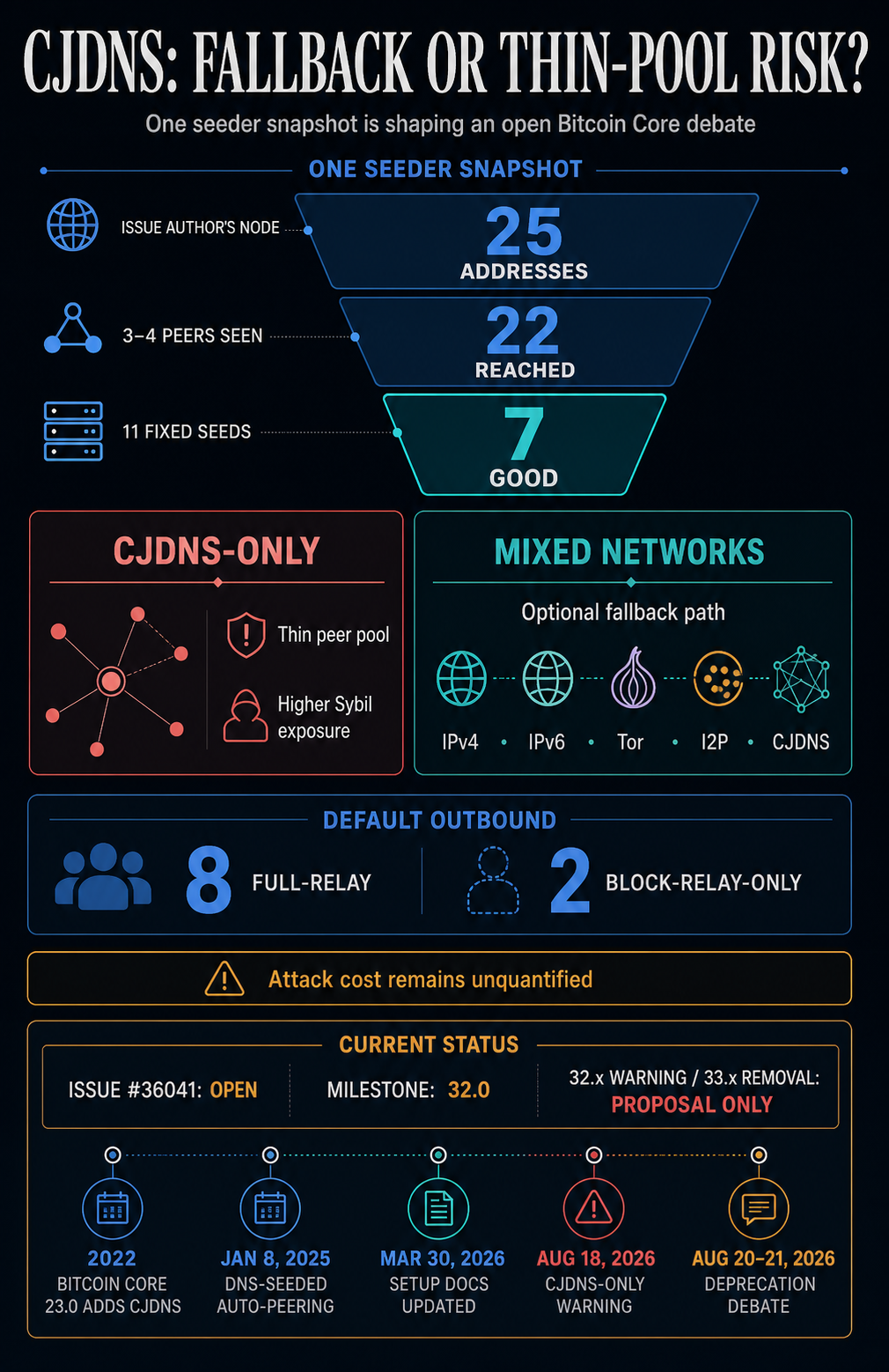
Peer-count arithmetic alone leaves the eclipse cost unknown. Bitcoin Core normally maintains eight full-relay outbound connections and two block-relay-only connections, with an occasional feeler or extra block-relay-only connection. A contributor suggested grounding any CJDNS threshold in the cost of filling those regular slots and eclipsing a CJDNS-only node.
An eclipse attack isolates a node by monopolizing the peers that shape its view of the network. On a transport with a small known address set, an attacker has a more concentrated target. Bitcoin Core's current CJDNS documentation already discourages CJDNS-only operation because a node may fail to fill its outbound slots, repeatedly try the few addresses it knows and become more susceptible to Sybil attacks.
A successful eclipse depends on more than the ten regular outbound slots. The public discussion leaves the full attack cost unquantified. Address availability, address selection, crawler reliability gates and occasional extra outbound connections all affect practical exposure. The measured pool supports a concentration concern for CJDNS-only nodes, while the cost of exploiting that concern remains unquantified.
Redundancy depends on how CJDNS is used
CJDNS offers a different proposition when it is one path among several. Bitcoin Core's documentation presents it as a complementary option alongside IPv4, IPv6, Tor and I2P, allowing a node to keep another route available if one network has problems.
That option has become easier to use. CJDNS 22.1 introduced DNS-seeded auto-peering on Jan. 8, 2025, making manual peer addition optional. Bitcoin Core then merged updated setup documentation on March 30, 2026, replacing obsolete manual-peering instructions with the newer flow.
Those changes reduced setup friction. Any effect on Bitcoin's CJDNS peer population remains unmeasured. Bitcoin Core merged another documentation change on Aug. 18, 2026, explicitly discouraging CJDNS-only use because the address pool remained too small to fill outbound slots reliably.
CJDNS-only and mixed-network operators therefore face different stakes. A CJDNS-only operator faces the thin-pool risk that the documentation now warns about. A mixed-network operator uses CJDNS for optional route diversity and can retain other automatic paths even when CJDNS has few peers.
A future deprecation would remove transport settings while leaving block-validity rules unchanged. Bitcoin Core added full CJDNS support in version 23.0 as a P2P networking feature. The debate is confined to address handling and connection options; Bitcoin's consensus and block-validity rules sit outside its scope.
The directly affected operators would be those using -cjdnsreachable, which tells Bitcoin Core to treat the relevant IPv6 range as CJDNS, or -onlynet=cjdns, which limits automatic outbound connections to that transport. The same option can currently be combined with other networks, while inbound and manually added connections remain available under -onlynet, according to the documentation.
Issue #36041 remains open, with the warning and removal sequence recorded only as a proposal. It shows a small observed peer set, multiple expressions of support for deprecation and one proposed release sequence. It also shows why a usage count alone is an incomplete test: backup capacity is most valuable before a primary route fails, but a backup network that fails to fill connections may offer less resilience than its presence in the code suggests.
Bitcoin Core still supports CJDNS. A merged warning or removal pull request would change the status of the debate. Seven good nodes makes the transport-diversity tradeoff measurable and leaves the removal choice open.
Source: CryptoSlate