


FILTERED RESULTS
FILTERS
MCap $2.7T +0.4%24h Vol $74B -33%Fear & Greed 63/100Alts Index 35/100
BTC.D 58.3% -0.1%Stable.D 9.9% -0.1%ETH.D 11.6% +0.1%Others.D 20.2% +0.1%
LSK$0.2341+80.96%•AI$0.3437+36.42%•UAI$0.7955+18.86%•ETHFI$0.7661+11.45%•BTW$0.5531+10.54%•PROM$5.782+10.06%•WLFI$0.0570+7.35%•SKY$0.0638+6.35%•JST$0.1089+6.19%•AKE$0.0153+5.37%•
APEPE$0.00000133-20.5%•VVV$22.997-12.54%•Q$0.0239-11.18%•MET$0.2375-10.3%•NEAR$2.375-9.84%•LIT$4.342-8.15%•ENA$0.1415-7.72%•FF$0.1501-7.69%•MARSCOIN$0.1227-7.29%•ATOM$1.634-6.17%•
•
·
·
FILTERED RESULTS
This Textbook XRP Chart Pattern Could Trigger Rally Toward $60, Analyst Asserts
UK Reform Party Receives £72 Million in Donations from Two Crypto Tycoons in Two Days
Solana’s weekly transaction count surpassed 1B, crossing a new ATH record....
Staked ether should be seen as the benchmark of the decentralized economy
The dilution trap where Bitcoin holdings rise while shareholder value stalls
Morgan Stanley Predicts Yen Decline Amid Carry Trade Rebuilding
170,811,658 $USDC (170,806,533 USD) transferred from USDC Treasury to #Kraken...
Bitcoin’s Price Just Drew an $85M Bet From Last Year’s ETH Top-Caller
110,819,258 $USDC (110,815,933 USD) minted at USDC Treasury...
USDC Treasury Mints Approximately 111 Million USDC on Ethereum Chain
Mexican Authorities Dismantle Clandestine Crypto Mining Operation Linked to Cartels
Investigator ZachXBT says he was blocked by Revolut on X after data breach alert....
Polymarket Indicates High Probability of Federal Reserve Rate Hike on September 16
ChatGPT Images 2.5 vs Nano Banana 2: Which One is Better?
Revolut Exposed Passports and Bitcoin Records After Fake Government Request: Report
Polymarket and Kalshi Lack EU Authorization for Event Contracts, ESMA Says
Solana Reclaims Top Spot in Daily DEX Volume, Surpassing Robinhood Chain
Hunter Biden’s LAPTOP Burns $3.5M After Eric Trump and Beeple Mentions
Anchorage Digital Gives Institutions Direct Access to…
Weekly Project Updates: Base App reverts to Coinbase Wallet, Kalshi launch Gold & Silver...
Coinbase User Alleges $1.3M USDC Freeze Led to Hyperliquid…
StonkFun's 24-Hour Revenue Surpasses Hyperliquid, Pump.fun, Fomo, and GMGN
Tokenized Grindr Stock on Solana Achieves $31 Million in Trading Volume
Donut AI Founder Reveals Significant On-Chain Holdings and Trading Profits
ICYMI: Bybit AI is live.Our CEO @benbybit went live to reveal it himself. What it does, how it...
LaunchOnSF FLIPS HyperliquidX, Pumpfun, fomo, gmgnai IN 24H REVENUE - ponsdotfamily...
Pineapple Financial Tokenizes Over $1 Billion in Mortgages on Injective Blockchain
Ethereum Price Momentum Builds as $1M+ Whale Transactions Surge
zachxbt SAYS HE WAS BLOCKED BY Revolut AND revolutsupport ON X ...
WuBlockchain note: Arthur Hayes has a relatively poor historical track record on market forecasts...
Betmgm Bets on Injury Refunds and a $50K Free-to-Play NFL Jackpot
Clearpool Proposes Migration to XRP Ledger for Institutional Lending
Ripple (XRP) Price Outlook: Two Key Metrics Are Flashing Warning Signs
BTC Settles at $77K After a Wild Ride, ETH Slumps Following Major Rally: Weekend Watch
ESMA Warns Crypto's Deepening Ties to Finance Could Amplify the Next Shock
Wall Street is building tokenized deposits to lock in customer balances
Corporate America Anticipates $2.5 Trillion AI Spending Surge Amid Mixed Returns
Revolut Allegedly Leaks User Data in Targeted Attack on High-Net-Worth Clients
Tokenized Stock Asset Holders Surge 619.1% in Past 90 Days, Reaching 3.6 Million
Bitcoin activity, passports exposed after Revolut falls for fake government request
Arthur Hayes: I Don't Follow Any Bitcoin Technical IndicatorsI In an August 23, 2026 video...
Bitwise is closing the lowest-fee Dogecoin ETF after rivals captured nearly all the capital
ZachXBT: Revolut Allegedly Leaks User Data, Likely Targeting High-Net-Worth IndividualsOn-chain...
Latam Banking Giant Nu Launches US Operations With Lead Bank
Revolut Handed Over Bitcoin Histories, Passports on Spoofed Government Email
Alameda/FTX Address Unlocks $20.62 Million in SOL for Creditor Compensation
India's Demat 2.0 Pilot Settles $107M in Bonds Using the Digital Rupee
Follow the Money: Over $200 Million in Venture Investments, a $400 Million Acquisition, and Weak Activity From Corporate Investors
Trader's $114.37M ETH Long Position Turns from $4.9M Floating Loss to $1.98M Profit
Robinhood CEO Spoke Out Against Issuers’ Right to Block Shares’ Tokenization
Bitcoin ETFs See $461M Outflows This Week With Zero Inflows
Ethereum Whales Just Woke Up as ETH Exploded to 8-Month High: What’s Next?
Blockstream bets 600 Bitcoin by rejecting Liquid hacker’s $50 million bounty demand
A16z Wants Your Crypto Private and Your Car Tracked by Flock
BNB Price Faces $750 Test After Sharp Rebound: Can Bulls Push Higher?
Crypto Liquidity Is Moving – Here’s Where the Money Is Going
Bitcoin ETFs Ended Three-Week Streak of Inflows with $463M in Outflows
Revolut Allegedly Leaks Personal Information of High-Net-Worth Users
Revolut Faces Allegations of User Data Leak Due to Fraudulent Requests
REVOLUT DISCLOSES DATA BREACH WITH PASSPORTS, STATEMENTS AND BITCOIN...
Huobi Founder Leon Li Sells London Mansion for £190M After Buying It for £139MAccording to the...
Nomic Double-Spend Leaves a Third of Osmosis Bitcoin Unbacked
Fed Rate Hike Odds Jump to 87% as FOMC Meeting Nears
Bloomberg: SemiAnalysis Acquires Citrini Research, Founder to Remain as CEO
A whale has spent 85.42M $USDC to buy 1,075.6 $BTC at an average price of $79,412 over the past 4...
ZachXBT: Revolut Suspected of Failing to Identify Fraudulent Request, Some Users' Personal Information Leaked
Mecka AI Nears Funding Round Led by Sequoia, Valuation Around $500M
Huobi Founder Li Lin Sells London Mansion for £190 Million
Bitcoin Investors Now Have the Full Picture Before the Fed’s Move: Here’s What It Says
The next phase of tokenization is utility


The following is a guest post and opinion from Vincent Maliepaard, VP of Marketing at Sentora.
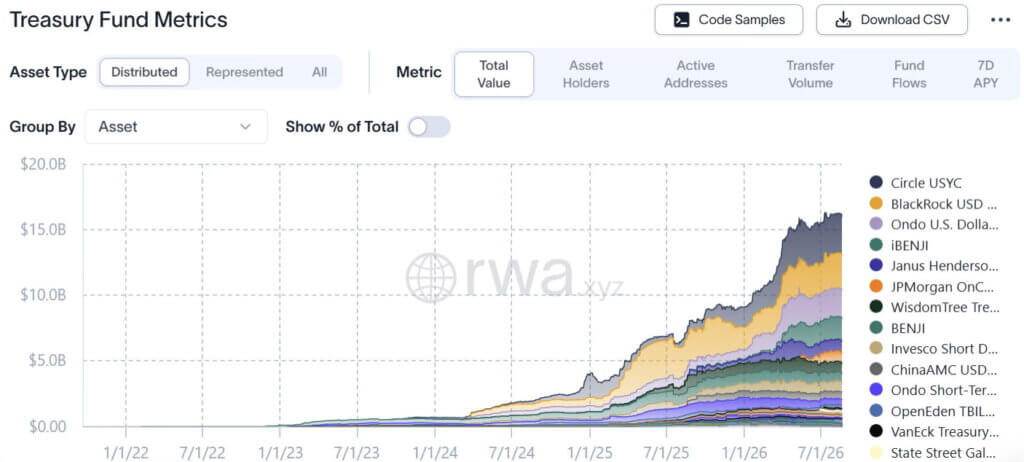
Tokenized funds have stopped being a novelty. Tokenized US Treasury funds alone now hold roughly $16 billion in distributed value and the list of issuers includes most of the largest names in traditional asset management. Issuance is a solved problem. The harder question is what happens to one of these assets after it exists onchain, because most of them currently do very little.
The typical tokenized fund is held, occasionally transferred, and eventually redeemed. That is a real improvement in distribution and settlement, but it leaves the asset economically idle. The larger opportunity lies in financial utility: using a traditional asset inside an onchain system as collateral, as margin, or as a component of a structured position. The two outcomes look almost identical on a balance sheet, and they behave very differently in practice.
From Representation to Utility
Consider an investor holding a tokenized fund that owns $100 million of bonds. If that investor needs cash, the conventional path is to redeem the fund, wait for the underlying assets to settle, receive the proceeds, and then deploy that capital somewhere else. The plumbing is faster than it would be offchain, but the economics are unchanged. The investor gave up the position in order to access liquidity.
The alternative is to deposit the same token into a lending market as collateral and borrow stablecoins against it. The credit exposure and its yield stay with the investor, the loan provides the cash, and nothing is sold. The function of the asset changes rather than the asset itself, and that shift is where tokenization begins to look like financial infrastructure rather than a faster distribution channel.
In traditional markets, an enormous amount of financial machinery exists to mobilize the value sitting inside assets rather than simply to own them, and that machinery is what tokenization has the potential to make programmable.
Why Collateral Is a Higher Standard Than Issuance
The difficulty is that a lending protocol cannot treat every tokenized asset as interchangeable. When ETH falls through a liquidation threshold, the protocol sells it into a market that runs continuously and whose depth is visible onchain. A tokenized credit portfolio behaves nothing like that. Its underlying bonds trade during traditional market hours, its NAV may be struck periodically rather than continuously, and redemption can take days. DeFi liquidates in minutes while traditional credit settles in days, and wrapping the asset in a token does not close that gap. Closing it requires design work around the token rather than inside it.
The practical result is that an asset built for distribution and an asset built for collateral use should be held to quite different standards.
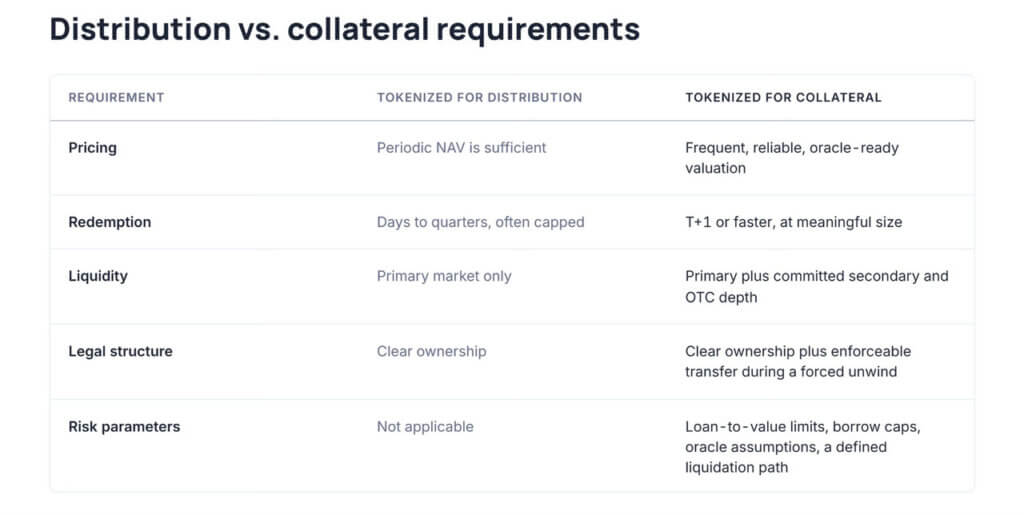 For an issuer, this reframes the question entirely. It is no longer whether an asset can be tokenized, but whether an onchain financial system can safely do anything with it once it has been.
mWIN as a Working Example
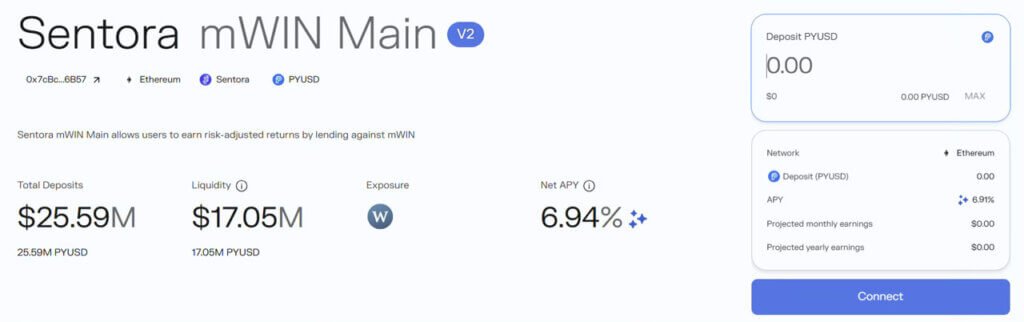
mWIN, launched in August 2026, is a useful case study because it was built against the second question from the start. Midas issues the token, Wellington Management runs the underlying credit strategy, and Northern Trust holds the assets. The strategy was issued natively onchain rather than wrapped around an existing fund after the fact, and the portfolio spans investment-grade CLOs and other asset-backed credit at a current yield of around 6.9%.
mWIN can be minted and redeemed daily on a T+1 basis, drawing on several competing sources of liquidity rather than relying on secondary market depth. Sentora then curates a Morpho market where mWIN backs loans in PayPal's PYUSD, and sets the parameters for it based on an extensive dossier of historical NAV, past market stress events, liquidity and redemption mechanics. This combination ensures that a sensible loan-to-value limit can be set, sized so that a forced sale can complete before the collateral is worth less than the debt.
So while the token makes the asset programmable, these arrangements around it are what make the programmability safe to use.
The Path Forward: Measuring Utility Instead of Issuance
The industry currently measures tokenization by the value of assets issued onchain. That figure is easy to publish and incomplete as a signal, because it counts assets that sit idle alongside assets doing real work. A more useful set of questions is already available: how much tokenized collateral is securing loans, how much stablecoin liquidity can be raised against tokenized securities, how much collateral can move between venues without selling the underlying asset, and how much of that activity settles without leaving the common infrastructure.
The market is starting to move in that direction. Figure PRIME’s growth on Morpho this year surpassed 200 million. Aave launched Horizon in August 2025 specifically to let institutions borrow stablecoins against tokenized assets, and it currently has a TVL of over $250 million.
More and more Morpho markets are being built around tokenized credit, and tokenized equities are entering the same infrastructure.
Digitizing documents did not make the internet transformative on its own; networked documents did. Financial assets appear to be following a comparable path, moving from representation to distribution and now to utility. The eventual value of tokenization will be measured by what markets can build once these assets are genuinely usable, rather than by how many of them exist.
Source: CryptoSlate