


FILTERED RESULTS
FILTERS
MCap $2.6T 0%24h Vol $92.5B +1.1%Fear & Greed 50/100Alts Index 37/100
BTC.D 58.5% +0.1%Stable.D 10.1% 0%ETH.D 11.3% 0%Others.D 20.1% -0.1%
CASHCAT$0.1988+27.6%•DRV$0.1748+25.23%•DGB$0.00447714+24.52%•HNT$0.4906+23.53%•USELESS$0.2673+17.27%•ZEC$1,358.85+16.09%•NEAR$2.703+15.92%•VVV$24.887+14.26%•LIT$4.804+14.06%•TRAC$0.3471+13.5%•
AI$0.2684-16.48%•STONK$0.1705-13.09%•STABLE$0.0239-11.32%•牛来$0.1078-9.28%•SKY$0.0568-5.24%•ZCAT$0.1006-4.71%•PI$0.0833-3.7%•APEPE$0.00000117-3.46%•JLP$4.309-2.34%•HTX$0.00000166-1.89%•
•
·
·
FILTERED RESULTS
Only 290 People Worldwide Hold $100 Million or More in Crypto, Henley SaysAn estimated 290 people...
Elon Musk Relocates to RV Near xAI Data Center in Memphis
Huawei Announces Early Release of Ascend 960 Chip
What Is Bitcoin? How It Works, Who Controls It and Why the…
South Korea Probes 26 Polymarket Users Over 17.6B Won Bets
BlackRock ETF Clients Withdraw $110 Million from Ethereum Amid Broader Crypto Fund Outflows
Jeff Bezos Says One Question in a Job Interview Reveals Who Never Did the Reading
Celsius Estate Sues BitMEX for $495 Million Over 2020 Covid Crash Liquidations
Quantum isn't the real threat to Bitcoin, the migration is. Ledger CTO...
Analyst: Bitcoin's Volatility Range Narrows Between 'Active Supply Support' and 'Capital Break-Even Resistance'
SYN surged over 100% today.Trader 0x161C opened a 4x long on 3.25M $SYN ($588K) on @Aster_DEX and...
Vitalik Buterin says 90% of his net worth is effectively a bet that crypto can survive the AI...
Celsius sues BitMEX for $495M over 2020 Bitcoin crash liquidations ahead of exchange...
BitMEX faces Celsius lawsuit ahead of exchange closure
Another whale (0x0058) spent 13M $USDC to buy 5,368 $ETH at an average price of $2,422 over the...
ETF Flows : 16 Sep 2026 BTC ETFs : -$299.4M ETH ETFs : -$224.1M SOL ETFs : $800.0K XRP ETFs :...
Russia’s Largest Stock Exchange MOEX to Launch Crypto Perpetual Futures on BTC, ETH, SOL, XRP and...
Revolut Hackers Demand $3 Million in Monero, Set 24-Hour…
Crypto VC Funding Rebounds to $5.7 Billion in Q2, Up 31%…
XRP Trades Flat: What’s Next for Ripple’s Altcoin in September?
FCA Clears Crypto Rulebook, but UK Banks Can Still Block Transfers
307,303 $HYPE (24,276,345 USD) transferred from #Kinetiq to unknown wallet...
BlackRock’s IBIT Reports $144 Million in Net Outflows Amid Bitcoin ETF Declines
South Korean Police Probe 26 Polymarket Users Over $12.7…
Spot bitcoin ETFs reported $296 million in net outflows on Wednesday, with $144 million
A New York federal court will hear arguments today in a $15 million loan fight against
U.S. Bitcoin, Ether ETFs See $520 Million Combined Outflow as BlackRock ETHA Leads RedemptionsU.S....
XRP’s 70% Breakout Had a Warning Sign: 85 Millionaire Wallets Moved First
Bitcoin Hovers Around $76,000 as Hawkish Fed and CLARITY…
Zcash jumps 23% as bitcoin and major tokens rise despite Fed’s first hike since 2023
NEW: South Korean police have booked 26 local Polymarket users and referred 18 ofm to
Bitcoin and Ether ETFs Lose $520 Million as Crypto Fund…
How $230M in Crypto for Venezuelan Oil Vanished on USB Drives
Circle Launches Arc Mainnet, a USDC-Native Layer 1 Backed by BlackRock, Visa, Mastercard as Validators
Upbit parent company Dunamu has signed an agreement with Kazakhstan's Alatau City
Dunamu Partners with Kazakhstan's Alatau City on $6 Billion Digital Finance Initiative
NEW: Revolut hackers are demanding $3 million in Monero monero:native within 24 hours, ory will
Goldman pivots, now forecasts Fed hike in October
CLARITY Act Update After Failure: SEC Chair Breaks Silence, Says ‘Stay Tuned’
US House Passes Strategic Bitcoin Reserve Bill 28-21 With 20-Year Lock
Vitalik Buterin Rejects Claim AI Hackers Will Make Cybersecurity UnwinnableEthereum co-founder...
Bybit CEO : We Actually Gave Every Employee an AI AgentOn April 15, 2026, Bybit co-founder and CEO...
UK’s New Crypto Rules Won’t Force Banks to Lift Payment…
Paul Atkins Says SEC Will Deliver Crypto Clarity ‘With or…
Ethereum’s client diversity picture fractures under incompatible estimates
Kraken Parent Payward Plans Hyperliquid Perpetual Futures…
Microsoft AI Chief Raises Concerns Over Humanization of AI Systems
ZEC is pumping.Trader 0x3c83 closed his long and flipped to short on 767.2 $ZEC ($1M) 7 hours...
7 Democratic Senators Vow to Keep Pushing CLARITY Act After Setback
Bitcoin absorbs Fed rate hike as officials see more tightening
Whales are accumulating $ETH!A newly created wallet, 0xC2f1, withdrew 2,695 $ETH ($6.94M) from...
Revolut Hackers Demand $3 Million in Monero, Set 24-Hour DeadlineHackers calling themselves...
Seven Senate Democrats Vow to Revive CLARITY Act After 49-50 Cloture Defeat
Chinese AI Startup Manus Seeks $500 Million Financing to Double Valuation
Fed Raises Rates 25 Basis Points to 3.75%-4%, First Hike Since 2023, as Bitcoin Holds Near $76,000
Important News Last Night and This Morning (September 16 - September 17)
Column Launches Four Financial Products to Enhance Stablecoin and US Dollar Payment Integration
Dormant Address Withdraws 2,500 ETH from Binance After 9 Months, Builds Position Worth $6.02 Million
Circle opens Arc mainnet as it seeks an edge for USDC utility
$AVA listed on Bithumb spot・
30,335 $ETH (73,712,618 USD) transferred from #Coinone to unknown wallet...
Bithumb to List AVA Token on Korean Won Market
Garrett Jin(@GarrettBullish), the largest on-chain $ZEC short, is now down over $26M!He added more...
Cosmos Ventures Launches $77.6 Million Fund to Support AI Innovators
Hyperliquid Perps to Enter US Market via Kraken; HYPE Up 1.7%
Ripple Says XRP Is Not a Security, Recognized as Digital Commodity
Seven Democratic Senators Support Restarting Clarity Act Negotiations, Aiming for Passage by Year-End
South Korean Police Probe 26 Polymarket Users Over $12.7 Million in Alleged Illegal BetsSouth Korean...
$BTC is still just 0.5% of global financial assets...
Avalanche’s Helicon upgrade cuts validator lockups from 14 days to 48 hours


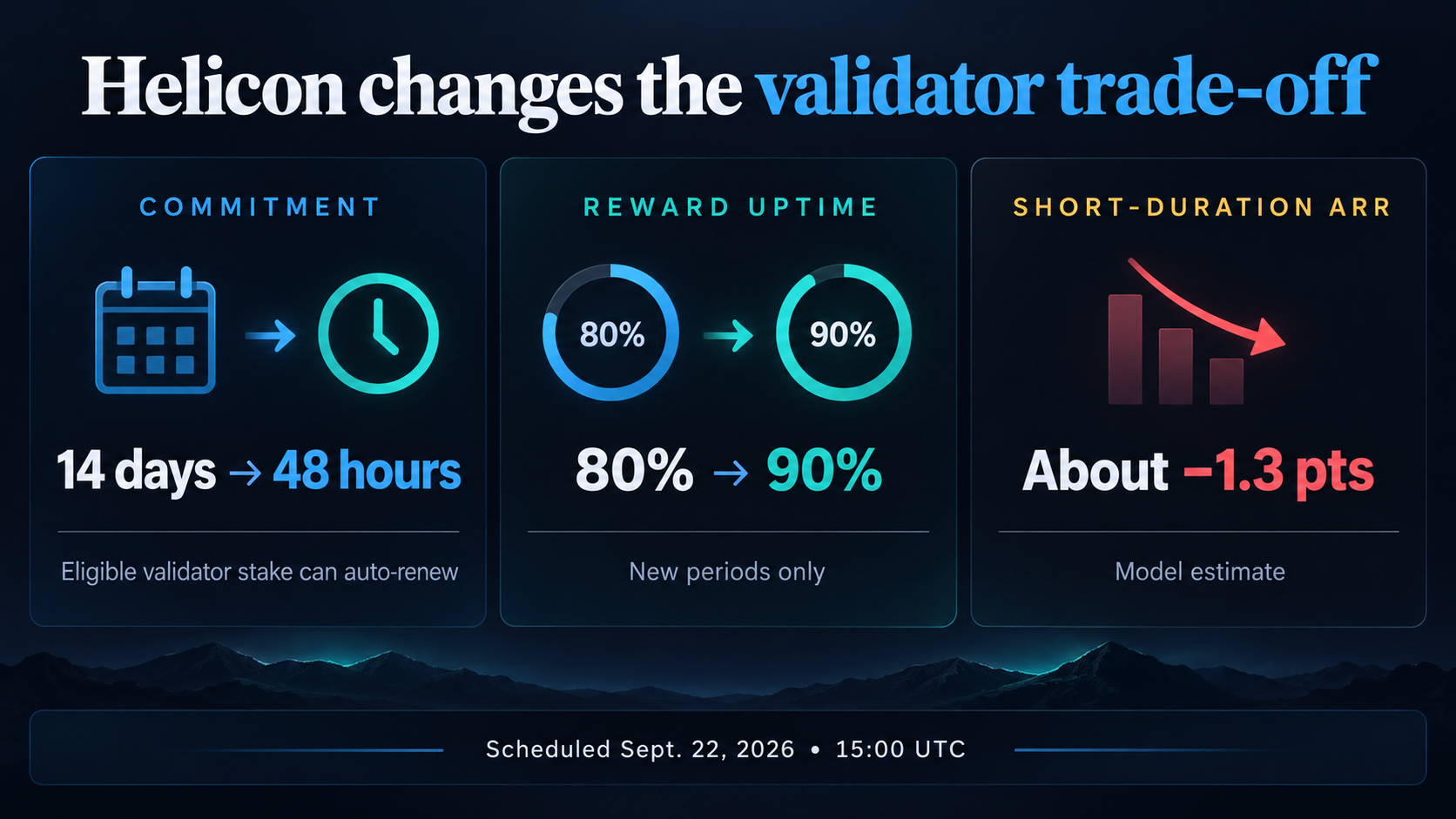
Avalanche’s Helicon upgrade is scheduled to give validators shorter, auto-renewing commitments while raising the uptime cutoff for rewards and reducing returns at the shortest durations.
The network upgrade is set to activate on Avalanche Mainnet on Sept. 22 at 15:00 UTC. Validators must install AvalancheGo v1.15.0 beforehand to remain compatible with the upgraded chain.
What changes for validators
Helicon will cut the minimum Primary Network validation period from 336 hours to 48 hours. It will also let eligible validators automatically begin another cycle when the current one ends, reducing manual signing work and potential reward gaps from repeatedly leaving and rejoining the validator set.
Operators can choose how much of each cycle’s reward to compound into the next one and can update the configuration for a future cycle. That creates a way to combine brief capital commitments with continuous validation, instead of choosing between a long lockup and repeated manual restaking.
The feature applies only to the validator’s own stake. Delegations will not auto-renew, and each delegation must fit inside one validator cycle because the validator is not guaranteed to continue beyond that boundary.
Validation periods that start on or after Helicon activation must achieve at least 90% uptime to earn rewards, up from 80%. The rule is not retroactive: periods that began before activation remain subject to the existing 80% requirement even if they extend beyond Sept. 22.
Avalanche's uptime measurement will not change, and rewards will remain all or nothing. Falling below the applicable threshold forfeits the full reward for that period, though the validator’s principal is not slashed.
For a validator using auto-renewal, missing the threshold has an additional consequence. The position will not roll into another cycle, and the validator will exit. Its principal and rewards accrued in earlier cycles are returned, but the failed cycle’s reward is lost.
Short cycles reduce how long capital is committed, while the higher threshold raises the operational reliability required to collect each cycle’s reward and continue automatically. For operators, that links continuity to cycle-by-cycle performance without changing how Avalanche measures peer responsiveness or adding a partial-reward buffer.
How short-duration Avalanche rewards change
Helicon will also begin a 90-day adjustment to Avalanche’s reward curve. The protocol’s minimum consumption rate, an input that helps determine staking rewards, is scheduled to decline linearly from 10% to 7.5%. The maximum rate at the one-year duration will remain unchanged.
Avalanche’s modeling estimates that this adjustment will reduce the annualized reward rate at the shortest duration by about 1.3% after the phase-in. The exact realized yield will remain variable because it depends on factors including AVAX supply, duration, and compounding choices.
The same modeling projects annual AVAX inflation falling by roughly 0.5% to 1% and the stake-weighted average duration increasing by about two months. Those outcomes are estimates depending on how validators and delegators respond.
The mechanical trade-off is more certain: Helicon makes short, renewable validator commitments easier to use, but sets a lower reward at the short end while preserving the one-year rate and demands more reliable uptime for new validation periods.
Source: CryptoSlate