


FILTERED RESULTS
FILTERS
MCap $2.6T +0.1%24h Vol $93.2B +1.9%Fear & Greed 50/100Alts Index 37/100
BTC.D 58.6% +0.2%Stable.D 10.1% 0%ETH.D 11.4% +0.1%Others.D 19.9% -0.3%
DRV$0.1748+25.23%•CASHCAT$0.1903+23.68%•HNT$0.4922+23.45%•USELESS$0.2759+20.91%•ZEC$1,358.39+18.83%•MARSCOIN$0.1118+17.59%•LIT$4.818+16.9%•VVV$25.107+16.49%•NEAR$2.661+14.03%•DASH$57.745+14.03%•
AI$0.2684-16.48%•STONK$0.1705-13.09%•LSK$0.4848-11.35%•STABLE$0.0239-11.21%•牛来$0.1078-9.28%•SKY$0.0569-6.13%•ZCAT$0.1006-4.71%•PI$0.0833-3.98%•APEPE$0.00000117-3.46%•JLP$4.309-2.34%•
•
·
·
FILTERED RESULTS
307,303 $HYPE (24,276,345 USD) transferred from #Kinetiq to unknown wallet...
BlackRock’s IBIT Reports $144 Million in Net Outflows Amid Bitcoin ETF Declines
South Korean Police Probe 26 Polymarket Users Over $12.7…
Spot bitcoin ETFs reported $296 million in net outflows on Wednesday, with $144 million
A New York federal court will hear arguments today in a $15 million loan fight against
U.S. Bitcoin, Ether ETFs See $520 Million Combined Outflow as BlackRock ETHA Leads RedemptionsU.S....
XRP’s 70% Breakout Had a Warning Sign: 85 Millionaire Wallets Moved First
Bitcoin Hovers Around $76,000 as Hawkish Fed and CLARITY…
Zcash jumps 23% as bitcoin and major tokens rise despite Fed’s first hike since 2023
NEW: South Korean police have booked 26 local Polymarket users and referred 18 ofm to
Bitcoin and Ether ETFs Lose $520 Million as Crypto Fund…
How $230M in Crypto for Venezuelan Oil Vanished on USB Drives
Circle Launches Arc Mainnet, a USDC-Native Layer 1 Backed by BlackRock, Visa, Mastercard as Validators
Upbit parent company Dunamu has signed an agreement with Kazakhstan's Alatau City
Dunamu Partners with Kazakhstan's Alatau City on $6 Billion Digital Finance Initiative
NEW: Revolut hackers are demanding $3 million in Monero monero:native within 24 hours, ory will
Goldman pivots, now forecasts Fed hike in October
CLARITY Act Update After Failure: SEC Chair Breaks Silence, Says ‘Stay Tuned’
US House Passes Strategic Bitcoin Reserve Bill 28-21 With 20-Year Lock
Vitalik Buterin Rejects Claim AI Hackers Will Make Cybersecurity UnwinnableEthereum co-founder...
Bybit CEO : We Actually Gave Every Employee an AI AgentOn April 15, 2026, Bybit co-founder and CEO...
UK’s New Crypto Rules Won’t Force Banks to Lift Payment…
Paul Atkins Says SEC Will Deliver Crypto Clarity ‘With or…
Kraken Parent Payward Plans Hyperliquid Perpetual Futures…
Microsoft AI Chief Raises Concerns Over Humanization of AI Systems
ZEC is pumping.Trader 0x3c83 closed his long and flipped to short on 767.2 $ZEC ($1M) 7 hours...
7 Democratic Senators Vow to Keep Pushing CLARITY Act After Setback
Bitcoin absorbs Fed rate hike as officials see more tightening
Whales are accumulating $ETH!A newly created wallet, 0xC2f1, withdrew 2,695 $ETH ($6.94M) from...
Revolut Hackers Demand $3 Million in Monero, Set 24-Hour DeadlineHackers calling themselves...
Seven Senate Democrats Vow to Revive CLARITY Act After 49-50 Cloture Defeat
Chinese AI Startup Manus Seeks $500 Million Financing to Double Valuation
Fed Raises Rates 25 Basis Points to 3.75%-4%, First Hike Since 2023, as Bitcoin Holds Near $76,000
Important News Last Night and This Morning (September 16 - September 17)
Column Launches Four Financial Products to Enhance Stablecoin and US Dollar Payment Integration
Dormant Address Withdraws 2,500 ETH from Binance After 9 Months, Builds Position Worth $6.02 Million
Circle opens Arc mainnet as it seeks an edge for USDC utility
$AVA listed on Bithumb spot・
30,335 $ETH (73,712,618 USD) transferred from #Coinone to unknown wallet...
Bithumb to List AVA Token on Korean Won Market
Garrett Jin(@GarrettBullish), the largest on-chain $ZEC short, is now down over $26M!He added more...
Cosmos Ventures Launches $77.6 Million Fund to Support AI Innovators
Hyperliquid Perps to Enter US Market via Kraken; HYPE Up 1.7%
Ripple Says XRP Is Not a Security, Recognized as Digital Commodity
Seven Democratic Senators Support Restarting Clarity Act Negotiations, Aiming for Passage by Year-End
South Korean Police Probe 26 Polymarket Users Over $12.7 Million in Alleged Illegal BetsSouth Korean...
$BTC is still just 0.5% of global financial assets...
Vitalik Buterin Advocates for AI-Enhanced Software Security
UPBIT Launches Trading for PayPal USD and JPY Coin
ECB opens merchant applications for controlled 2027 digital euro pilot
U.S. Democratic Senator Kirsten Gillibrand and six others said in a new statement that
ESS Frontier Files Lawsuit Against Ostium and Co-Founders in New York
Hong Kong to Test Tokenized Funds with Stablecoins in 2026
BlackRock Withdraws $62 Million in Cryptocurrency from Coinbase Prime
River Report Advocates Increased Bitcoin Allocation for Long-term Investors
$PYUSD, $JPYC listed on Upbit spot (KRW)・
The Attackers Who Deceived Revolut Now Demand 6,000 XMR
Satoshi Nakamoto's Bitcoin Holdings Increase by $12.37 Billion This Month
Google DeepMind Launches DeepMind Institute to Address AGI Challenges
Ethena Pay Launches Self-Custodial Neobank Offering High Yields
Haun Ventures Partner Highlights AI and Stablecoins as Catalysts for New Insurance Giants
Vitalik Buterin Advocates for Defensive Cybersecurity in Cryptocurrency
Micron Unveils World's First 512GB DDR5 Memory Module, Set for Mass Production in 2027
OpenAI CEO Sam Altman to Attend State Dinner for Chinese Leader Xi Jinping
US lawmakers advance bill to lock Trump’s Bitcoin reserve into law
Wintermute Transfers 2,550 BTC to Binance, Worth Approximately $193 Million
182,000,000 $USDC (181,962,988 USD) transferred from Unknown Whale 1 to #Aave...
KLEA Crypto Daily: Wednesday, September 16, 2026
PURR CEO: Goldman Sachs Doubled Hyperliquid’s Institutional AppealOn Sept. 1, PURR CEO David...
Ethereum’s client diversity picture fractures under incompatible estimates


Ethereum validators rely on independently built consensus clients to agree on the chain, and that diversity is a safety feature. If a defect affects a client used by too much of the network, Ethereum can stop finalizing blocks or, under more extreme conditions, finalize the wrong chain.
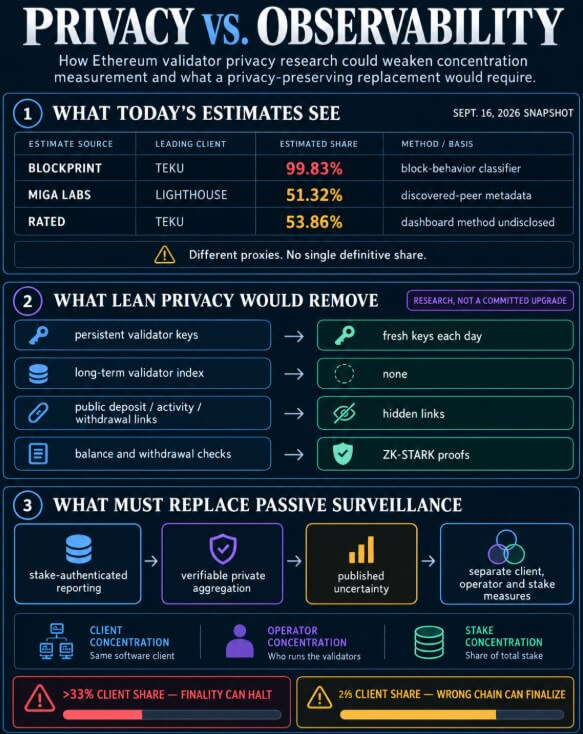
Yet a Sept. 16 snapshot of one client-diversity dashboard offered three incompatible answers about which client had the largest share. Clientdiversity.org showed Blockprint estimating Teku at 99.83%, Miga Labs estimating Lighthouse at 51.32%, and Rated estimating Teku at 53.86%.
Those are readings coming from different proxies, and one is attached to a tool its developer now calls defunct. Ethereum researchers are exploring stronger validator privacy.
A Lean-chain research proposal would use fresh validator keys each day and hide links between deposits, validator activity and withdrawals, weakening some of the traces used to measure operator and stake concentration.
The central question is whether Ethereum can replace imperfect surveillance with authenticated aggregate reporting before those persistent identifiers disappear.
Why the disputed numbers matter
Ethereum.org’s client-diversity guidance describes two distinct failure levels.
A bug in a consensus client used by more than 33% of nodes could prevent finality, a liveness failure that leaves users unable to rely on transactions as irreversible.
A critical bug in a client with a two-thirds majority could cause an incorrect split chain to finalize, a safety failure that could leave validators facing slashing or an expensive exit-and-re-entry process.
The public guidance uses node share as shorthand. Researchers seeking a consensus-risk measure care about the distribution across validators and their voting weight, because a simple count of visible machines does not show how much stake backs each client.
The Sept. 16 snapshot did not provide that clean, stake-weighted answer.
| Estimate | Largest displayed client | Displayed share | Underlying signal |
|---|---|---|---|
| Blockprint | Teku | 99.83% | Machine-learning classification from block behavior |
| Miga Labs | Lighthouse | 51.32% | Client metadata from discovered peers |
| Rated | Teku | 53.86% | Method not disclosed on clientdiversity.org |
Sigma Prime’s archived repository says the classifier is no longer accurate after Ethereum’s Electra upgrade and considers the project defunct. Clientdiversity.org nevertheless labeled the Blockprint panel as updated daily.
Miga measures a different signal. Its Ant crawler discovers peers and requests client metadata. Firewalls, refused connections, discovery gaps, and rotating peer IDs can limit coverage. One node can serve many validators, so a node sample does not reveal how much stake is behind each observation.
Rated’s documentation shows a separate attribution problem. For operator-level analysis, Rated groups validator keys by deposit address, then maps those groups to entities using transaction research, block graffiti and voluntary disclosure.
Rated says there is no standard method for that higher-order mapping. Its operator attribution is not an explanation of the client estimate displayed on clientdiversity.org, but it shows how much concentration analysis can depend on persistent public links.
Client concentration, operator concentration and stake concentration are related but not interchangeable. A large operator can diversify across clients, while nominally separate validators can share one operator, hosting provider, or software stack.
Ethereum Lean privacy would change what observers can measure
Buterin’s July research post proposes moving much of Ethereum’s per-validator accounting into zero-knowledge proofs. Under its privacy phase, the active validator registry would be rebuilt each day, validators would register fresh keys, and no long-term validator index would remain.
Balance updates and withdrawal conditions would be proven with ZK-STARKs. Deposits would use hiding commitments so a withdrawal address is not publicly linked to earlier validator activity.
Buterin described the result as strong validator anonymity. In the discussion, he also acknowledged that privacy can hide centralization, while suggesting that large operations may still leak enough aggregate data to be identifiable.
Ethereum’s broader privacy roadmap describes several protocol changes as active work or candidates under consideration, and says the roadmap is unfinished and subject to change.
Daily key changes would disrupt methods that assume a validator can be followed over time. Hiding deposit and withdrawal links would also erode deposit-address grouping used in some operator attribution.
Miga’s crawler observes network peers rather than relying on long-lived validator keys. A block classifier looks for behavior rather than identity. Neither method would automatically disappear because keys rotate, although new protocol and client behavior could make their signals less reliable.
Blockprint’s failure after Electra already shows how a protocol change can invalidate a fingerprint.
A 2025 USENIX study reported that four observer nodes located more than 15% of Ethereum validators in the peer-to-peer network during a three-day measurement. That experiment shows how network traces can reveal hosting concentration, but also why preserving those traces creates privacy and targeting risks.
A research path exists for publishing aggregate client shares without revealing each validator’s choice, but it does not yet solve authentication.
A Nethermind research project explored private voting for client reporting. Validators could encrypt their client choices, prove their ballots are structurally valid, and allow a set of authorities to recover only the aggregate. The design considered homomorphic encryption, distributed key generation, and zero-knowledge proofs.
An IETF research draft on verifiable distributed aggregation describes related cryptographic tools for private sums, histograms, groupings, and heavy hitters. These primitives can validate the form of a submitted measurement while hiding the individual input.
Multiplexed setups and distributed validators may also use more than one consensus or execution client, making an honest report more complex than a single label. Nethermind’s post identifies sampling, fake data, software attestation, decryption authorities, and performance as unresolved design questions.
Private client aggregate reporting could show whether a client crossed a warning threshold without revealing individual validators, yet still miss that one company controlled many unrelated keys. Client share and operator share need separate authenticated measurements. Neither the Lean post nor the private-reporting research specifies a complete operator-concentration system.
Ethereum can make validators more private without abandoning its client-diversity safety discipline, but measurement must become an explicit part of the privacy design. That means stake-authenticated reporting, verifiable aggregation, published uncertainty, and separate treatment of client, operator, and stake concentration.
Daily re-anonymization would expose how much the current picture already depends on incompatible estimates and public traces that privacy research is meant to remove.
Source: CryptoSlate