


FILTERED RESULTS
FILTERS
MCap $2.6T +0.4%24h Vol $105.1B -0.4%Fear & Greed 51/100Alts Index 27/100
BTC.D 58.6% 0%Stable.D 10.2% 0%ETH.D 11.3% 0%Others.D 19.9% 0%
AKE$0.0273+78.56%•LSK$0.5149+49.94%•AI$0.3214+35.32%•ARB$0.1656+20.67%•龙虾$0.1779+19.42%•USELESS$0.2334+13.16%•牛来$0.1189+11.99%•MARSCOIN$0.0999+10.94%•LAPTOP$0.2390+9.71%•ZEC$1,225.24+8.05%•
UAI$0.3767-28.04%•PI$0.0834-12.58%•PONS$0.5770-12.16%•RAIN$0.0132-12.14%•CAP$0.0582-10.3%•XCN$0.0038948-10%•XLM$0.1763-9.53%•INJ$5.391-8.84%•JTO$0.4056-8.24%•FIL$0.8055-8.24%•
•
·
·
FILTERED RESULTS
680 $BTC (51,793,983 USD) transferred from Coinbase Institutional to unknown wallet...
NEW: UK Treasury has laid amendments to its crypto regulations, including exclusions for
Bitcoin Core 32 Enters Final Testing Phase Ahead of October Release
Clarity Act Fails in U.S. Senate, Impact on Crypto Stocks Uncertain
Michael Saylor Anticipates Regulatory Advances for Bitcoin Custody in the U.S.
680 $BTC (51,929,768 USD) transferred from Coinbase Institutional to unknown wallet...
Morning Minute: Clarity Act Vote Falls Short as Democrats All Vote ‘No’
Singapore Crypto Poker Heist Ends With Six Malaysians Jailed
Circle’s USDC-Native Layer 1 Blockchain ‘Arc’ Goes Live on Mainnet
Bitcoin Hovers at $76K as Analysts Argue the Fed Matters More Than Clarity Act
680 $BTC (51,900,166 USD) transferred from Coinbase Institutional to unknown wallet...
Binance Completes Integration of USDC (USDC) on Arc Network, Opens Deposits - 2026-09-16Binance has ...
Nvidia Needs To Worry About This Company, And Not AMD
U.S. Regulatory Agencies Expected to Advance Cryptocurrency Rules Amid CLARITY Act Stalemate
Bitcoin Core 32 enters final testing with faster validation, fee changes and security fixes
Pi Network (PI) Tumbles 14% Daily: Is a Recovery on the Horizon?
Kraken parent Payward has confirmed plans to bring onchain perpetual futures to U.S.
Malicious Uniswap v4 hooks are baiting DeFi traders with fake swap quotes
Bitcoin Buy Signal Emerges Ahead of Federal Reserve Rate Decision
krakenfx PARENT COMPANY Payward INTENDS TO BRING ONCHAIN PERPETUAL FUTURES TO U.S....
SKY (SKY) Price Prediction 2026, 2027 – 2030: Is SKY a Strong Long-Term DeFi Investment?
Circle launches Arc mainnet with USDC as native gas token
Trump and Melania’s coins are down over 95% from ATHs
Kraken Parent Payward Plans to Offer Onchain Perpetual Futures to U.S. Clients, Starting with...
Two crypto bills are in Congress today- One would eliminate capital gains tax on crypto...
Two crypto bills are in Congress todayOne would eliminate capital gains...
Whale Sells 866 BTC for 26,924 ETH Hours Before Bitcoin Price Tanked
A quick guide to analyzing a crypto project’s website
KuCoin Opens Direct USDC Transfers as Circle’s Arc Blockchain Goes Live
Researchers Uncovered Scheme Involving Fake Crypto Requests on Revolut
Bitcoin miners and other emerging AI infrastructure developers have disclosed 8 GW of
Shares of Coinbase and Strategy Shares Drop Following Senate Vote on Digital Asset Bill
Hyperliquid and Payward Launch HIP-3* Markets for US Traders
Bitcoin loses touch with the Dollar Index, U.S. stocks ahead of the Fed
Why Arbitrum (ARB) & Zcash (ZEC) Price Defying the Crypto Market Ahead of FOMC?
NEW: Bitcoin onchain activity is at one of its most subdued levels on record, with just 3.8 million
Bitcoin On-Chain Activity at Historic Lows, Only 3.8 Million BTC Transferred in Past 180 Days
US 20-year bond auction just had its worst showing ever
1,604 $BTC (121,894,733 USD) transferred from unknown wallet to unknown wallet...
Kalshi Seeks $750 Million Funding at $40 Billion Valuation
The Future of RWA + DeFi: What Comes After Tokenized Treasuries?
Tokenized Private Credit in DeFi: The Biggest RWA Category
CLARITY Act Fails in the US Senate: How the Crypto Community Reacted, and Whether Analysts See Signs of a Bottom?
BTC, ETH, and XRP Plunge After CLARITY Setback but All Eyes Turn on Fed Now: Market Watch
The Standard Chartered Effect: Is bank research becoming crypto’s new short-term catalyst?
CoinEx to Cease Operations After Nine Years, Withdrawals End December 22
Crypto's Biggest Senate Bet Collapses as Clarity Act Falls Short of 60 Votes
Bitcoin traders brace for Fed hike, but a surprise hold could pose bigger risk
Two Prime makes onchain finance push with $10 million-backed bitcoin yield vault
Deutsche Bank Seeks Approval for Digital Asset Custody Service
Circle Launches Arc Mainnet with Major Financial Institutions as Validators
Bitcoin ETFs shed $450 million as Clarity Act fails
Deutsche Bank close to debuting crypto custody for institutions
Arbitrum Price Prediction: Can ARB Turn Standard Chartered’s $10 Call Into a New Rally?
India Crypto News: Parliament Panel Wraps Year-Long Crypto Review, Report Due Soon
ICON (ICX) Price Prediction 2026, 2027-2030: Is ICX A Good Investment?
Stand With Crypto says senators who voted against the CLARITY Act will...
Bernstein says Clarity Act's failure shifts crypto regulation toward SEC and CFTC
Elizabeth Warren Said She Is Ready to Work on a New Crypto Law After the Failure of the CLARITY Act
Live updates: Zcash climbs 6% as majors slide ahead of Fed rate decision
New wallet bought $7.72M worth of HYPE via FalconX 2 hours ago
Circle launches Arc mainnet with BlackRock and Visa among validators, mints 10 billion ARC tokens
A newly created wallet (0xF426) bought 99,834 $HYPE($7.72M) via #FalconX 2 hours...
Kalshi Hits $40B+ Volume and 80% of US Prediction Market
Italy Investigates Government Email Breach Linked to Revolut Data Leak
PANews Sep 16: Cumberland Sold 1.5M PONS in Past 5 Hours After Accumulating 17.64M PONS Over Two Weeks
Circle debuts Arc blockchain which Jeremy Allaire calls ‘more consequential’ than USDC
Tokenized S&P 500 Index Fund Achieves $104 Million in Trading Volume on Base
Twenty One Capital Weighs STRC-Style Preferred Stock to Buy More Bitcoin
Bitcoin miners are getting a new AI hedge, but it may protect them from the wrong risk


The US derivatives regulator is exploring a market for futures tied to AI computing power just as Bitcoin miners pour hundreds of millions of dollars into data centers, but the contracts may leave their biggest risks untouched.
On Aug. 19, the Commodity Futures Trading Commission (CFTC) opened a consultation on compute derivatives, seeking feedback on the size and liquidity of underlying markets, manipulation risks, customer protections and perpetual futures tied to computing capacity.
CFTC Chairman Michael Selig said a robust derivatives market for compute would be important to US competitiveness in artificial intelligence, describing the consultation as an initial step toward establishing rules for the emerging market.
Exchanges are already preparing products. CME Group plans to launch H100 Rental Index Futures and B200 Rental Index Futures on Oct. 5, pending regulatory review. The cash-settled contracts would track Silicon Data benchmarks for hourly rental prices of specific Nvidia GPUs. Intercontinental Exchange is separately developing futures linked to GPU compute indexes.
A futures market could give cloud operators a way to protect revenue against falling GPU rental rates, while companies buying compute could hedge rising costs. It could also establish a forward price curve for an industry where capacity is increasingly treated like a commodity.
Multicoin Capital co-founder Tushar Jain, a member of the CFTC’s Innovation Advisory Committee, has urged regulators to provide an innovation exemption or safe harbor for emerging markets including compute derivatives, allowing new products to develop within a regulated framework.
The push comes as Bitcoin miners increasingly turn their power infrastructure toward AI in search of higher and more predictable returns than mining alone.
HIVE Digital Technologies recently signed a five-year AI cloud agreement worth about $350 million, but expects to spend roughly $185 million deploying 2,016 Nvidia Blackwell Ultra GPUs before the contract reaches its projected $70 million annualized revenue run rate.
Riot Platforms has taken the transition further into data-center infrastructure, arranging access to as much as $573 million of debt financing for a 191 critical IT megawatt project at its Rockdale site.
Those commitments make miners obvious potential users of compute derivatives. However, they also show why futures may hedge only a fraction of what investors worry about.
Financing could matter more than compute prices
VanEck’s Matthew Sigel argues that miners are increasingly being valued around the capital required for their AI projects rather than Bitcoin alone.
Bitcoin’s correlation with mining stocks has fallen to an all-time low, according to Sigel, as investors price in the prospect that miners will need to issue shares to fund the equity portion of new data-center developments.
Using an assumed financing mix of 80% debt and 20% equity, Sigel estimates Riot would need about $475 million of equity for its visible Rockdale AI pipeline. CleanSpark could require roughly $385 million for Sandersville, while Hut 8 could need about $774 million for Beacon Point Phase 2.
Those figures are estimates based on Sigel’s financing assumptions, rather than guidance from the companies. But they illustrate a risk that GPU futures cannot offset.
A miner can hedge a decline in compute rental prices and still face higher interest costs, construction overruns, equipment delays, or shareholder dilution because it cannot finance the project.
Sigel argues Bitcoin could itself change that equation.
At higher Bitcoin prices, miners generate more cash from existing operations while the value of coins available for sale or collateral also rises. That can increase their ability to fund AI development without issuing common stock.
CleanSpark has already demonstrated part of that strategy. The company has said the anticipated equity portion of Sandersville is fully funded, while Sigel noted it had been buying back shares even as investors were pricing in dilution.
The proposed futures also face a more basic mismatch with some miner projects.
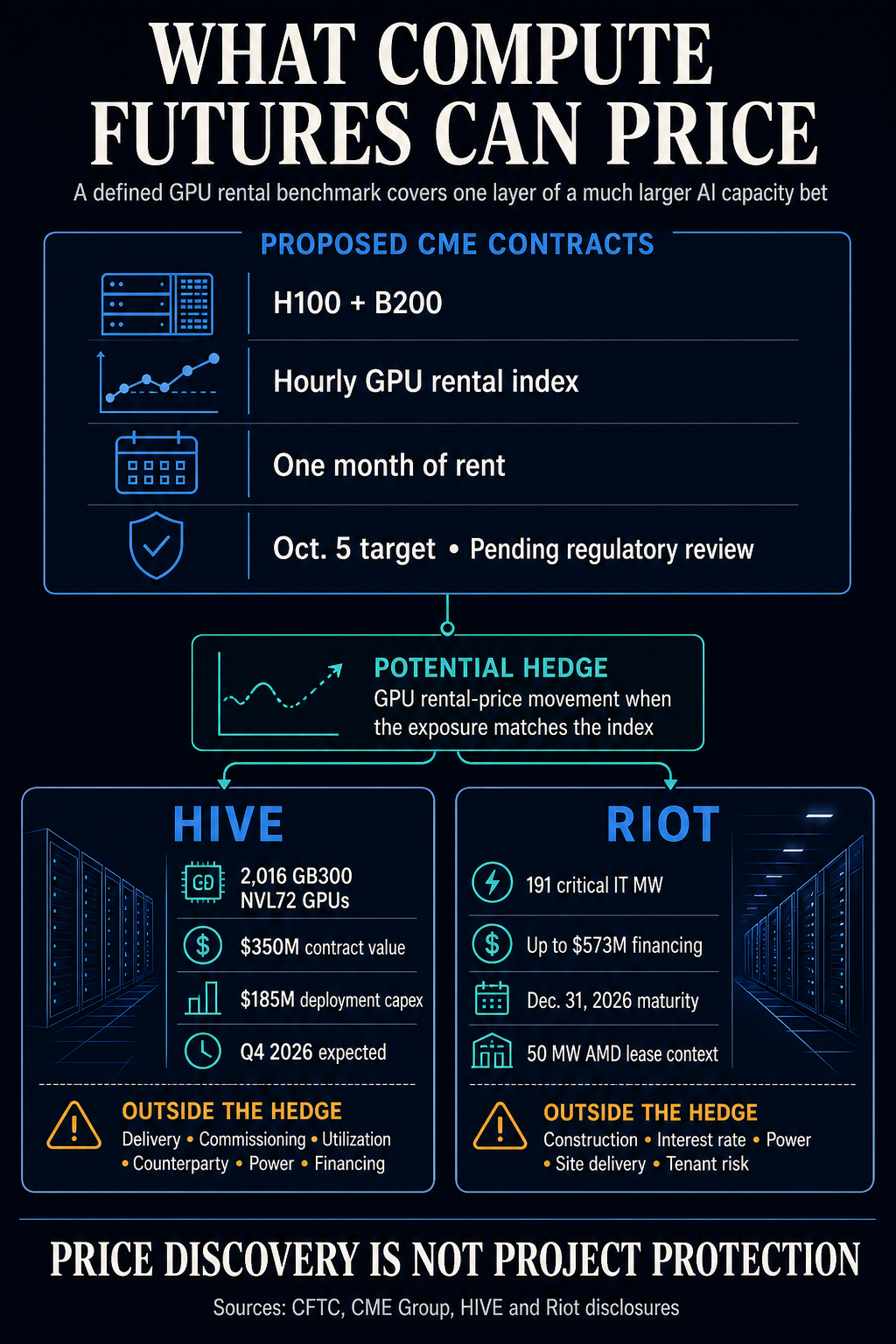
HIVE is deploying GB300 NVL72 systems, while CME’s initial contracts reference H100 and B200 rental rates. The prices may move together, but differences between chip generations, regions and contract structures create basis risk.
Riot’s exposure is further removed. Its Rockdale economics depend on construction, power, financing and long-term data-center leases measured in megawatts rather than floating sales of H100 or B200 GPU hours.
Compute futures could still give miners and lenders a useful benchmark for valuing capacity and negotiating future contracts. For operators selling uncontracted GPU hours, they could eventually become a direct hedge.
But Bitcoin miners are entering AI through capital-intensive projects where compute price is only one variable.
The new futures may help them hedge what their GPUs can earn. They cannot hedge what it costs to get those GPUs online without diluting shareholders.
Source: CryptoSlate