


FILTERED RESULTS
FILTERS
MCap $2.6T +0.1%24h Vol $93.2B +1.9%Fear & Greed 50/100Alts Index 37/100
BTC.D 58.6% +0.2%Stable.D 10.1% 0%ETH.D 11.4% +0.1%Others.D 19.9% -0.3%
DRV$0.1748+25.23%•CASHCAT$0.1912+22.79%•USELESS$0.2777+22.48%•HNT$0.4850+21.94%•ZEC$1,357.90+15.71%•VVV$25.073+15.65%•LIT$4.806+14.54%•MARSCOIN$0.1122+14.38%•ARB$0.1721+13.7%•DASH$57.736+12.4%•
AI$0.2684-16.48%•STONK$0.1705-13.09%•STABLE$0.0239-11.33%•牛来$0.1078-9.28%•SKY$0.0568-6.16%•ZCAT$0.1006-4.71%•PI$0.0832-4.64%•APEPE$0.00000117-3.46%•FIL$0.7996-2.82%•JLP$4.309-2.34%•
•
·
·
FILTERED RESULTS
307,303 $HYPE (24,276,345 USD) transferred from #Kinetiq to unknown wallet...
BlackRock’s IBIT Reports $144 Million in Net Outflows Amid Bitcoin ETF Declines
South Korean Police Probe 26 Polymarket Users Over $12.7…
Spot bitcoin ETFs reported $296 million in net outflows on Wednesday, with $144 million
A New York federal court will hear arguments today in a $15 million loan fight against
U.S. Bitcoin, Ether ETFs See $520 Million Combined Outflow as BlackRock ETHA Leads RedemptionsU.S....
XRP’s 70% Breakout Had a Warning Sign: 85 Millionaire Wallets Moved First
Bitcoin Hovers Around $76,000 as Hawkish Fed and CLARITY…
Zcash jumps 23% as bitcoin and major tokens rise despite Fed’s first hike since 2023
NEW: South Korean police have booked 26 local Polymarket users and referred 18 ofm to
Bitcoin and Ether ETFs Lose $520 Million as Crypto Fund…
How $230M in Crypto for Venezuelan Oil Vanished on USB Drives
Circle Launches Arc Mainnet, a USDC-Native Layer 1 Backed by BlackRock, Visa, Mastercard as Validators
Upbit parent company Dunamu has signed an agreement with Kazakhstan's Alatau City
Dunamu Partners with Kazakhstan's Alatau City on $6 Billion Digital Finance Initiative
NEW: Revolut hackers are demanding $3 million in Monero monero:native within 24 hours, ory will
Goldman pivots, now forecasts Fed hike in October
CLARITY Act Update After Failure: SEC Chair Breaks Silence, Says ‘Stay Tuned’
US House Passes Strategic Bitcoin Reserve Bill 28-21 With 20-Year Lock
Vitalik Buterin Rejects Claim AI Hackers Will Make Cybersecurity UnwinnableEthereum co-founder...
Bybit CEO : We Actually Gave Every Employee an AI AgentOn April 15, 2026, Bybit co-founder and CEO...
UK’s New Crypto Rules Won’t Force Banks to Lift Payment…
Paul Atkins Says SEC Will Deliver Crypto Clarity ‘With or…
Ethereum’s client diversity picture fractures under incompatible estimates
Kraken Parent Payward Plans Hyperliquid Perpetual Futures…
Microsoft AI Chief Raises Concerns Over Humanization of AI Systems
ZEC is pumping.Trader 0x3c83 closed his long and flipped to short on 767.2 $ZEC ($1M) 7 hours...
7 Democratic Senators Vow to Keep Pushing CLARITY Act After Setback
Bitcoin absorbs Fed rate hike as officials see more tightening
Whales are accumulating $ETH!A newly created wallet, 0xC2f1, withdrew 2,695 $ETH ($6.94M) from...
Revolut Hackers Demand $3 Million in Monero, Set 24-Hour DeadlineHackers calling themselves...
Seven Senate Democrats Vow to Revive CLARITY Act After 49-50 Cloture Defeat
Chinese AI Startup Manus Seeks $500 Million Financing to Double Valuation
Fed Raises Rates 25 Basis Points to 3.75%-4%, First Hike Since 2023, as Bitcoin Holds Near $76,000
Important News Last Night and This Morning (September 16 - September 17)
Column Launches Four Financial Products to Enhance Stablecoin and US Dollar Payment Integration
Dormant Address Withdraws 2,500 ETH from Binance After 9 Months, Builds Position Worth $6.02 Million
Circle opens Arc mainnet as it seeks an edge for USDC utility
$AVA listed on Bithumb spot・
30,335 $ETH (73,712,618 USD) transferred from #Coinone to unknown wallet...
Bithumb to List AVA Token on Korean Won Market
Garrett Jin(@GarrettBullish), the largest on-chain $ZEC short, is now down over $26M!He added more...
Cosmos Ventures Launches $77.6 Million Fund to Support AI Innovators
Hyperliquid Perps to Enter US Market via Kraken; HYPE Up 1.7%
Ripple Says XRP Is Not a Security, Recognized as Digital Commodity
Seven Democratic Senators Support Restarting Clarity Act Negotiations, Aiming for Passage by Year-End
South Korean Police Probe 26 Polymarket Users Over $12.7 Million in Alleged Illegal BetsSouth Korean...
$BTC is still just 0.5% of global financial assets...
Vitalik Buterin Advocates for AI-Enhanced Software Security
UPBIT Launches Trading for PayPal USD and JPY Coin
ECB opens merchant applications for controlled 2027 digital euro pilot
U.S. Democratic Senator Kirsten Gillibrand and six others said in a new statement that
ESS Frontier Files Lawsuit Against Ostium and Co-Founders in New York
Hong Kong to Test Tokenized Funds with Stablecoins in 2026
BlackRock Withdraws $62 Million in Cryptocurrency from Coinbase Prime
River Report Advocates Increased Bitcoin Allocation for Long-term Investors
$PYUSD, $JPYC listed on Upbit spot (KRW)・
The Attackers Who Deceived Revolut Now Demand 6,000 XMR
Satoshi Nakamoto's Bitcoin Holdings Increase by $12.37 Billion This Month
Google DeepMind Launches DeepMind Institute to Address AGI Challenges
Ethena Pay Launches Self-Custodial Neobank Offering High Yields
Haun Ventures Partner Highlights AI and Stablecoins as Catalysts for New Insurance Giants
Vitalik Buterin Advocates for Defensive Cybersecurity in Cryptocurrency
Micron Unveils World's First 512GB DDR5 Memory Module, Set for Mass Production in 2027
OpenAI CEO Sam Altman to Attend State Dinner for Chinese Leader Xi Jinping
US lawmakers advance bill to lock Trump’s Bitcoin reserve into law
Wintermute Transfers 2,550 BTC to Binance, Worth Approximately $193 Million
182,000,000 $USDC (181,962,988 USD) transferred from Unknown Whale 1 to #Aave...
KLEA Crypto Daily: Wednesday, September 16, 2026
US 20-year bond auction just had its worst showing ever


Yesterday morning, the head of the US Treasury proudly reported in front of Congress that the government had just run two of its best bond auctions in decades.
By 1pm, the Treasury conducted its worst 20-year bond auction in history.
On Tuesday, the US government had to pay a record-breaking 5.42% interest yield-to-maturity to sell its auction of 20 year maturity bonds — the most expensive cost of capital the US government has paid for Treasuries of this maturity since modern record-keeping began in 1986.
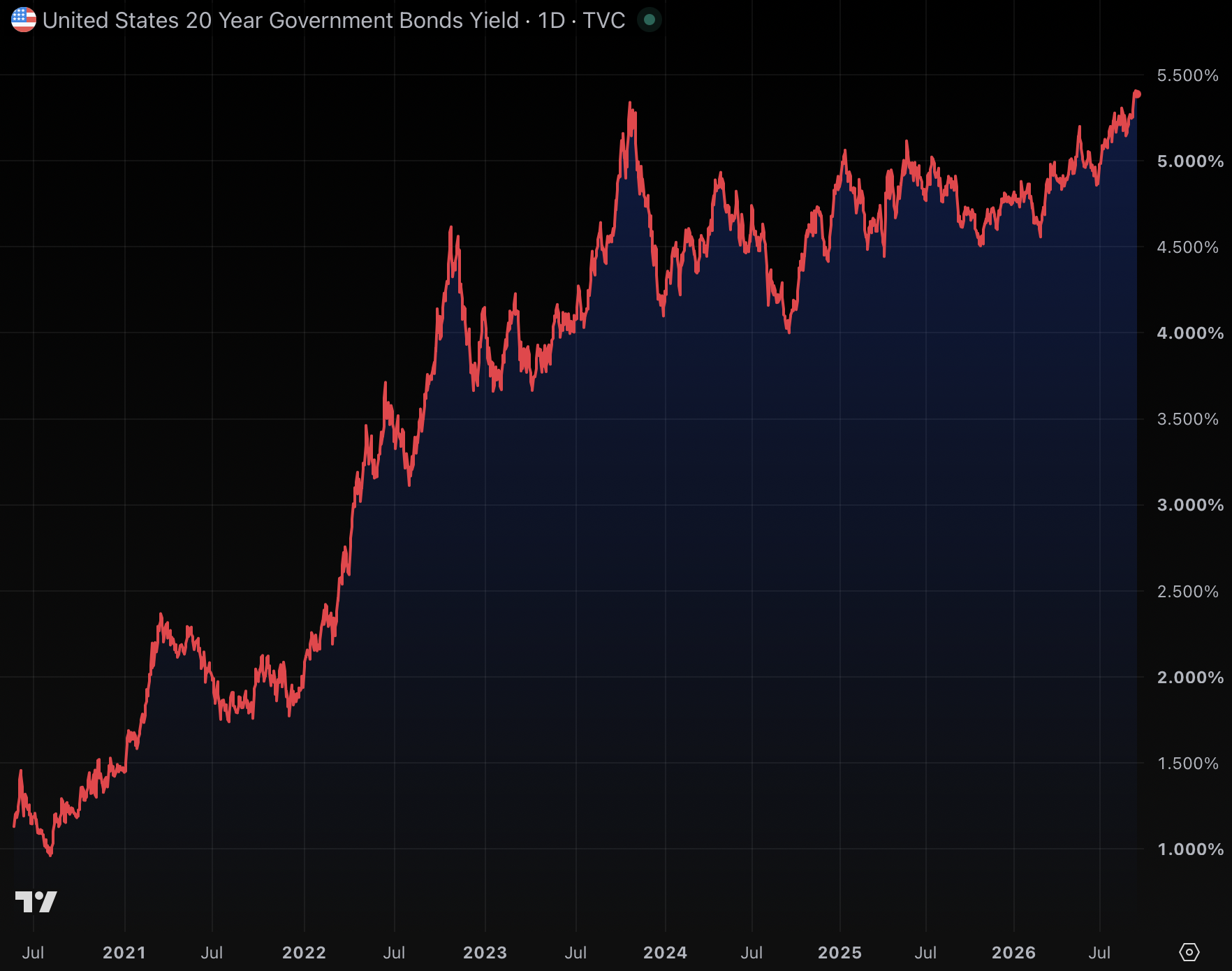
On a bit of a technicality, the government avoided paying 5.42% interest on the bonds, instead paying 5.125% yet selling them below par to mathematically offer 5.42% de facto yield to purchasers.
Worse, the particular type of investors Washington needs for offloading its sovereign debt — foreign investors — bought the lowest percentage ever of that $13 billion auction.
Record cost to borrow money for 20 years
Bond auctions aren’t complicated. The US Treasury offers IOUs, and buyers around the world name the yield they’ll accept.
At each live auction, yield-to-maturity is focus. The bond’s effective interest rate is the cost of capital for the US government.
The higher the yield, the less creditworthy the US government is in the opinion of bond traders. With $40.1 trillion and rising of outstanding debt that costs taxpayers over $1.1 trillion per year in interest payments, US debt-to-GDP at 123% is a growing concern for bond investors.
Tuesday’s sale was terrible on three counts.
The rate was the start of the disaster. Twenty-year bonds traded around 5.40% minutes before the sale and cleared at 5.42%. In other words, Washington paid more than the open market was charging at the end, just to find sufficient takers to fully clear the auction.
Traders call that additional 0.02% a two basis point “tail,” and it was the worst tail for any 20-year auction since 2024.
Second, the crowd mix was terrible. So-called “indirect bidders” are Treasury auction participants like foreign central banks and overseas buyers.
Like any sovereign, the US wants to sell as much of its debt to buyers abroad as possible.
Instead, indirect bidders took just 52.5% of yesterday’s auction, lower than August’s 62.9% and the lowest percentage on record for any 20-year Treasury auction since the 1980s besides a small, idiosyncratic $25 million special auction in 2021.
Third, the liquidity or depth of demand was thin as well, as measured by the bid-to-cover ratio. Specifically, bids covered yesterday’s bond sale 2.57 times, below the 2.65 average of the previous six auctions.
Read more: How the bond market helped push BTC to all-time high
Did Scott Bessent expect no one would notice?
Given the historically bearish turnout for yesterday’s Treasuries sale, anyone could rightly be curious as to why Secretary Scott Bessent had so little foresight when boasting about the supposed strength of US creditworthiness during yesterday’s Congressional testimony.
To be fair, despite the immediate embarassment, Bessent actually had a real basis for his positive remarks for a few hours prior to 1pm.
Indeed, last week’s 10-year and 30-year bond sales went smoothly.
Indirect bidders took a healthy 79.5% of the $22 billion 30-year bond sale on September 10, for example. That success was true and fleetingly newsworthy.
Questioned at a US House hearing, Bessent leaned in.
“We then proceeded to have the two most successful treasury auctions that we’ve had in 20 years, and the US bond market, since President Trump has come in, has been the best performing bond market in the developed world.”
Connecticut Democrat Jim Himes wasn’t buying it. “Wait, wait, wait. The 10-year went up by 20 basis points. How can you say it was successful?” he asked, hours before the 20-year auction supplied an even worse data point.
Treasury yields provide the floor under which banks price mortgage and corporate borrowing rates. The household version, i.e. the average 30-year mortgage rate in the US, costs homeowners an alarming 6.76%.
Interest expense on the national debt now costs more than $1.1 trillion a year and is the US government’s second biggest expense behind Social Security payments.
The next 20-year US bond auction is scheduled for October 21, 2026.
Got a tip? Send us an email securely via Protos Leaks. For more informed news and investigations, follow us on X, Bluesky, and Google News, or subscribe to our YouTube channel.
The post US 20-year bond auction just had its worst showing ever appeared first on Protos.
Source: Protos