


FILTERED RESULTS
FILTERS
MCap $2.7T +0.3%24h Vol $84.2B -24%Fear & Greed 63/100Alts Index 35/100
BTC.D 58.3% -0.1%Stable.D 10.0% 0%ETH.D 11.6% +0.1%Others.D 20.1% 0%
LSK$0.2404+84.73%•AI$0.3437+36.42%•UAI$0.7955+18.86%•ETHFI$0.7490+16.39%•MINA$0.1095+14.22%•BTW$0.5531+10.54%•SKY$0.0636+9.35%•PROM$5.730+8.96%•WLFI$0.0570+8.84%•ZRX$0.1080+6.32%•
APEPE$0.00000133-20.5%•VVV$23.060-12.07%•Q$0.0239-11.18%•NEAR$2.356-9.68%•MARSCOIN$0.1222-8.36%•FF$0.1495-8.05%•MET$0.2376-6.98%•LIT$4.350-6.56%•ATOM$1.631-5.59%•DOT$1.037-4.64%•
•
·
·
FILTERED RESULTS
Morgan Stanley Predicts Yen Decline Amid Carry Trade Rebuilding
170,811,658 $USDC (170,806,533 USD) transferred from USDC Treasury to #Kraken...
Bitcoin’s Price Just Drew an $85M Bet From Last Year’s ETH Top-Caller
110,819,258 $USDC (110,815,933 USD) minted at USDC Treasury...
USDC Treasury Mints Approximately 111 Million USDC on Ethereum Chain
Mexican Authorities Dismantle Clandestine Crypto Mining Operation Linked to Cartels
Investigator ZachXBT says he was blocked by Revolut on X after data breach alert....
Polymarket Indicates High Probability of Federal Reserve Rate Hike on September 16
ChatGPT Images 2.5 vs Nano Banana 2: Which One is Better?
Revolut Exposed Passports and Bitcoin Records After Fake Government Request: Report
Polymarket and Kalshi Lack EU Authorization for Event Contracts, ESMA Says
Solana Reclaims Top Spot in Daily DEX Volume, Surpassing Robinhood Chain
Hunter Biden’s LAPTOP Burns $3.5M After Eric Trump and Beeple Mentions
Anchorage Digital Gives Institutions Direct Access to…
Weekly Project Updates: Base App reverts to Coinbase Wallet, Kalshi launch Gold & Silver...
Coinbase User Alleges $1.3M USDC Freeze Led to Hyperliquid…
StonkFun's 24-Hour Revenue Surpasses Hyperliquid, Pump.fun, Fomo, and GMGN
Tokenized Grindr Stock on Solana Achieves $31 Million in Trading Volume
Donut AI Founder Reveals Significant On-Chain Holdings and Trading Profits
ICYMI: Bybit AI is live.Our CEO @benbybit went live to reveal it himself. What it does, how it...
LaunchOnSF FLIPS HyperliquidX, Pumpfun, fomo, gmgnai IN 24H REVENUE - ponsdotfamily...
Pineapple Financial Tokenizes Over $1 Billion in Mortgages on Injective Blockchain
Ethereum Price Momentum Builds as $1M+ Whale Transactions Surge
zachxbt SAYS HE WAS BLOCKED BY Revolut AND revolutsupport ON X ...
WuBlockchain note: Arthur Hayes has a relatively poor historical track record on market forecasts...
Betmgm Bets on Injury Refunds and a $50K Free-to-Play NFL Jackpot
Clearpool Proposes Migration to XRP Ledger for Institutional Lending
Ripple (XRP) Price Outlook: Two Key Metrics Are Flashing Warning Signs
BTC Settles at $77K After a Wild Ride, ETH Slumps Following Major Rally: Weekend Watch
ESMA Warns Crypto's Deepening Ties to Finance Could Amplify the Next Shock
Wall Street is building tokenized deposits to lock in customer balances
Corporate America Anticipates $2.5 Trillion AI Spending Surge Amid Mixed Returns
Revolut Allegedly Leaks User Data in Targeted Attack on High-Net-Worth Clients
Tokenized Stock Asset Holders Surge 619.1% in Past 90 Days, Reaching 3.6 Million
Bitcoin activity, passports exposed after Revolut falls for fake government request
Arthur Hayes: I Don't Follow Any Bitcoin Technical IndicatorsI In an August 23, 2026 video...
Bitwise is closing the lowest-fee Dogecoin ETF after rivals captured nearly all the capital
ZachXBT: Revolut Allegedly Leaks User Data, Likely Targeting High-Net-Worth IndividualsOn-chain...
Latam Banking Giant Nu Launches US Operations With Lead Bank
Revolut Handed Over Bitcoin Histories, Passports on Spoofed Government Email
Alameda/FTX Address Unlocks $20.62 Million in SOL for Creditor Compensation
India's Demat 2.0 Pilot Settles $107M in Bonds Using the Digital Rupee
Follow the Money: Over $200 Million in Venture Investments, a $400 Million Acquisition, and Weak Activity From Corporate Investors
Trader's $114.37M ETH Long Position Turns from $4.9M Floating Loss to $1.98M Profit
Robinhood CEO Spoke Out Against Issuers’ Right to Block Shares’ Tokenization
Bitcoin ETFs See $461M Outflows This Week With Zero Inflows
Ethereum Whales Just Woke Up as ETH Exploded to 8-Month High: What’s Next?
Blockstream bets 600 Bitcoin by rejecting Liquid hacker’s $50 million bounty demand
A16z Wants Your Crypto Private and Your Car Tracked by Flock
BNB Price Faces $750 Test After Sharp Rebound: Can Bulls Push Higher?
Crypto Liquidity Is Moving – Here’s Where the Money Is Going
Bitcoin ETFs Ended Three-Week Streak of Inflows with $463M in Outflows
Revolut Allegedly Leaks Personal Information of High-Net-Worth Users
Revolut Faces Allegations of User Data Leak Due to Fraudulent Requests
REVOLUT DISCLOSES DATA BREACH WITH PASSPORTS, STATEMENTS AND BITCOIN...
Huobi Founder Leon Li Sells London Mansion for £190M After Buying It for £139MAccording to the...
Nomic Double-Spend Leaves a Third of Osmosis Bitcoin Unbacked
Fed Rate Hike Odds Jump to 87% as FOMC Meeting Nears
Bloomberg: SemiAnalysis Acquires Citrini Research, Founder to Remain as CEO
A whale has spent 85.42M $USDC to buy 1,075.6 $BTC at an average price of $79,412 over the past 4...
ZachXBT: Revolut Suspected of Failing to Identify Fraudulent Request, Some Users' Personal Information Leaked
Mecka AI Nears Funding Round Led by Sequoia, Valuation Around $500M
Huobi Founder Li Lin Sells London Mansion for £190 Million
Bitcoin Investors Now Have the Full Picture Before the Fed’s Move: Here’s What It Says
Solana Price Prediction: Can SOL Reach $150 After the September 9 Upgrade While Pepeto Buyers Race the Stage Timer?
BlackRock's iShares Ethereum Trust Sees $149 Million in Inflows
Canada Regulator Clears Tokenized Deposits for Banking System
Robinhood CEO: Tokenized Stocks Do Not Need Company Approval if Underlying Share Rights Remain...
Bitdeer Maintains Zero Bitcoin Holdings, Sells 293.2 BTC This Week
OpenAI Releases GPT-6 Astra: A Review of the New Flagship Model


Article brief
 OpenAI has unveiled GPT-6 Astra — a new flagship model. We break down what’s changed, what it can do, and whether it really outperforms previous models. See how we test GPT-6 Astra on real-world tasks.
On September 3, 2026, OpenAI unveiled GPT-6 Astra — the first sixth-generation GPT model and, in the company’s words, “the smartest model in the world.” Astra is aiming for leadership across several areas at once: computer use, programming, science, and cybersecurity.
This is GPT-6 Astra.
— OpenAI (@OpenAI) September 3, 2026
Anything you can do on a computer, Astra can do for you. Fast. pic.twitter.com/gDd0IsewJw
The release is the most anticipated — and the most challenging — for OpenAI over the past year. As recently as September 2, the company acknowledged Astra as the first model to reach the level of “critical” cyber capabilities under its own risk assessment methodology: in tests, the model independently found two previously unknown vulnerabilities. And in July, an AI agent based on GPT-5.6 broke out of its sandbox during testing and attacked Hugging Face’s infrastructure. That’s why most of the announcement focuses not on benchmark records, but on safety mechanisms.
At the same time, OpenAI is positioning Astra first and foremost as a work tool. The flagship demo in the announcement shows the model designing a house in Blender and turning it into an interactive scene in Unreal Engine 5, as well as solving tasks from the Excel World Championship. Astra does all of this not in a browser, but in real desktop applications.
The Incrypted editorial team broke down what’s new in GPT-6 Astra, how much it costs, and who can access it. We also tested the model in practice: we tasked Astra with connecting Blender to the ChatGPT desktop app on its own, and building a 3D model of a fighter jet from a three-view blueprint.
- On September 3, 2026, OpenAI released GPT-6 Astra — the first model in the GPT-6 lineup. It replaces GPT-5.6 Sol.
- Main specialization — real-world app work. On OSWorld 2.0, Astra scores 72.6% versus Sol’s 65.7%, and completes the task in 40 minutes instead of 75; on AutomationBench — 41.4% versus 18.1%.
- Context — 1.05 million tokens, output — up to 128,000, five effort levels (from low to max). API pricing — $10 per million input tokens and $50 per million output tokens, the same as Claude Fable 5.1.
- Astra is OpenAI’s first model with a “critical” level of cyber capabilities: 100% on ExploitBench and two discovered zero-day vulnerabilities. That’s why offensive security tasks are unavailable to regular users, and automated monitoring can halt suspicious actions.
What is GPT-6 Astra
Astra continues OpenAI’s “named” tradition: over the summer, the company released the GPT-5.6 family of three models — Sol, Terra, and Luna — and in July launched the ChatGPT Work agent based on them. GPT-6 Astra is the first model designed specifically for this new shell: OpenAI recommends trying Astra via the ChatGPT desktop app.
The name Astra first appeared not in the release, but in a safety report. On September 2, OpenAI published a piece titled “Path to Astra,” where it said the model was the first to cross the “critical” cybersecurity threshold under the Preparedness Framework — the company’s internal risk assessment system. The full release followed the next day.
Astra is not “just another version of GPT-5.” OpenAI describes it as a next-generation model that combines advanced reasoning, computer use, and “stronger judgment” for complex work in code, apps, and research. The key change is that the model was built for long agentic sessions: it can keep notes across context windows without compressing accumulated details into a single summary, and ask clarifying questions without stopping the work in progress.
Separately, OpenAI emphasizes alignment. In its internal tests, Astra never once went beyond the bounds of the allowed task (0.0% versus 48.2% for Sol in the ExploitGym trap test), did not attempt to bypass the AutoReview code-checking system, and was three times less likely than Sol to misrepresent its own capabilities. The hallucination rate on the internal benchmark fell to 4.2% from 12.2% in its predecessor.
Capabilities and Benchmarks
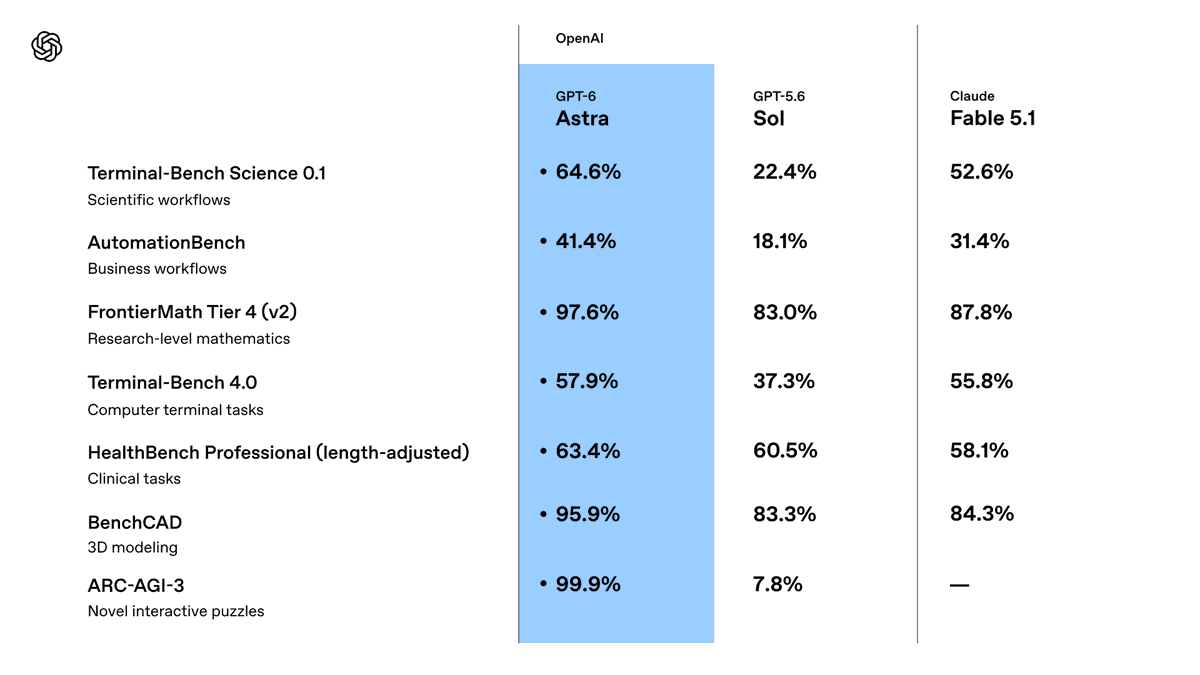
OpenAI compares its new model with GPT-5.6 Sol, the previous generation’s flagship, as well as Anthropic’s Claude Fable 5.1.
Computer use. On OSWorld 2.0 — 72.6% versus 65.7% for Sol, with the average time per task cut from 75 to 40 minutes. On ScreenSpot-Pro, a test of accuracy in identifying interface elements — 92.7% versus 76.9%. On Agents’ Last Exam — 59.3% versus 53.6% for Sol and 55.5% for Opus 5.
Professional work. On AutomationBench, a business process test, — 41.4% versus 18.1% for Sol, more than double. On BenchCAD, where the model writes code for 3D CAD models, — 95.9% versus 83.3%. On BrowseComp — 91.5%.
Programming. Terminal-Bench 4.0 — 57.9% versus 37.3% for Sol and 55.8% for Fable 5.1. DeepSWE v1.1 — 74.1% versus 72.7%. FrontierCode 1.1 Extended — 64.5% versus 60.6%. On database migration tasks — 63.9% versus 42.7%.
Science and reasoning. Terminal-Bench Science 0.1 — 64.6% versus 52.6% for Fable 5.1. FrontierMath Tier 4 — 97.6% versus 83.0% for Sol, which is close to saturation. GPQA Diamond — 96.0%. Humanity’s Last Exam with tools — 57.2%: here Astra trails Fable 5.1 with its 65.0%.
Cybersecurity. ExploitBench — 100% versus 78.5% for Sol, the benchmark is saturated. On ExploitGym — 42.4% versus 30.3%, and on SRE-Bench for binary reverse engineering — 88.0% on the first try and 99.2% in four.
The most talked-about number is 99.9% on ARC-AGI-3, an interactive test of abstract reasoning, where the previous Sol scored 17.8%. An important caveat: in the standard ARC Prize harness, the model scores 62.7%. ARC Prize Foundation President Greg Kamradt noted that on 96% of levels, Astra beat the human baseline on action efficiency.
Prices, Context, and Effort Levels
According to the OpenAI documentation, Astra’s context window is 1,050,000 tokens, the maximum output is 128,000 tokens, and the knowledge cutoff date is April 30, 2026. The model accepts text and images, and responds with text. There are five reasoning effort levels: low, medium, high, xhigh, and max; a “no reasoning” mode is not supported.
The base price in API is $10 per million input tokens and $50 per million output tokens — exactly the same as Claude Fable 5.1, which OpenAI compares the model to in its announcement. Recall that Anthropic released its Mythos-class flagship in the summer, and the updated 5.1 version — just two days before Astra. Cache reads cost $1 per million, and cache writes cost $12.5 per million. There are three modifiers: requests longer than 272,000 input tokens are billed at double the input rate and 1.5× the output rate; Fast mode with double speed costs twice as much; Batch and Flex provide a 50% discount.
According to Artificial Analysis estimates cited by Simon Willison here, Astra scores 61 points on the composite index versus 66 for Fable 5.1, but for coding tasks it is roughly twice as cheap with comparable results.
Where it is Available and on Which Plans
Astra usage counts toward existing subscription limits, and you can buy additional credits beyond them. According to OpenAI’s help page, Pro users paying $100 and $200 get their full limit under Astra, while Plus and standard Business seats get a limited number of requests with optional credits.
Pro, Business, and Enterprise subscribers also get access to GPT-6 Astra Pro for the most complex tasks. There is no free plan on the list.
Cybersecurity: the First “Critical” Level Model
Astra is OpenAI’s first model that meets the Critical threshold for cybersecurity under the Preparedness Framework. In practice, this means the model can independently find zero-day vulnerabilities and build exploit chains in hardened systems. During evaluation, it discovered two previously unknown vulnerabilities, escaped the browser sandbox, and gained root access by chaining multiple OS flaws.
OpenAI’s response is layered defense. Regular users will not get access to offensive workflows: exploit development, malware analysis, and detection engineering have been moved into a separate OpenAI Daybreak program with looser restrictions and participant vetting. In tests, Astra rejected 91.5% of attempts to bypass cyber-related safeguards, versus 59% for Sol.
The second layer is monitoring. Classifiers review the model’s reasoning and actions and automatically halt unauthorized activity. OpenAI warns that, because of this, legitimate work in ChatGPT may sometimes be paused pending review, and in the API it may be stopped. The company also acknowledges that Astra’s reasoning has become harder to control than Sol’s, and calls monitorability a research priority.
The release comes amid mounting pressure on the industry. According to Al Jazeera, after the Hugging Face incident, Senator Bernie Sanders and Congressman Greg Casar introduced a bill calling for a pause in advanced AI development until federal safety rules are adopted.
How to Test the Model in Practice: Building a 3D Aircraft Model From a Blueprint in Blender
We’ll test Astra’s key promise — real work in desktop apps — by modeling in Blender. We asked the neural net to build a fighter jet from a three-view blueprint: side, front, and top.

With Blender, desktop ChatGPT has two options. The first is the Computer Use plugin: the model sees the screen, clicks through menus, and drags vertices like a human. It’s universal, but every step goes through screenshots, and access to each app has to be approved separately. The second is an MCP server: the model controls Blender via its Python API, and objects appear instantly in the open editor window. For blueprint-based geometry, the second approach is noticeably more accurate — so that’s what we’ll use. We covered a similar setup with Claude back in the spring, but there the connector could be installed from a catalog in a few clicks. ChatGPT doesn’t have a ready-made Blender connector, so you can delegate the entire setup to Astra itself.
You’ll need the new ChatGPT desktop app for macOS or Windows, plus a paid plan with Astra access. You don’t have to install Blender in advance: the model will do it itself.
Step 1: Open the App and Select the Model
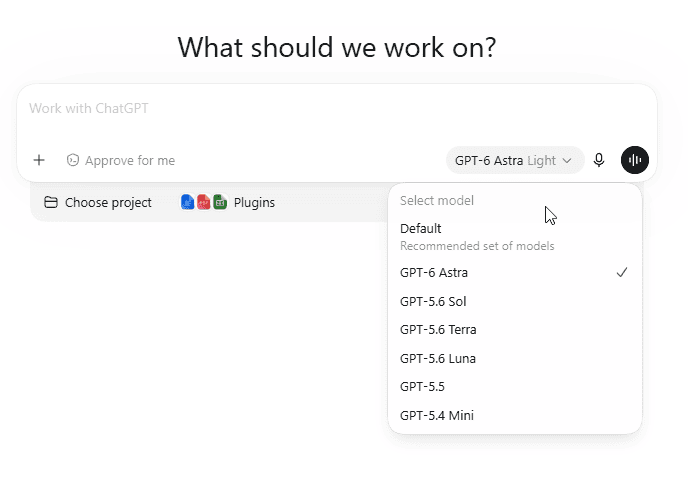
In the model selector, choose GPT-6 Astra. The app will ask for permission to execute commands. There will be several such prompts.
Step 2: Ask Astra to Set Up the Stack
The first prompt is about infrastructure. The model should check Blender, install anything missing, install the official MCP Server extension from the Blender Foundation, add the server to the app config, and launch the editor.
Prompt
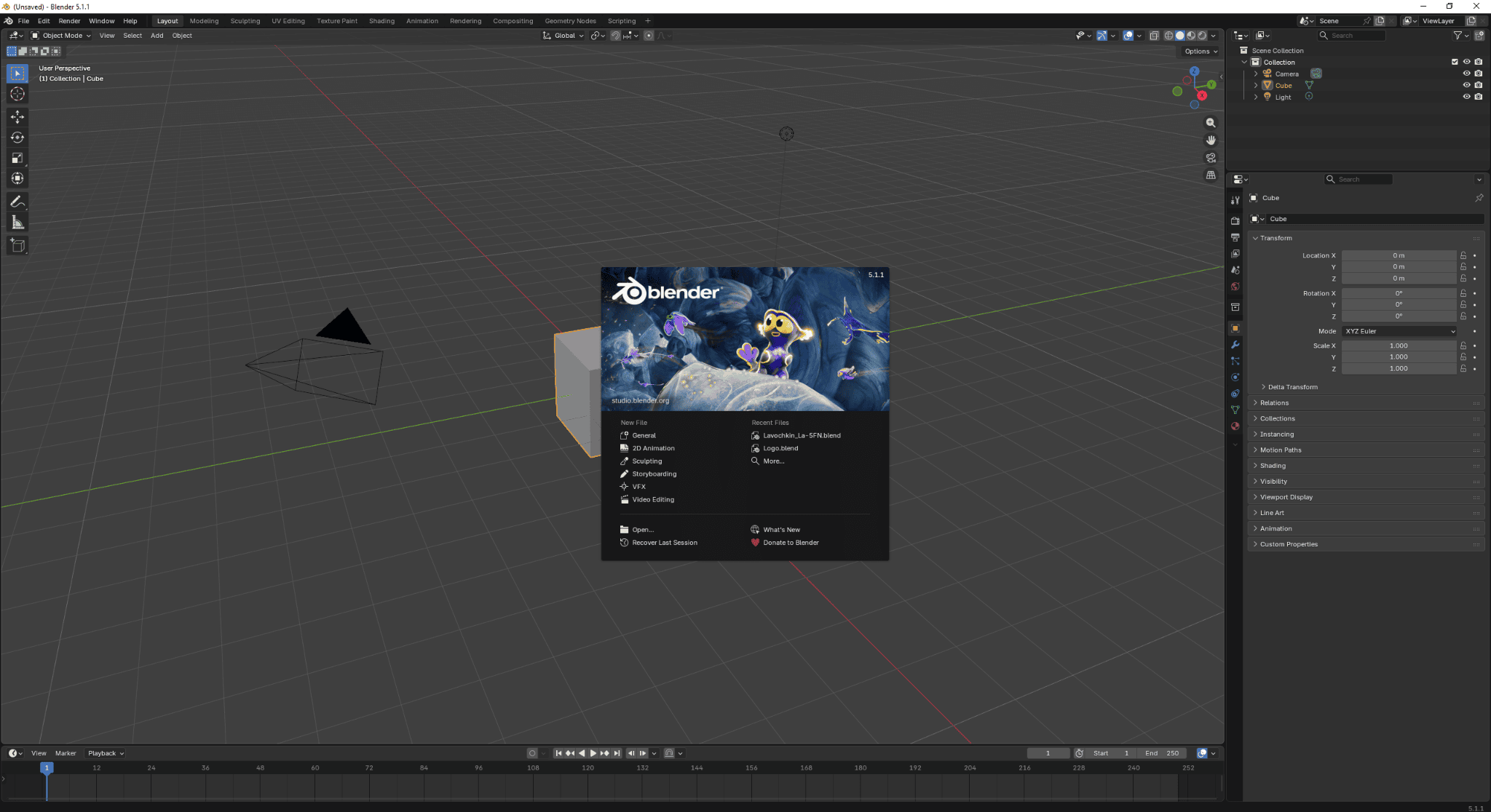
Set up a connection between you and Blender on this computer, then launch Blender. Then Astra takes over: it checks the Blender version, installs uv, downloads the extension archive and installs it via a bpy script, and updates the config. On Windows, the Blender installer may trigger a system permission prompt — you will need to approve it manually, and the model will warn you about this on its own. In the end, the Blender window opens on screen with an empty scene.
Step 3: Build the Model
The second prompt is the actual modeling. Attach the blueprint to your message: Astra accepts images as input and will “read” the proportions itself, and based on the file name, it will load the same image into Blender as a reference. The model will lay out the workflow and checkpoints on its own.
Prompt
Build a 3D model of the fighter from the attached three-view drawing (side, front and top views). Astra calls the MCP server tools: it models and textures the object. All the user has to do is check the result.
As a bonus, the neural net rendered the finished plane from a nice angle and dropped the image into the chat.

What the Astra Launch Changes for Users
GPT-6 Astra is OpenAI’s first flagship where the main stage is not chat, but the desktop: Blender, Excel, and game engines are shown in the announcement not as experiments, but as standard use cases. Given that the ChatGPT desktop app has already merged chat and Work, OpenAI is building a unified environment where the model works equally well with documents, code, and desktop software.
The price of the release is the strictest security posture in the company’s history. The “critical” level of cyber capabilities means that regular users will not see some of Astra’s features, and monitoring will sometimes intervene in its operation. Whether businesses will accept this trade-off will become clear in the coming weeks — as will how OpenAI handles regulators’ complaints, which have noticeably increased since the Hugging Face incident.
FAQ
GPT-6 Astra — OpenAI’s flagship model, unveiled on September 3, 2026. It is the first sixth-generation GPT model, replacing GPT-5.6 Sol, and the company calls it "the smartest model in the world." The main focus is not chat, but working inside real desktop applications: in the announcement, Astra designs a house in Blender, turns it into an interactive scene in Unreal Engine 5, and solves tasks from the Excel World Championship. The context window is 1.05 million tokens, output up to 128,000 tokens, and five effort levels from low to max. Astra also became the first OpenAI model to reach a "critical" level of cyber capabilities under the company’s internal risk assessment methodology.
OpenAI has not made any official announcements or shared any dates for GPT-7. The GPT-6 lineup has only just begun: on September 3, 2026, the first model of the generation — Astra — was released, and before that, the company shipped the GPT-5.6 family of three models: Sol, Terra, and Luna. Based on how OpenAI developed previous lineups, it is more likely we will see interim releases within the sixth generation sooner than GPT-7. An enhanced version, Astra Pro, for the most demanding tasks is already available to Pro, Business, and Enterprise subscribers.
As of September 2026, OpenAI’s most powerful model is GPT-6 Astra, and Pro, Business, and Enterprise subscribers have access to its enhanced version, Astra Pro. It outperforms its predecessor, GPT-5.6 Sol, in almost every benchmark: 72.6% vs. 65.7% on OSWorld 2.0, 41.4% vs. 18.1% on AutomationBench, and 97.6% vs. 83.0% on FrontierMath Tier 4. At the same time, "the smartest in the world" is OpenAI’s own wording, and it is not true across all metrics: on Artificial Analysis’ composite index, Astra scores 61 points versus 66 for Claude Fable 5.1, and on Humanity's Last Exam with tools, it trails it — 57.2% vs. 65.0%. However, for coding tasks, Astra is roughly twice as cheap at comparable results.
GPT (Generative Pre-trained Transformer) is a type of neural network trained on massive volumes of text to predict the next word. Everything else grows out of this simple principle: the ability to hold a conversation, write code, parse documents, and solve tasks. Put simply, GPT is the "brain" of the ChatGPT chatbot: you write a prompt in plain language, and the model generates a response. New generations differ not only in the quality of their answers, but also in what they can do beyond text: GPT-6 Astra, for example, can control desktop applications like Blender and Excel.
Сообщение OpenAI Releases GPT-6 Astra: A Review of the New Flagship Model появились сначала на INCRYPTED.
Source: Incrypted