


FILTERED RESULTS
FILTERS
MCap $2.6T -3.2%24h Vol $104.7B +15%Fear & Greed 69/100Alts Index 27/100
BTC.D 58.8% +0.2%Stable.D 10.2% +0.3%ETH.D 11.3% -0.2%Others.D 19.7% -0.3%
AKE$0.0273+78.56%•AI$0.3214+35.32%•龙虾$0.1779+19.42%•ARB$0.1508+12.56%•牛来$0.1189+11.99%•USELESS$0.2186+11.88%•FF$0.1394+9.8%•LAPTOP$0.2390+9.71%•H$0.0864+4.99%•AWE$0.0625+3.14%•
UAI$0.3767-28.04%•LSK$0.3218-15.56%•B$0.1969-15.25%•INJ$5.477-13.27%•FIL$0.8167-13.12%•RAIN$0.0132-12.14%•IOTA$0.0389-10.38%•STX$0.2371-10.32%•MET$0.1975-10.28%•RAY$1.248-10.12%•
•
·
·
FILTERED RESULTS
Grayscale Sees US Crypto Policy Maturing Despite CLARITY Setback
Two Robinhood Engineers Charged With Trading on Confidential Crypto Listing InformationThe U.S....
XRP Ledger Batch V1.1 Nears Activation After Security Rebuild
Tonkeeper Rebrands as Keeper and Expands Beyond TON to…
Ethiopia’s Bitcoin Mining Boom Just Ran Into a Water Problem
There were many conductors in the derailment of the crypto industry's Clarity Act
CoinEx quits after 9 years as crypto trading activity concentrates at biggest exchanges
Cipher Digital Receives Conditional ERCOT Classifications for 3.2 GW in Texas
Michael Burry Joins Minerva Investment Management as Senior Advisor
ChatGPT and Crypto: What OpenAI Has Said About Launching a…
Wall Street Bets on Fed Rate Hike: Here's What It Means for Bitcoin, Bonds and Trump
Clarity's Vote Failed. Now What?
BIS Study Highlights Variability in Bitcoin Transaction Estimates
Does Adblock Stop Crypto Mining Scripts? How Browser…
Crypto on the FAFSA: How Digital Asset Holdings Affect…
Senate voted 49-50 against advancing Clarity Act, throwing landmark crypto
Tether Blacklists 15 Tron Wallets Holding $3.31 Million in…
AMD Showcases Local AI Workstations at Autodesk University 2026
Remember Limewire? A Meme Coin Just Bought the Legacy P2P Brand
Coinbase-Backed Crypto Group Warns of Midterms Payback After Clarity Act Fails
Senate Blocks Landmark CLARITY Act, But Ripple’s Garlinghouse Says Crypto’s Endgame Is Still a Win — Here’s Why
Why Tokenless Crypto Projects Wait: The Strategy Behind…
AI Agents Are Gambling With Our (Crypto) Lives
CoinEx Calls Time After Nearly Nine Years as Crypto Market Pressure Mounts
Bitpanda CEO to Depart as Crypto Broker Delays Frankfurt IPO
7-day blockchain outage wipes out a full week of staking rewards after emergency aelf shutdown
XRP News: Ripple CEO Brad Garlinghouse Vows Post-Mortem After CLARITY Act Defeat
U.S. Senate Rejects CLARITY Act Amidst Controversy Over Trump Family's Crypto Profits
Crypto stocks slide after CLARITY Act fails to advance in Senate
CLARITY Act Isn’t Dead, but Washington Is Running Out of Calendar
Grove Basin Launches Noncustodial Credit Facility for Instant Stablecoin Liquidity
0x Critiques Uniswap v4 Hooks, Uniswap Founder Responds
Senate Blocks Key Digital Asset Bill, Leading to Decline in Crypto Stocks
The U.S. Justice Department alleges two Chinese companies used Binance accounts to move...
Zenith Joins DTC Digital Assets Working Group on Tokenization
Bitget Wallet Users Gain Access to 1,700 Tokenized US Stocks
Top Trending Coins (Today) 1. FIRO 2. TRUMP 3. BTC 4. HYPE 5. PENGU 6. XRP 7. STONK 8. PONS 9. LIT ...
OpenAI's Brockman Says Safety Concerns Have Already Slowed Its Most Advanced AI Work
Crypto stocks sink after Senate rejects Clarity Act
Clarity Act Fails to Advance in U.S. Congress Amidst Political Divisions
The Weekly Hill Update - September 2026
Bitcoin’s Price Plunges to $75,000 as Senate Votes Against Advancing Crypto CLARITY Act
Hyperliquid’s $319 Target Hinges on Token Dilution: Analyst
Major Bitcoin Core update changes default wallet protocols, risking temporary disruption across popular apps
Trump ethics fight sinks CLARITY Act in dramatic Senate defeat
Bitcoin Price Crashed Below $75K After CLARITY Act Failed to Pass in the Senate
OranjeBTC Launches First Bitcoin-Backed Digital Credit ETF on Brazil's B3 Exchange
The U.S. Senate Failed to Advance the CLARITY Act, Ending…
Binance's AI Prevents $4.6B Potential Losses in Real-Time Risk Ops
JPMorgan's Petno says the firm does not see significant institutional demand for...
Dense vs. MoE Models: Key Tradeoffs Developers Must Know
Tokenized RWAs Hit $46.7B as Ethereum Holds Nearly Half the Market
105,148 $ETH (252,538,117 USD) transferred from unknown wallet to #Coinbase...
Bitcoin Drops the Most Since June After US Senate Blocks Bill
NVIDIA DSX Boosts AI Factory Efficiency with 24% Token Gain
NVIDIA Showcases AI Factory Efficiency Gains with Vera Rubin Platform
U.S. Senate Fails to Advance CLARITY Act as Cloture Vote Falls Short of 60-Vote ThresholdJust In:...
CLARITY Act Fails in Senate as Cloture Vote Falls Short of 60 Votes
TD Cowen Sees 60% Chance Clarity Act Cloture Vote Fails Today
Crypto Market Today Falls As Senate Fails To Advance CLARITY Act
Bitcoin Experiences Volatile Trading as Price Dips Below $75,000
Crypto Reacts: Bitcoin Slides as Clarity Act Fails to Clear Senate Vote
Treasury Secretary Scott Bessent Addresses Congress on International Financial System
NVIDIA NVLink 6 Boosts AI Factory Resiliency with Multi-Layer Approach
Robinhood Employees Allegedly Profited From Crypto…
You can check it out here:
Mastercard Just Added Cardano to its $9.2 Trillion Payment Network — Could This Be the Catalyst That Sends ADA Parabolic?
Polymarket unveils Midterm Hub as it approaches $14.5B in volumes this year for Political
Google Launches Gemini 3.8 Live Models for Real-Time AI Dialogue
Aave V4 proposal would put DAO funds first in line to absorb lending losses


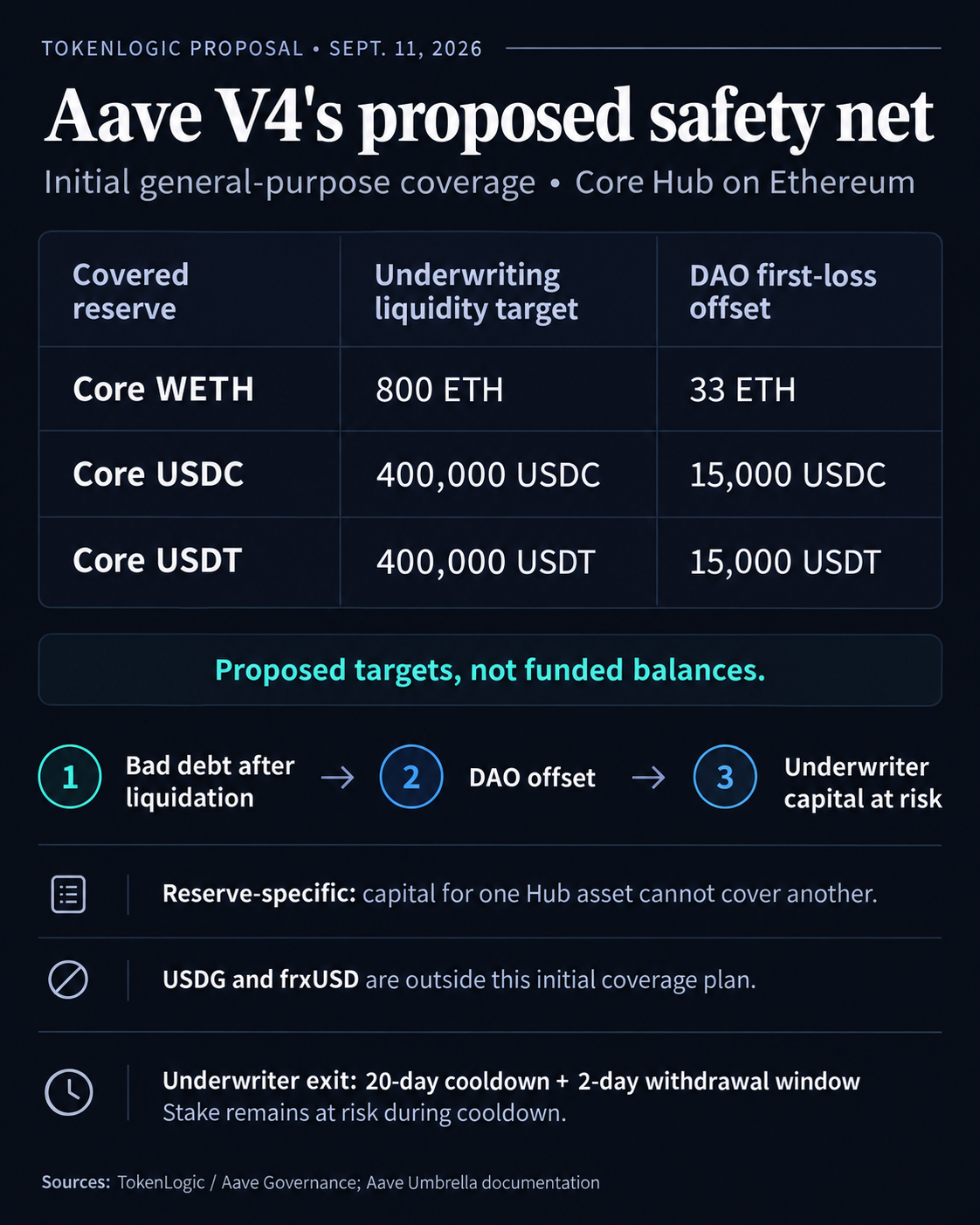
Aave V4 lenders supplying wrapped Ether (WETH), USDC or USDT to its Core liquidity Hub on Ethereum would receive a bad-debt backstop under a Sept. 11 proposal from TokenLogic. The Umbrella plan would put Aave’s DAO first in absorbing losses, followed by volunteer underwriters, while limiting this initial coverage to those three lending markets.
The proposed underwriting targets are 800 ETH for Core WETH, 400,000 USDC for Core USDC and 400,000 USDT for Core USDT. TokenLogic sized them for six to eight weeks of expected loan growth. They are targets for a proposed configuration, not balances already committed to protecting lenders.
For suppliers, the boundary is the specific reserve, or asset pool, receiving their deposit. Coverage for Core USDC would not extend to USDC supplied to another Hub, even though the token is the same. Capital allocated to one Hub asset cannot clear another reserve’s deficit.
Who would absorb losses?
Bad debt arises when liquidation exhausts a borrower’s collateral but leaves debt unpaid. Under the proposed framework, Aave’s DAO would absorb an initial layer through “deficit offsets”: 33 ETH for Core WETH, 15,000 USDC for Core USDC and 15,000 USDT for Core USDT.
Umbrella underwriters could lose their committed capital to cover deficits beyond that layer. Their funds would keep earning supply yield until used, with coverage implemented by burning supplied Hub shares. Additional rewards compensate participants for accepting that loss risk.
Eligibility for that coverage would include all borrowing from each protected reserve. That includes loans originated through Spokes, the components where debt is created, whose collateral sits in other Hubs. Those credit lines still expose the Core reserve supplying the borrowed asset.
Underwriters would also face a delay when leaving. Each proposed market specifies a 20-day cooldown followed by a two-day withdrawal window. Aave’s withdrawal guidance says participants who miss the window must activate another cooldown and wait a further 20 days.
Starting that exit process does not remove the risk: Aave’s Umbrella documentation says staked assets remain exposed to slashing during cooldown while continuing to earn rewards. The extra yield therefore comes with both potential capital loss and restricted access to funds.
TokenLogic does not recommend initial general-purpose coverage for USDG or frxUSD. It cites uncertainty over incentive-sensitive lending activity and the ability to attract underwriters who transfer risk away from existing suppliers. For frxUSD, it highlights a concentrated, issuer-linked supplier base.
The assessment also leaves other Hubs’ reserves outside the initial plan, for varying reasons including limited incremental protection and narrow supplier bases. These exclusions do not mean the loans lack collateral or that losses are imminent.
TokenLogic proposes monitoring conditions after activation and reassessing the framework after three months, with excluded markets reconsidered as lending activity matures and supplier bases diversify.
Source: CryptoSlate