


FILTERED RESULTS
FILTERS
MCap $2.7T +2.4%24h Vol $70.2B +32%Fear & Greed 57/100Alts Index 29/100
BTC.D 58.4% -0.6%Stable.D 9.8% -0.3%ETH.D 11.3% -0.3%Others.D 20.5% +1.2%
BR$0.5024+93.84%•CAP$0.0718+54.57%•ZCAT$0.1092+13.63%•UB$0.1360+13.62%•FIL$1.020+12.99%•B$0.2293+10.86%•NPC$0.0220+9.53%•LIT$4.436+8.71%•BTW$0.6994+8.2%•ANTFUN$0.0907+7.74%•
LSK$0.4166-51.77%•STONK$0.1954-25.23%•MINA$0.0802-19.17%•MARSCOIN$0.0927-14.15%•牛来$0.1059-13.02%•FF$0.1266-12.65%•MET$0.2141-12.46%•GLM$0.1175-10.81%•ATH$0.00452789-7.14%•SKR$0.0177-6.14%•
•
·
·
FILTERED RESULTS
Don’t let perfect be the enemy of Clarity
U.S. 10-year Treasury yield hits 5%, its highest level since October...
DeFi Development Corp. said its treasury holdings have grown by 55,491 SOL to
Swiss Bitcoin Pay Temporarily Shuts Down Servers Due to Malicious Intrusion
Here is the revised Clarity Act ethics provision Donald Trump has agreed to
18 State AGs Push Back on CLARITY Act Ahead of Key Senate Vote New York Attorney General Letitia...
Stablecoin Supply Declines by $414 Million Amid Rising DEX Trading Volumes
Centrifuge to Release Report on Structural Differences in Tokenized Money Market Funds
US Senate Schedules Cloture Vote on Clarity Act for Wednesday at 2:15 AM Beijing Time
UAE Moves National ID System to Avalanche Blockchain (AVAX)
Sky Ecosystem Completes First Token Burn, Reducing Supply by 2.86 Million SKY Tokens
Binance and Robinhood Collaborate to Expand Ecosystem Integration
Lisk Initiates Burn of 100 Million LSK Tokens to Reduce Total Supply
Trump says his administration has stopped AI figures like Anthropic’s...
U.S. Senate to Vote on Clarity Act for Cryptocurrency Regulation
Cathie Wood (Sister Wood) Adds $27.9 Million in Meta Stock
Swiss Bitcoin Pay Shuts Down Servers Following Suspected Data Breach
Crypto Rises as Long-Shot US Bill Gains Better Odds of Passage
NVIDIA Expands CUDA-Q Platform With Fault-Tolerant Quantum Tools
Ether, XRP and Solana Record Weekly Gains as Bitcoin ETFs Lose $463M
From Tokenless to TGE: How Crypto Projects Time Their Token…
US-listed cryptocurrency concept stocks strengthen, Bullish up over 8%
Kaiko extends Series B funding round to $110 million with S&P Global, BNP Paribas
Nike Downgraded While Affirm Receives Upgrade Amid Analyst Calls
New York AG Letitia James led a letter, along with 17 other attorneys general, telling
MetaMask Adds New Wallet Protections Against Crypto Scams
Sept 7–Sept 13, 2026 #LookonchainWeeklyReport
The Weekly MA50 Is Holding Bitcoin (BTC) Back – Here Are the Levels to Watch
Strategy Stays on the Sidelines Again but Strive Buys More Bitcoin
Fed data shows hedge funds added $400 billion before Bitcoin’s September rate test
Coinbase Partners with Moov to Enhance Stablecoin Access for Community Banks
Strive slowed its bitcoin buying last week, adding 469 $BTC to bring its holdings to an
Jumper vs. Li.Fi vs. Socket: Cross-Chain Aggregators…
Sept 14 Update:#Bitcoin ETFs:1D NetFlow: -933 $BTC(-$72.67M)7D NetFlow: -5,892...
UAE Integrates Avalanche Blockchain Into National Digital ID Platform
Satsuma Technology Liquidates Bitcoin Holdings, Returns £31.9 Million to Shareholders
Public company insider sells outweighed buys 10-to-1 in August
Symbiosis Recovers 15 Bitcoin After Native Bridge Exploit
S&P Global Leads $110M Kaiko Round Backed by Nasdaq, BNP Paribas and Coinbase
PayPilot Review: Cryptocurrency, a Card, and a Fiat Account in One App
25,474 $ETH (63,826,023 USD) transferred from unknown wallet to #Coinbase...
HYPE price could suffer as Binance takes its revenue: Alice Liu
Kaito Launches Browser Extension for Zero-Knowledge Verification on X
Strategy’s Bitcoin War Chest Sat Still While Saylor Defended STRC
DeFi Development Corp. Increases SOL Holdings and Launches $300 Million Preferred Stock Program
Trump Agrees to 80% of Stricter Ethics Rules Tied to…
Nvidia, Palantir, and Booz Allen to Restrict Use of Anthropic and OpenAI Models
Bitcoin Price Holds $77,650 Going Into a Fed Hike Priced at…
Avalanche Now Powers UAE PASS Digital Vault Used by 12 Million People
Community-Built Explorers Launch for Robinhood Chain
Media: Democrats Are Preparing Large-Scale Investigations into Trump if They Win the Election
What we know about the Revolut customer data leak
etherscan INTRODUCES RobinhoodCrypto CHAIN EXPLORER "ROBINSCAN"...
Bitmine adds $68 million in ether as Tom Lee sees more upside catalysts ahead
Galaxy Digital’s Alex Thorn Flags CLARITY Act’s Missing Criminal Shield for Developers
Wall Street braces for a Monday meltdown – so why is Bitcoin holding near $78,000?
S&P 500 Free Cash Flow Yield Reaches Lowest Level Since Dot-Com Bubble
Key Economic Events to Watch This Week: CLARITY Act, FOMC, Japan CPI
BitMine Expands Ethereum Holdings to Nearly 6 Million
Tom Lee's Bitmine $BMNR acquired 27,180 ethereum:native over past week, bringing its
Former Alameda Research CEO Caroline Ellison Has Joined Manifund
An address suspected of selling $8.4 million worth of ETH
Abraxas Capital now holds over $980M in short positions on Hyperliquid!This includes shorts on...
Abraxas Capital Holds Over $980 Million Short Position on Hyperliquid
BitMine Buys 27,180 ETH, Bringing Holdings to 5.96M ETH BitMine said it acquired 27,180 ETH over...
S&P Global led a strategic investment in crypto data provider Kaiko, extending its
Bitcoin’s Price Refused to Break at $76K, but $79K Won’t Give
Michael Saylor’s Strategy Buys Back $139M in STRC, Skips Bitcoin Purchase
Revolut Hackers Begin Publicly Releasing Files Containing Customer Sensitive Information Including Bitcoin Transaction Records
Another Bitcoin liquidity test arrives with Tuesday’s US tax deadline


Tuesday’s US estimated-tax deadline will shift cash toward the Treasury, testing whether last week’s improvement in bank reserves can hold through the Federal Reserve’s meeting. Bitcoin liquidity could come under pressure if the transfer tightens dollar funding and limits risk-taking before policymakers conclude their September 15–16 meeting.
The IRS calendar sets September 15, 2026 as the third installment deadline for individuals and corporations subject to estimated-tax payments. It falls on the opening day of the Fed meeting, putting a scheduled cash movement alongside the policy decision due the following day.
Bank reserves are balances commercial banks hold at the Fed. They support payments and funding, rather than measuring traders’ available cash. The starting point is stronger than a week earlier. The Fed’s September 10 balance-sheet release showed weekly-average bank reserves rose $96.779 billion to about $2.991 trillion in the week ended September 9. Over the same period, the Treasury General Account, the government’s account at the Fed, fell $84.6 billion to $883.3 billion on a weekly-average basis.
Those are averages, not Wednesday’s snapshot. The separate September 9 levels were about $3.037 trillion for reserves and $843.705 billion for Treasury cash.
How US tax payments could affect Bitcoin liquidity
The accounting mechanism is straightforward: tax payments move balances from commercial banks’ reserve accounts into the Treasury’s account. Treasury spending moves funds back to recipient banks. Other things equal, incoming taxes reduce reserves, while outgoing government payments replenish them.
That can matter for short-term financing, including repo markets where cash is borrowed against securities. The New York Fed’s account of September 2019 describes how a temporary reserve decline, Treasury settlements and a corporate tax date combined with a spike in repo rates. It is a historical example of the mechanism, not evidence that this Tuesday will repeat it.
Several forces can cushion the transfer. In its August 5 refunding statement, Treasury anticipated September reductions in shorter-dated bill auction sizes because of mid-month tax receipts. Less bill borrowing could partly offset cash absorption relative to unchanged issuance. The size of that offset depends on actual borrowing and spending.
The Fed also plans for seasonal reserve demand. Its May 2026 balance-sheet report says reserve-management purchases accommodate fluctuations such as tax dates and adjust to the reserve outlook. The New York Fed describes the Standing Repo Facility as a backstop supplying eligible institutions with temporary cash against securities to limit upward funding pressure.
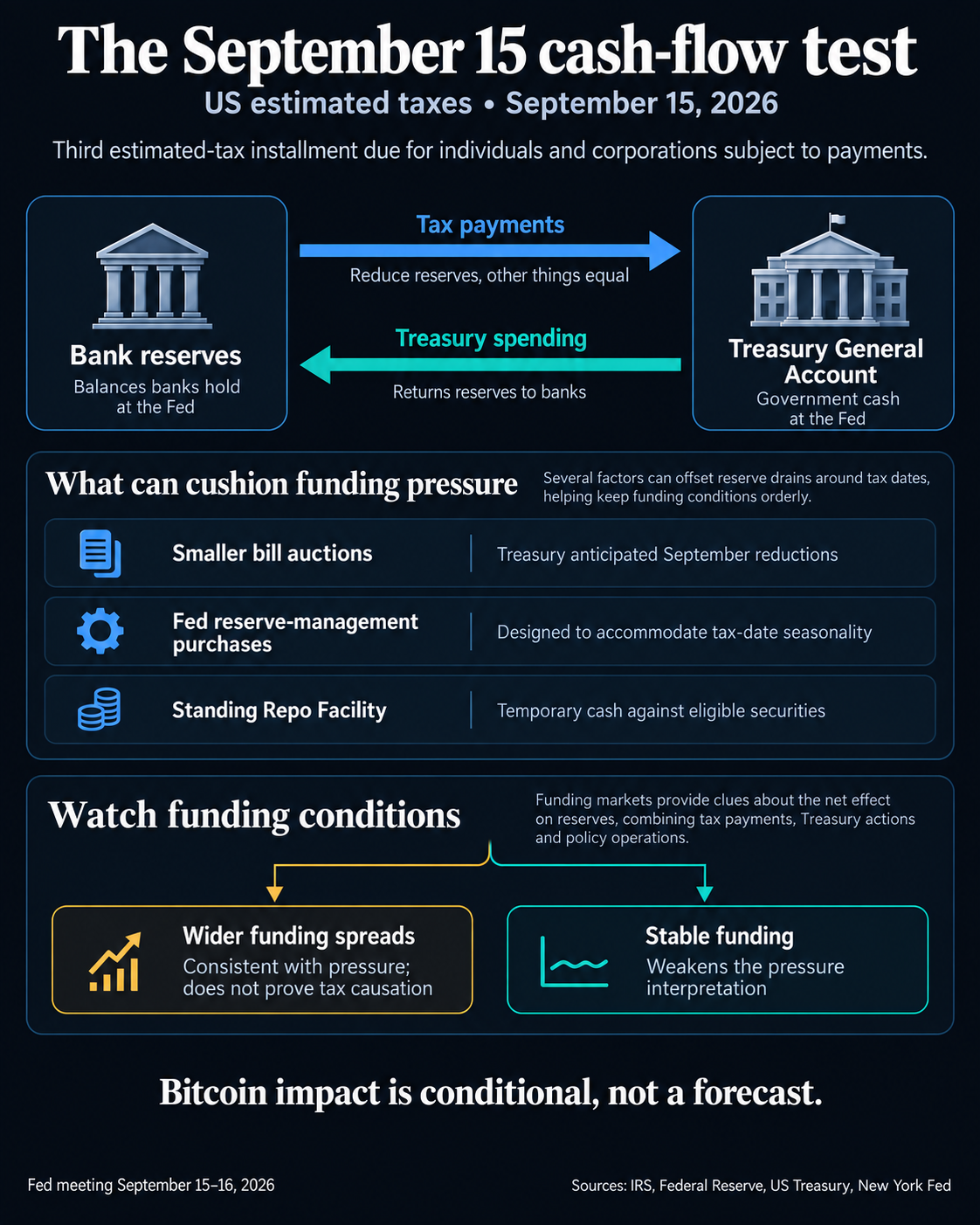
For Bitcoin investors, the possible effect runs through financing conditions and appetite for risk.
BIS research finds that stablecoin market capitalization declines after US monetary tightening. That supports broader sensitivity to monetary conditions, not a measured Bitcoin response to this tax deadline.
The useful signal is therefore whether short-term funding spreads widen relative to Fed-administered rates as taxes settle. Rising spreads would be consistent with funding pressure without proving taxes caused it; stable funding would weaken that interpretation. Tuesday’s calendar creates a test, while spending, bill supply and Fed liquidity tools help determine the result.
Source: CryptoSlate