


FILTERED RESULTS
FILTERS
MCap $2.6T -3.3%24h Vol $104.5B +15%Fear & Greed 69/100Alts Index 27/100
BTC.D 58.6% 0%Stable.D 10.2% +0.3%ETH.D 11.3% -0.2%Others.D 19.9% -0.1%
AKE$0.0273+78.56%•AI$0.3214+35.32%•龙虾$0.1779+19.42%•牛来$0.1189+11.99%•ARB$0.1504+11.93%•LAPTOP$0.2390+9.71%•FF$0.1389+9.59%•USELESS$0.2155+6.27%•H$0.0856+4.07%•RIF$0.0823+2.05%•
UAI$0.3767-28.04%•B$0.1965-16.28%•LSK$0.3287-15.43%•INJ$5.424-14.22%•FIL$0.8127-13.52%•RAY$1.225-12.27%•MET$0.1959-12.16%•RAIN$0.0132-12.14%•STX$0.2350-11.26%•XRP$1.281-11.07%•
•
·
·
FILTERED RESULTS
Ethiopia’s Bitcoin Mining Boom Just Ran Into a Water Problem
There were many conductors in the derailment of the crypto industry's Clarity Act
CoinEx quits after 9 years as crypto trading activity concentrates at biggest exchanges
Cipher Digital Receives Conditional ERCOT Classifications for 3.2 GW in Texas
Michael Burry Joins Minerva Investment Management as Senior Advisor
ChatGPT and Crypto: What OpenAI Has Said About Launching a…
Wall Street Bets on Fed Rate Hike: Here's What It Means for Bitcoin, Bonds and Trump
Clarity's Vote Failed. Now What?
BIS Study Highlights Variability in Bitcoin Transaction Estimates
Does Adblock Stop Crypto Mining Scripts? How Browser…
Crypto on the FAFSA: How Digital Asset Holdings Affect…
Senate voted 49-50 against advancing Clarity Act, throwing landmark crypto
Tether Blacklists 15 Tron Wallets Holding $3.31 Million in…
AMD Showcases Local AI Workstations at Autodesk University 2026
Remember Limewire? A Meme Coin Just Bought the Legacy P2P Brand
Coinbase-Backed Crypto Group Warns of Midterms Payback After Clarity Act Fails
Senate Blocks Landmark CLARITY Act, But Ripple’s Garlinghouse Says Crypto’s Endgame Is Still a Win — Here’s Why
Why Tokenless Crypto Projects Wait: The Strategy Behind…
AI Agents Are Gambling With Our (Crypto) Lives
CoinEx Calls Time After Nearly Nine Years as Crypto Market Pressure Mounts
Bitpanda CEO to Depart as Crypto Broker Delays Frankfurt IPO
7-day blockchain outage wipes out a full week of staking rewards after emergency aelf shutdown
XRP News: Ripple CEO Brad Garlinghouse Vows Post-Mortem After CLARITY Act Defeat
U.S. Senate Rejects CLARITY Act Amidst Controversy Over Trump Family's Crypto Profits
Crypto stocks slide after CLARITY Act fails to advance in Senate
CLARITY Act Isn’t Dead, but Washington Is Running Out of Calendar
Grove Basin Launches Noncustodial Credit Facility for Instant Stablecoin Liquidity
0x Critiques Uniswap v4 Hooks, Uniswap Founder Responds
Senate Blocks Key Digital Asset Bill, Leading to Decline in Crypto Stocks
The U.S. Justice Department alleges two Chinese companies used Binance accounts to move...
Zenith Joins DTC Digital Assets Working Group on Tokenization
Bitget Wallet Users Gain Access to 1,700 Tokenized US Stocks
Top Trending Coins (Today) 1. FIRO 2. TRUMP 3. BTC 4. HYPE 5. PENGU 6. XRP 7. STONK 8. PONS 9. LIT ...
OpenAI's Brockman Says Safety Concerns Have Already Slowed Its Most Advanced AI Work
Crypto stocks sink after Senate rejects Clarity Act
Clarity Act Fails to Advance in U.S. Congress Amidst Political Divisions
The Weekly Hill Update - September 2026
Bitcoin’s Price Plunges to $75,000 as Senate Votes Against Advancing Crypto CLARITY Act
Hyperliquid’s $319 Target Hinges on Token Dilution: Analyst
Major Bitcoin Core update changes default wallet protocols, risking temporary disruption across popular apps
Trump ethics fight sinks CLARITY Act in dramatic Senate defeat
Bitcoin Price Crashed Below $75K After CLARITY Act Failed to Pass in the Senate
OranjeBTC Launches First Bitcoin-Backed Digital Credit ETF on Brazil's B3 Exchange
The U.S. Senate Failed to Advance the CLARITY Act, Ending…
Binance's AI Prevents $4.6B Potential Losses in Real-Time Risk Ops
JPMorgan's Petno says the firm does not see significant institutional demand for...
Dense vs. MoE Models: Key Tradeoffs Developers Must Know
Tokenized RWAs Hit $46.7B as Ethereum Holds Nearly Half the Market
105,148 $ETH (252,538,117 USD) transferred from unknown wallet to #Coinbase...
Bitcoin Drops the Most Since June After US Senate Blocks Bill
NVIDIA DSX Boosts AI Factory Efficiency with 24% Token Gain
NVIDIA Showcases AI Factory Efficiency Gains with Vera Rubin Platform
U.S. Senate Fails to Advance CLARITY Act as Cloture Vote Falls Short of 60-Vote ThresholdJust In:...
CLARITY Act Fails in Senate as Cloture Vote Falls Short of 60 Votes
TD Cowen Sees 60% Chance Clarity Act Cloture Vote Fails Today
Crypto Market Today Falls As Senate Fails To Advance CLARITY Act
Bitcoin Experiences Volatile Trading as Price Dips Below $75,000
Crypto Reacts: Bitcoin Slides as Clarity Act Fails to Clear Senate Vote
Treasury Secretary Scott Bessent Addresses Congress on International Financial System
NVIDIA NVLink 6 Boosts AI Factory Resiliency with Multi-Layer Approach
Robinhood Employees Allegedly Profited From Crypto…
You can check it out here:
Mastercard Just Added Cardano to its $9.2 Trillion Payment Network — Could This Be the Catalyst That Sends ADA Parabolic?
Polymarket unveils Midterm Hub as it approaches $14.5B in volumes this year for Political
Google Launches Gemini 3.8 Live Models for Real-Time AI Dialogue
NVIDIA Groq 3 LPX Boosts AI Efficiency with Deterministic Execution
Viral report alleges Anthropic’s AI safety watchdog conflicted
Clarity Act fails in Senate: Here is how the crypto industry is reacting
Ethena Pay Set to Launch in US, UK, and Europe Following Successful Beta
US treasury relies on stablecoins to fund short-term debt, but they can’t fix its $28B long-bond problem


Stablecoin demand is becoming consequential in the U.S. government debt market, but the maturity of that demand matters more than the headline total.
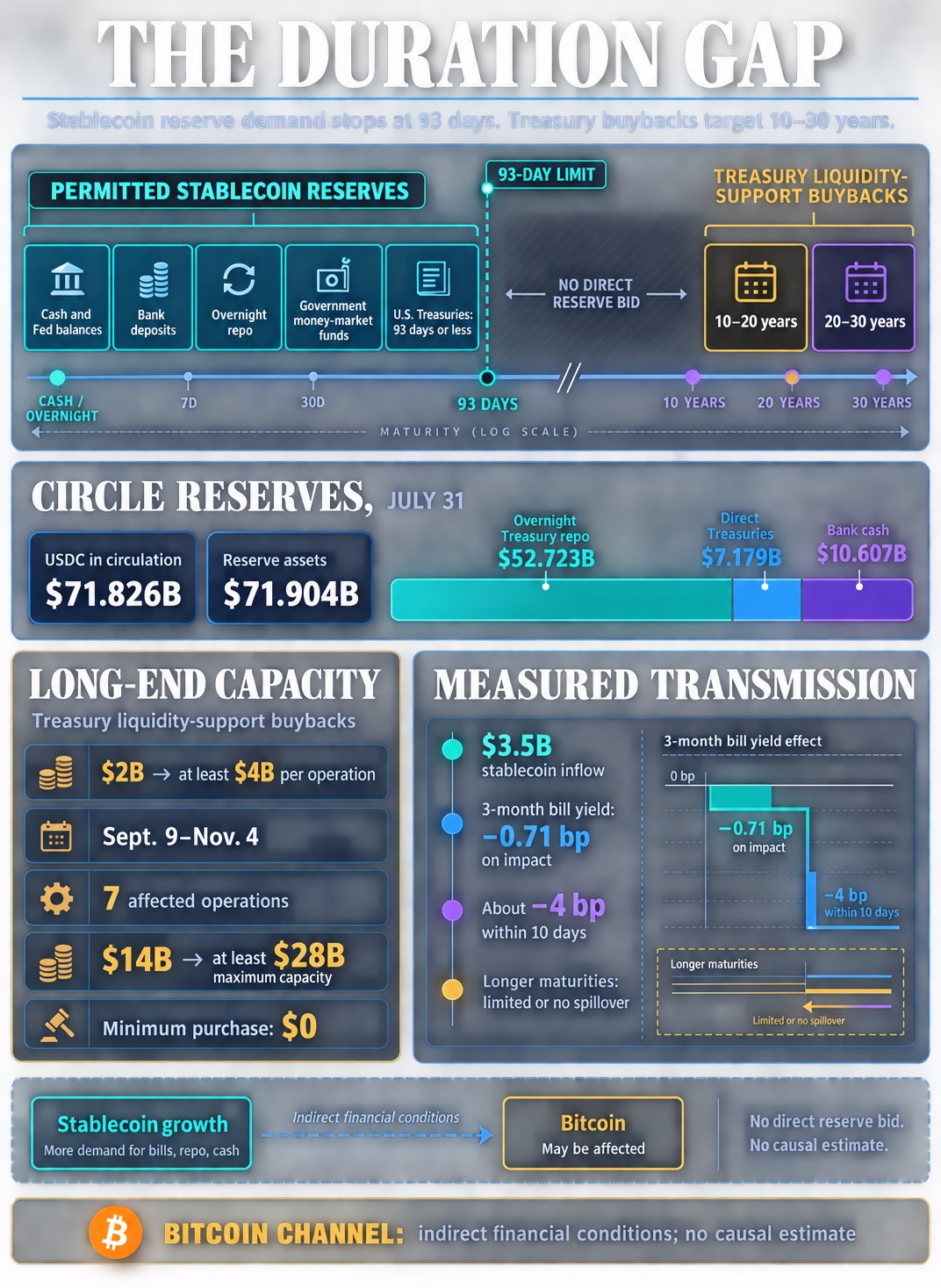
Washington now has two debt-market stories running at once. The federal framework for permitted payment stablecoins channels reserves into cash-like instruments and Treasuries with no more than 93 days remaining. Farther out on the curve, the Treasury Department said on Aug. 19 that it would at least double the maximum size of liquidity-support buybacks in the 10- to 20-year and 20- to 30-year nominal sectors beginning Sept. 9.
Together, those developments test a broad claim about digital dollars funding the United States. Stablecoin growth can reinforce demand for bills and overnight Treasury financing. Direct support for long-duration bonds remains outside the reserve mandate, while any connection to Bitcoin runs through wider financial conditions rather than a reserve trade.
The 93-day wall defines the stablecoin bid
The GENIUS Act requires permitted issuers to maintain identifiable reserves of at least one dollar for every payment stablecoin outstanding. Eligible assets include U.S. currency and Federal Reserve balances, withdrawable bank deposits, Treasuries with an original or remaining maturity of 93 days or less, qualifying overnight repo and reverse repo, government money-market funds invested in those instruments, regulator-approved similarly liquid federal assets, and qualifying tokenized versions.
The menu extends beyond Treasury bills, yet it remains built around liquidity and short duration. A newly issued 10-year note or 30-year bond falls outside the direct Treasury reserve category.
Implementation is still in progress. The law was enacted in July 2025, but its general effective date is the earlier of Jan. 18, 2027, or 120 days after final implementing rules. The Office of the Comptroller of the Currency issued its framework as a proposal in February. On Aug. 19, the Comptroller said the final OCC rule was expected by November. Current issuer portfolios show how short-duration reserves work in practice; they do not establish that every issuer already operates under a completed federal regime.
| Claim | Relevant market segment | Primary evidence | What it supports | What it leaves unresolved |
|---|---|---|---|---|
| GENIUS reserves favor cash-like assets | Cash, deposits, overnight repo and Treasuries at or below 93 days | Official statute | A direct front-end demand channel | Demand for 10- to 30-year bonds |
| Circle's reserves are short duration | Overnight Treasury repo, short Treasuries and bank cash | July USDC reserve report) | A large issuer already uses a cash-like mix | How much reserve growth is new Treasury demand |
| Treasury is expanding long-end buybacks | Off-the-run 10- to 30-year nominal coupons | Treasury announcement | More potential liquidity support for long bonds | A guaranteed purchase total or central-bank easing |
| Stablecoin flows move bill yields | Three-month Treasury bills | BIS working paper | A measurable front-end price effect | Reliable transmission to longer maturities or Bitcoin |
Circle provides a live example of short-duration reserve behavior rather than proof of systemwide demand. Its second-quarter filing put USDC circulation at $73.269 billion on June 30. A more detailed July assurance report) showed $71.826 billion in circulation and $71.904 billion of reserve assets on July 31.
Of that reserve, $60.717 billion sat in the Circle Reserve Fund, including $52.723 billion of overnight Treasury repo and $7.179 billion of Treasuries. Another $11.187 billion was held outside the fund, dominated by $10.607 billion of cash at regulated financial institutions. Every direct Treasury listed in the report matured by Sept. 22. The repo exposure involved lending cash against Treasury collateral. Both categories kept Circle's duration close to the front end of the market.
Those balances show the scale and boundary of the bid. Additional USDC can direct more cash toward bills, repo or bank deposits. The destination depends on the issuer's reserve allocation, and long coupons remain outside the direct channel.
The flow data add a second constraint: stablecoin market growth and fresh federal financing are different quantities. Circle customers minted $83.004 billion of USDC and redeemed $86.784 billion during the second quarter, leaving $3.780 billion of net redemptions. Quarter-end circulation was still 19% above a year earlier, but it stood about $2 billion below December. Gross issuance measures activity, and even net growth leaves the source of the dollars unknown.
The Treasury Borrowing Advisory Committee, a private-sector group that advises Treasury on debt management, has drawn the same distinction. Stablecoin issuance could add short-maturity Treasury demand. Part of that effect may be displaced when users move balances out of bank deposits, money-market funds or other cash-like instruments that already finance bills. Demand from new offshore dollar users would be more additive, but the official evidence does not quantify that share.
Stablecoins can therefore change which balance sheet holds a bill without giving Treasury a wholly new lender for every dollar of token growth.
Long-end buybacks address a separate market
Treasury's planned operations target off-the-run nominal coupons in the 10- to 20-year and 20- to 30-year sectors. The department described the purpose as liquidity support: providing dealers and investors a predictable outlet for older securities that may trade less readily than the newest issue.
The tentative calendar lists seven affected long-end operations on Sept. 10, Sept. 24, Oct. 1, Oct. 8, Oct. 15, Oct. 27 and Nov. 4. Raising each maximum from $2 billion to at least $4 billion lifts aggregate capacity across those operations from $14 billion to at least $28 billion.
That figure is a ceiling. Treasury's buyback guidance sets the minimum for an operation at zero and allows the department to accept less than the maximum when offers are unattractive.
The program also differs from quantitative easing. Treasury retires the securities it accepts and finances buybacks like other outlays. All else equal, each dollar bought back requires another dollar of Treasury issuance. The department can choose the mix of bills and coupons used to meet its overall financing needs. Stablecoin demand could absorb part of the bill component if that mix leans toward the front end, but the government's borrowing requirement remains and stablecoin reserves never enter the long-bond buyback as direct purchasers.
Empirical work reinforces the maturity divide. A Bank for International Settlements working paper using data through March 2026 found that a $3.5 billion stablecoin inflow lowered three-month bill yields by 0.71 basis points on impact, about 4 basis points within 10 days and roughly 5 basis points at the estimated trough. The effect strengthened under some conditions of market stress and bill scarcity.
Longer maturities showed limited or no spillover in the same research. That pattern fits the assets issuers buy: cash placed into securities that mature within weeks can compress bill yields while leaving investors to bear the duration risk in 10-, 20- and 30-year debt.
The official yield curve offers current context rather than causal proof. On Aug. 28, Treasury data put the 10-year yield at 4.73%, the 20-year at 5.21% and the 30-year at 5.22%. Each maturity sits far beyond the GENIUS ceiling for direct Treasury reserve assets. The levels reflect many forces; they simply locate the part of the curve where a direct stablecoin bid is absent.
Bitcoin feels the curve only through indirect channels
For Bitcoin, the defensible mechanism begins with broad financial conditions. Long-term Treasury yields can influence credit costs, the discount rates applied to risky assets and investors' appetite for volatile positions. Better trading conditions in older long bonds can improve market functioning, while a larger bill buyer base can support Treasury's front-end financing.
Those links create a possible macro channel, not a mechanical price signal. A stablecoin inflow may compress bill yields without lowering long-term yields. A Treasury buyback may improve liquidity without reducing net borrowing. Bitcoin can respond to changes in rates, dollar liquidity and risk appetite while moving for many unrelated reasons at the same time.
The evidence here provides no causal estimate connecting stablecoin flows, long-end buybacks or long yields to the price of Bitcoin. It therefore supports no fixed prediction for BTC from either stablecoin growth or the expanded buyback schedule.
The measurable conclusion is narrower. Stablecoins can become a larger source of demand for Washington's bills, especially when growth represents new dollar demand. The long-bond market still depends on investors willing to hold duration, leaving Treasury's liquidity operations and Bitcoin's financial-conditions channel separate from the regulated stablecoin reserve bid.
Source: CryptoSlate