


FILTERED RESULTS
FILTERS
MCap $2.6T +1.7%24h Vol $99.4B -5.8%Fear & Greed 51/100Alts Index 27/100
BTC.D 58.9% +0.3%Stable.D 10.2% 0%ETH.D 11.3% 0%Others.D 19.6% -0.3%
DRV$0.1748+25.23%•ZEC$1,338.19+17.74%•RAY$1.395+13.01%•ARB$0.1634+12.43%•BULLA$0.0831+10.21%•DASH$56.396+9.6%•ZEN$6.775+9.32%•BTW$0.7685+9.2%•USELESS$0.2291+9.03%•DGAI$0.8004+6.23%•
AI$0.2684-16.48%•STONK$0.1705-13.09%•PONS$0.5829-12.75%•牛来$0.1078-9.28%•PI$0.0834-9.2%•CRV$0.3121-8.44%•B$0.1882-8.15%•STABLE$0.0252-8.04%•SKY$0.0572-7.68%•AAVE$116.32-6.7%•
•
·
·
FILTERED RESULTS
Crypto Markets Face Continued Volatility Amid Regulatory Uncertainty
Zcash Price Surges to $1,300 Amid ETF Launch and Governance Upgrade
Revolut hackers demand $3 million in Monero, threaten to sell customer data
24,999 $ETH (59,662,582 USD) transferred from #FalconX to unknown wallet...
Fed Chair Warsh says the economy has strengthened, but inflation remains...
U.S. House Committee Approves First Federal Cryptocurrency Tax Framework
Breaking: Fed Raises Interest Rates by 25 Bps, Bitcoin Price Reacts
Robinhood Chain’s TVL Nears $1B, but Failed L1s Raise Sustainability Question
Bitcoin’s Fed move could run straight into a $6.3 billion IBIT options wall
1,000 $BTC (76,127,835 USD) transferred from #Coinbase to unknown wallet...
Debate on Future of Digital Asset Market Clarity Act Follows Senate Defeat
Bitcoin Core Software Update Aims for Speed and Security Patches
Quants are paying $4,000 a month to front-run Solana trades
Fed Chair Warsh says the FOMC is not yet confident underlying inflation...
Ondo Finance's Oasis Pro Markets Joins DTCC's Fund/SERV Network
Bitcoin bitcoin:native and ether ethereum:native whipsawed after Fed raised interest
UK FCA Releases Final Crypto Rules as Applications Open September 30
732 $BTC (55,176,089 USD) transferred from unknown wallet to #Coinbase...
Our Telegram will bring you the same news without the X noise...
Bankrupt crypto lending firm Celsius sued soon-to-be-shut-down crypto exchange
Spot Gold Breaks Below $4,300 Mark
Where is BNB Headed? Prediction Market Puts 53% Odds on BNB…
Bitcoin Faces ‘Double Whammy’ After Bill Rejection, Rate Hike
$ZEC SURPASSES $1,350 ...
Anchorage Digital Adds Custody Support for Etherlink and…
Fed Raises Rates by 25 Bps to 3.75%–4.00%; 16 of 18 Officials See at Least One More Hike in...
Goldman Sachs Reports Strong Growth in Asset and Wealth Management Division
660 $BTC (50,306,642 USD) transferred from unknown wallet to Coinbase Institutional...
Fed Hikes Rates for the First Time Since 2023, Bitcoin Spikes
Fed delivers its first rate hike since 2023 in a unanimous 12-0...
AVAX Price Faces $7 Test as CLARITY Act Shakes Market
Crypto Market Turns Red as CLARITY Act Setback Meets Fed Rate Decision
CFTC Chair: Americans Deserve Crypto Clarity After Senate Vote Fails 49–50
BTC Breaks Through $76,000, Up 0.31% in 24 Hours
Robinhood engineers charged over fraudulent Hyperliquid trades
After Years of Holds and Cuts, the Fed Just Raised Rates Again
Federal Reserve Raises Interest Rates by 25 Basis Points Amid Elevated Inflation
FOMC median forecast shows one additional 25 bps hike in 2026....
US House tax committee advances crypto tax overhaul in 38–5 vote
FED HIKES INTEREST RATE 25BPS ...
FED HIKES INTEREST RATE 25BPS...
ETH Breaks Through $2,400, Up 0.36% Today
Fed raises rates by 25 basis points in first hike since July 2023
🏴 The Arc Era Begins
Robinhood engineers face up to 30 years over $50,000 alleged Hyperliquid profits
Societe Generale Analysts Predict Rate Hikes by Reserve Bank of India Amid Rising Inflation
Standard Chartered Sets $10 Price Target for Arbitrum’s ARB Token Amid Price Decline
Biggest 1-Day Crypto Gain Ever: The Trades That Made…
How to Know if a Crypto Will Pump: 7 On-Chain and Technical…
Bitcoin Price Holds $75,500 as Traders Price In Fed Rate Hike
House Committee Advances Crypto Tax Bill With $10 Fee…
‘They’re Not Waiting Anymore’: Evernorth CEO On A Decade-Long Wall Street U-Turn On XRP
DTCC Adds Ondo’s Oasis Pro Markets to Fund/SERV Network
BitGo Acquires NYDIG's Trading Business for $42.5 Million
Salesforce Experiences Service Outage During Dreamforce Conference
House panel approves first federal crypto tax framework after Senate...
Celsius sues BitMEX for $495 million over 2020 crash liquidations
SEC and CFTC have signaledy will move ahead with crypto rulemaking usingir
Bitcoin Drops Below $76,000 Following Senate's CLARITY Act Stalemate
From Libra to a USD Stablecoin: Meta’s Long Road Back…
SEC and CFTC Take the Wheel After CLARITY Vote Failure
CFTC and SEC Double Down on Crypto After Clarity Act Defeat
Daler.com Launches Crypto Casino With Collectible Reward Packs and Player-Configurable Loyalty System
KAS Price Risks $0.025 as CLARITY Act Shock Hits Market
Blockaid Flags FlamingoFinance Contract Exploit, $345.9K Stolen
Senate Fails to Advance Clarity Act Amid Bipartisan Opposition
The House Ways and Means Committee just passed the crypto tax bill.Gas and transaction...
Strategy Inc. Repurchases Nearly $1 Billion in Preferred Stock to Stabilize Value
US House Committee Advances Comprehensive Crypto Tax Legislation
XRPL consensus freezes after removing just 12% of central nodes – but a simple tweak triples XRP defense


A new XRP Ledger study says two or three extra peer connections per participating node can sharply raise the number of nodes a targeted attack must remove to disrupt modeled consensus.
XRPL consensus depends on enough trusted validators receiving one another’s messages. A separate peer-to-peer network carries those messages between servers, so extra routes could keep validator traffic moving if an attack removes the network’s busiest hubs.
The Aug. 26 arXiv paper tests random K-out augmentation. K is the number of new undirected edges each participating node creates to peers chosen uniformly at random.
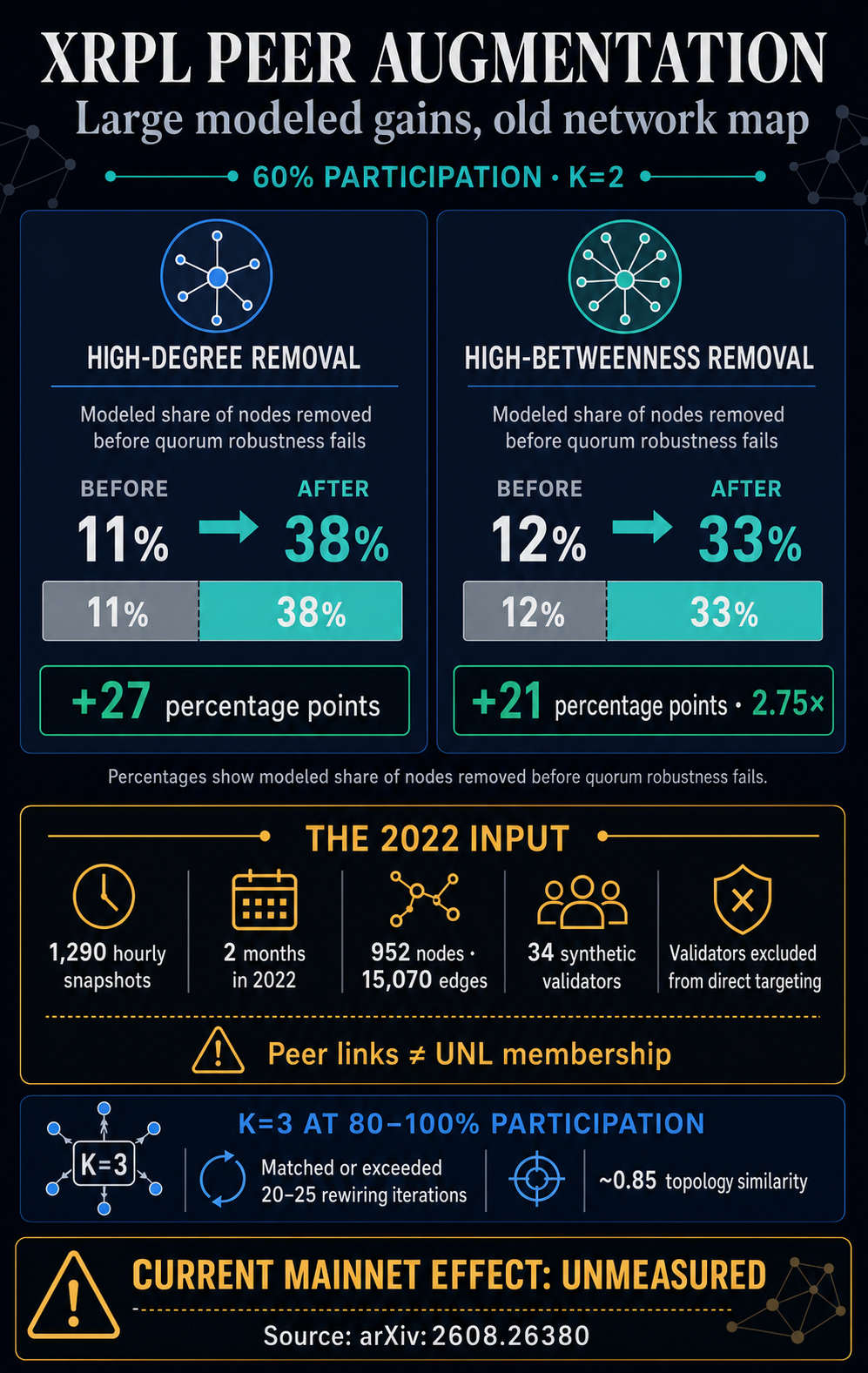
At 60% participation and K=2, the model’s quorum critical attack size rose from 11% to 38% when removals targeted the highest-degree nodes. Under an attack ordered by betweenness centrality, which prioritizes nodes that sit on many shortest paths, the threshold rose from 12% to 33%.
The second change is 2.75 times the baseline. The metric measures the simulated share of nodes removed before fewer than 80% of the model’s validators remain together in one connected component. Observed attack cost remains unknown.
At 80% and 100% participation, K=3 matched or exceeded the modeled robustness produced by roughly 20 to 25 iterations of a more invasive rewiring strategy across the paper’s network and quorum tests. K-out augmentation retained about 0.85 Jaccard similarity with the original edge set, while rewiring fell well below 0.5.
The comparison establishes a graph-level result: a small number of uniformly distributed links can create alternate paths while preserving more of the original network than repeated edge replacement. The authors also released their simulation code and snapshot files for the chosen inputs.
The 2022 XRP Ledger study map behind the gains
The study reuses 1,290 hourly snapshots collected over two months in 2022. It selects the graph closest to the dataset’s average characteristics, producing a representative snapshot with 952 nodes, 15,070 edges and average degree 31.7.
That historical map also anchors the starting thresholds. The Aug. 2026 paper says prior robustness work found that targeted removal of about 20% of nodes compromised network robustness, while about 9% compromised quorum robustness. Random failures required far larger removals. Every percentage describes an attack simulation on the old graph.
Validator placement introduces a second abstraction. The dataset did not identify validators, so each main simulation selected 34 validator nodes uniformly at random and excluded them from direct targeting. Sensitivity tests that favored either high-degree or low-degree nodes for validator assignment preserved the qualitative advantage of random augmentation, although the baseline and incremental gains changed.
The current network supplies different visible inputs. On Aug. 30, Bithomp’s live node explorer displayed 786 discoverable nodes, while its validator view showed 35 members on the displayed XRP Ledger Foundation UNL. The live count changes over time and comes from a third-party measurement rather than the paper’s crawl method. The comparison establishes that the inputs have changed; the direction of present-day resilience remains unresolved.
Public measurement also has documented blind spots. XRPL’s peer crawler can omit the IP address and port when a connected peer is a validator or private peer. Official validator guidance favors private or protected peer paths instead of public access. Those protections impede recursive endpoint discovery while still allowing some validator-adjacent connections to appear.
A fresh study would therefore need more than an updated node count. It would need a topology measurement with explicit coverage limits, a defensible current validator-placement model and the same Monte Carlo tests rerun against that graph.
Connectivity, trust and the operator test
Peer augmentation affects message routes, while XRPL’s trust lists determine whose validation votes count.
An XRPL server’s Unique Node List identifies validators that the operator trusts not to collude. The peer protocol carries transactions, ledger data, proposals and validations across server connections. A validator on a UNL can be reached through the overlay without being one of that server’s direct peers.
Adding two random peers therefore leaves UNL membership, the 80% consensus threshold and trusted-list overlap unchanged. The modeled benefit comes from keeping enough validators connected through alternate routes after central nodes disappear. Validator honesty and trust concentration sit outside that mechanism.
Current software provides several ways to create more links, but deployment has constraints that a graph operation does not capture. Official guidance sets xrpld’s default soft maximum at 21 peers and maintains at least 10 outgoing connections. Raising the soft maximum to a number below 68 does not increase outbound connections by itself because of the software’s incoming-to-outgoing allocation. Fixed peers, peer reservations and manual connections can exceed the soft maximum, according to the project’s reference configuration.
Durable connections across organizations add coordination. A guaranteed peer reservation requires the administrators on both sides to cooperate. Private validators may deliberately route through selected proxies or hubs to reduce public exposure. More peers also consume more bandwidth, an expense highlighted in the official configuration guidance.
The paper models participation subsets from 20% to 100%, showing how the graph responds when only part of the network adds links. Those scenarios supply no empirical adoption rate. Operator willingness, durable peer acceptance, peer-slot contention, bandwidth, privacy, malicious-peer exposure and denial-of-service effects remain unmeasured.
The XRP Ledger study’s contribution is a focused design result: on one representative 2022 XRPL graph, a few uniformly random edges reduced dependence on central nodes and raised modeled attack thresholds with less topology change than extensive rewiring.
Testing that result on mainnet now requires current topology inputs and an operational trial of how random links are selected, accepted and maintained. Until then, 9%, 20%, 33% and 38% remain model outputs. The practical question is whether marginal peer diversity can deliver the same resilience gain on the network XRPL operators run today.
Source: CryptoSlate