


FILTERED RESULTS
FILTERS
MCap $2.6T -2.9%24h Vol $103B +13%Fear & Greed 69/100Alts Index 29/100
BTC.D 58.3% -0.3%Stable.D 10.0% +0.1%ETH.D 11.2% -0.3%Others.D 20.5% +0.5%
AKE$0.0273+78.56%•AI$0.3214+35.32%•龙虾$0.1779+19.42%•FF$0.1420+12.08%•牛来$0.1189+11.99%•LAPTOP$0.2390+9.71%•PONS$0.6682+6.65%•CAP$0.0612+4.25%•ARB$0.1453+3.1%•NFT$0.00000024+2.5%•
UAI$0.3767-28.04%•LSK$0.3364-24.48%•B$0.2049-14.69%•FIL$0.8243-14.07%•SENT$0.0146-13.75%•INJ$5.545-12.95%•RAY$1.234-12.23%•RAIN$0.0132-12.14%•AR$2.493-11.45%•ICP$2.502-10.23%•
•
·
·
FILTERED RESULTS
Polymarket unveils Midterm Hub as it approaches $14.5B in volumes this year for Political
Google Launches Gemini 3.8 Live Models for Real-Time AI Dialogue
NVIDIA Groq 3 LPX Boosts AI Efficiency with Deterministic Execution
Viral report alleges Anthropic’s AI safety watchdog conflicted
Clarity Act fails in Senate: Here is how the crypto industry is reacting
JUST IN: In an initial procedural vote, U.S. Senate failed to advance Clarity Act after not
Ethena Pay Set to Launch in US, UK, and Europe Following Successful Beta
CLARITY Act Made 126 Concessions and Still Couldn’t Get 60 Votes
JUST IN: In an initial procedural vote, U.S. Senate failed to advance Clarity Act after not
Beyond the Hype: 5 Things Businesses Need to Know About the Next Wave of Crypto Disputes
BREAKING: US Senate Fails to Advance Crypto CLARITY Act, Here’s What It Means
Algorand (ALGO) x402 Challenge Offers $100K Prize for Pay-Per-Use Innovations
Did crypto’s $20 Billion DeFi surge just get stolen by price inflation?
US Senate Fails to Advance Digital Asset Market Clarity Act, Impacting Crypto Markets
CLARITY ACT DOES NOT GET REQUIRED 60 VOTES TO ADVANCE TO NEXT STAGE....
MYX Finance Price Prediction 2026, 2027-2030: Is MYX the Next Big Decentralized Futures Play?
U.S. CLARITY ACT FAILS TO GET REQUIRED 60 VOTES TO ADVANCE ...
Clarity Act Stalls in Senate as Crypto Bill Fails to Clear Key Vote
CLARITY ACT DOES NOT GET REQUIRED 60 VOTES TO ADVANCE TO NEXT...
Crypto Clarity Act flames out in failed U.S. Senate vote
Sen. Elizabeth Warren warns passing the CLARITY Act could put the US at risk of an...
BitMine (BMNR) Stock Drops 10.08% Intraday, Now at $23.19
CLARITY ACT IS ON TRACK TO FAIL PROCEDURAL HURDLE IN SENATE ...
CLARITY ACT DOES NOT GET REQUIRED 60 VOTES TO ADVANCE TO NEXT STAGE ...
Warren Calls for Senate No Vote on CLARITY Act Over Trump Ethics
XRP Ledger’s Batch V1.1 Amendment Nears Activation Threshold
Senator Elizabeth Warren urges Congress to block Crypto Clarity Act....
Crypto Fees Under $10 Would Be Tax-Free Unless You Made…
Erebor Bank Modifies Free Stablecoin-to-Cash Conversion Policy
New York Fed Investigates Hedge Fund Involvement in Treasury Market
Dinari Powers Bitcoin.com’s U.S. Launch of Tokenized Equities
X Launches U.S. Cashtag Trading Program With Coinbase, Kraken and Gemini
Two Robinhood Engineers Charged With Insider Trading on Hyperliquid
AMC and Robinhood Engage in Dispute Over Tokenized Stock Offerings
Bitcoin Miner Bitdeer Adds 65.1MW for Nvidia AI as Pipeline Hits $7B
Federal Reserve Raises Interest Rates for First Time Since 2023
Coinbase Shares Decline Ahead of Key Senate Vote on Crypto Legislation
Sen. Elizabeth Warren warns passing the CLARITY Act could put the US at...
Binance Introduces Wealth Management Services with U.S.-Listed ETFs
Solana lender Kamino taps Yieldstreet co-founder as CEO in Wall Street expansion
240,000,000 DOGE in a Week: Where Is Dogecoin Headed Next?
Sen. Elizabeth Warren doesn’t support current Clarity Act — but she says she’s still
Why Japan’s 3.8% bond shock is quietly setting a trap for Bitcoin
Why a CLARITY victory may still leave Bitcoin trapped at $76,000
Hackers Exploit Italian Government Email to Target Revolut Customers
MEV Bot Captures $7.7M in rsETH After Safe Module Exploit
Tensions Mount as U.S. Senate Prepares to Vote on Clarity Act
Robinhood Engineers Charged With Fraud Over Alleged Crypto Listing Trades
Crude Oil Tops $106, Hits Four-Month HighAccording to Trading Economics market data, crude oil...
1,385 $BTC (106,012,190 USD) transferred from #Coinbase to unknown wallet...
Two Robinhood engineers charged in crypto insider trading scheme involving Hyperliquid...
'It's Now or Never' for Clarity Act, Says 'Bitcoin Senator' Lummis
1,258 $BTC (96,116,022 USD) transferred from unknown wallet to #Coinbase...
Circle, Ripple Invest in Velocity as Funding Hits $48M
Revolut’s Breach Toll Emerges as the ICO Opens a Probe
Robinhood Engineers Accused of Turning Listings Into Insider Trades
106,210,347 $USDC (106,305,936 USD) burned at USDC Treasury...
DOJ charged Robinhood engineers Hefu Chai and Huaisong Xiang with commodities fraud
Two Robinhood Engineers Charged with Insider Trading in Hyperliquid Case
Anthropic's Guide to AI-Driven Sales with Claude Released
NEW: Democrats' counteroffer to Republicans' revised Clarity bill text would have broadened ethics
Crude Oil Tops $106, Hits Four-Month HighCrude oil prices rose above $106 per barrel on Tuesday,...
Dow Jones Index Declines Amid Rising Yields and Oil Prices
Manifund hires Caroline Ellison while fighting FTX over $1.5M
1,183.54 #BTC ($90,349,552) aggregated inflows to #Binance ...
U.S. Stock Market Declines Amid Anticipation of Interest Rate Hike
US Seeks Forfeiture of $61 Million in Crypto Linked to Alleged Iranian Oil Scheme
NVIDIA FLARE Expands Federated Learning with Kubernetes, Slurm
ROBINHOOD EMPLOYEES CHARGED WITH COMMODITIES FRAUD FOR INSIDER TRADING ON HYPERLIQUID: DOJ ...
BlackRock’s staking Ethereum ETF pays yield but investors still prefer its $9 billion ETHA fund


Staking was supposed to strengthen Ethereum exchange-traded funds (ETFs), but BlackRock’s early results show investors still favor its original fund.
When US spot Ethereum ETFs launched in July 2024, the absence of staking was widely identified as one of their biggest structural disadvantages. Investors buying the funds gained exposure to ETH's price but forfeited the rewards available to holders who committed their tokens to securing the Ethereum network.
At the time, JPMorgan cited the removal of staking from ETF filings as one reason it expected weaker demand than for Bitcoin funds. BitMEX Research similarly argued that institutional investors could find non-staking products less attractive, while Galaxy Digital estimated that giving up staking represented a meaningful opportunity cost for ETF investors.
BlackRock now offers an early test of that argument.
Its iShares Ethereum Trust ETF (ETHA) provides straightforward exposure to ether without staking. The newer iShares Staked Ethereum Trust ETF (ETHB) stakes part of its holdings and distributes a portion of the resulting income to shareholders.
So far, adding yield has not overturned the hierarchy.
ETHA held about $8.96 billion in net assets on Sept. 11, compared with roughly $1.05 billion for ETHB, BlackRock fund data show.
The difference is even larger in secondary-market trading: ETHA generated an estimated $1.86 billion of share turnover that day based on volume multiplied by its closing price, roughly 30 times ETHB’s $61.8 million.
ETHB is also paying investors. The fund listed a distribution of $0.036487 per share payable Sept. 10 after beginning to earn staking rewards in May.
Yet ETHA attracted $148.8 million of net inflows on Sept. 11, compared with $18.3 million for ETHB, Farside Investors data show.
The comparison comes with an important limitation. ETHA has had substantially more time to accumulate assets, trading relationships, and institutional adoption, while ETHB is still building its track record. Its roughly $1 billion asset base also represents meaningful demand for a newer product.
Still, ETHA’s continued inflows after staking income became available challenge the stronger version of the thesis that missing yield was the main constraint on Ethereum ETF demand.
Staking removes one handicap, but not ETHA’s head start
ETHB removes much of the opportunity-cost problem that shaped criticism of the original Ethereum ETF structure. It cannot immediately replicate the liquidity ETHA has accumulated since becoming one of the first US spot Ethereum ETFs.
BlackRock reported a 30-day median bid-ask spread of 0.05% for ETHA as of Sept. 11, compared with 0.06% for ETHB. That difference is small, but the much wider disparity in trading activity gives institutions substantially more capacity to enter and exit larger ETHA positions.
Daily flows have yet to show a sustained migration toward the staking product.
Both funds recorded no net flows on Sept. 8 and attracted capital on Sept. 9. ETHA suffered an outflow on Sept. 10 while ETHB gained assets, but both returned to inflows the next day, with ETHA attracting substantially more money.
Those movements cannot establish whether individual investors are rotating between the products. ETF flow data identify creations and redemptions at the fund level but do not reveal whether an investor selling ETHA subsequently used the proceeds to purchase ETHB.
That distinction matters if staking eventually changes the competitive balance. A sustained period of ETHB creations accompanied by ETHA redemptions would provide much stronger evidence that investors are actively exchanging simpler exposure for yield-bearing exposure.
Yield introduces costs and another layer of liquidity management
Staking also gives ETHB a more complicated economic structure than simply adding yield to ETHA.
About 75.85% of ETHB’s ether was classified as staked as of Sept. 10, while roughly 24.15% remained unstaked. The unstaked portion provides liquidity for fund operations and redemptions without requiring BlackRock to wait for ether to exit Ethereum’s staking process.
Investors also face two separate layers of charges.
ETHB carries a standard annual sponsor fee of 0.25%, the same headline rate as ETHA, although a temporary waiver reduces the fee to 0.12% on its first $2.5 billion of assets for 12 months beginning March 12.
Staking rewards carry another charge. An April prospectus supplement sets the aggregate staking fee at 10% of gross staking consideration, down from an earlier 18%.
The fees apply to different bases. The sponsor fee is assessed against fund assets, while the staking fee is deducted from rewards generated by participating in Ethereum’s proof-of-stake network.
Distributions are also conditional, not a fixed yield. BlackRock can consider staking consideration received, legal requirements, and the fund’s operational and liquidity needs when determining payments.
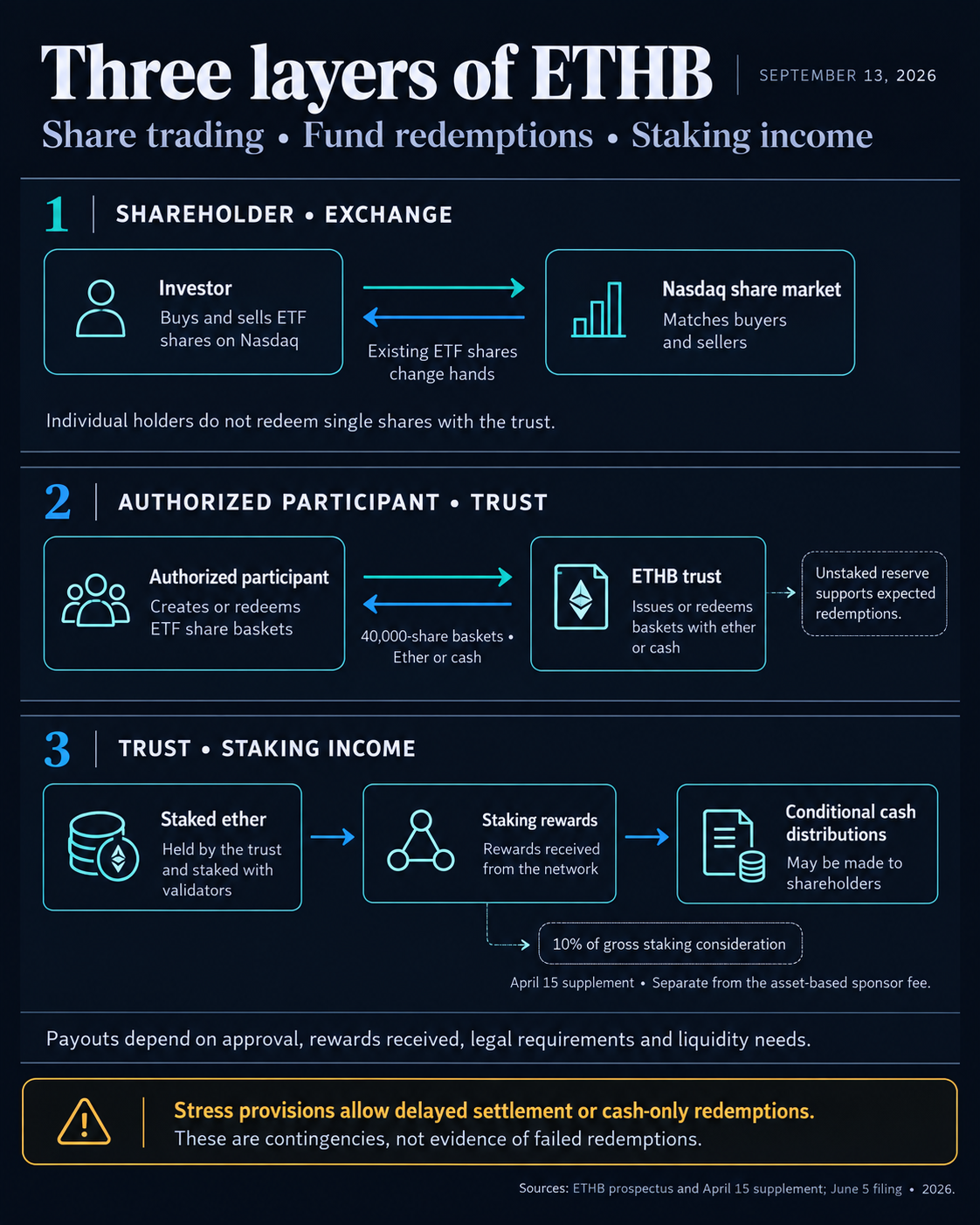
The structure introduces additional redemption considerations. Under stressed conditions, ETHB’s prospectus allows delayed settlement or cash-only redemptions when staking exit times or available liquidity make ordinary settlement more difficult.
Those trade-offs put the staking thesis to a tougher test than whether investors like receiving additional income.
ETHB must generate enough after-fee value to persuade investors to choose a younger, less-traded vehicle over an incumbent with nearly $9 billion in assets.
The next signal will be whether ETHB can convert its distribution feature into sustained creations rather than episodic demand around payouts. If that happens while ETHA begins losing assets, the staking thesis will have stronger support.
Until then, BlackRock can capture both preferences: investors prioritizing ETHA’s established liquidity and those willing to accept additional complexity to earn staking income through ETHB.
Source: CryptoSlate