


FILTERED RESULTS
FILTERS
MCap $2.6T -0.5%24h Vol $93.5B -11%Fear & Greed 51/100Alts Index 27/100
BTC.D 58.6% 0%Stable.D 10.2% 0%ETH.D 11.2% -0.1%Others.D 20.0% +0.1%
DRV$0.1748+25.23%•BULLA$0.0831+10.21%•RAY$1.348+9.83%•ZEC$1,245.48+9.68%•BTW$0.7685+9.2%•DGAI$0.8004+6.23%•USELESS$0.2245+5.34%•龙虾$0.1874+5.3%•LIT$4.364+5.19%•H$0.0881+4.21%•
AI$0.2684-16.48%•PONS$0.5766-16.4%•PI$0.0812-14.02%•STONK$0.1705-13.09%•CRV$0.3058-10.98%•XRP$1.258-10.39%•STX$0.2303-10.17%•JTO$0.3992-10.11%•AAVE$114.11-9.85%•XLM$0.1739-9.71%•
•
·
·
FILTERED RESULTS
FED HIKES INTEREST RATE 25BPS ...
FED HIKES INTEREST RATE 25BPS...
ETH Breaks Through $2,400, Up 0.36% Today
Fed raises rates by 25 basis points in first hike since July 2023
🏴 The Arc Era Begins
Robinhood engineers face up to 30 years over $50,000 alleged Hyperliquid profits
Societe Generale Analysts Predict Rate Hikes by Reserve Bank of India Amid Rising Inflation
Standard Chartered Sets $10 Price Target for Arbitrum’s ARB Token Amid Price Decline
Biggest 1-Day Crypto Gain Ever: The Trades That Made…
How to Know if a Crypto Will Pump: 7 On-Chain and Technical…
Bitcoin Price Holds $75,500 as Traders Price In Fed Rate Hike
House Committee Advances Crypto Tax Bill With $10 Fee…
‘They’re Not Waiting Anymore’: Evernorth CEO On A Decade-Long Wall Street U-Turn On XRP
DTCC Adds Ondo’s Oasis Pro Markets to Fund/SERV Network
BitGo Acquires NYDIG's Trading Business for $42.5 Million
Salesforce Experiences Service Outage During Dreamforce Conference
House panel approves first federal crypto tax framework after Senate...
Celsius sues BitMEX for $495 million over 2020 crash liquidations
SEC and CFTC have signaledy will move ahead with crypto rulemaking usingir
Bitcoin Drops Below $76,000 Following Senate's CLARITY Act Stalemate
From Libra to a USD Stablecoin: Meta’s Long Road Back…
SEC and CFTC Take the Wheel After CLARITY Vote Failure
CFTC and SEC Double Down on Crypto After Clarity Act Defeat
Daler.com Launches Crypto Casino With Collectible Reward Packs and Player-Configurable Loyalty System
KAS Price Risks $0.025 as CLARITY Act Shock Hits Market
Blockaid Flags FlamingoFinance Contract Exploit, $345.9K Stolen
Senate Fails to Advance Clarity Act Amid Bipartisan Opposition
The House Ways and Means Committee just passed the crypto tax bill.Gas and transaction...
Strategy Inc. Repurchases Nearly $1 Billion in Preferred Stock to Stabilize Value
US House Committee Advances Comprehensive Crypto Tax Legislation
Hackers Hijack HBO Max’s Reddit Account to Spread Crypto-Stealing Malware
Wyoming Picks Chainlink Over LayerZero, Citing FRNT Security Failures
Solana treasury giant DeFi Development opens $300M CHAD offering backed by a massive 13% dividend catch
XRPL proved it can handle over 3,000 transactions, but the traffic was entirely synthetic
BitGo Launches Brazilian Subsidiary Amid Growing Tokenization in Capital Markets
Blueprint Infrastructure Integrates Coinbase Prime Suite for Enhanced Fund Management
SEC Chair Paul Atkins says Crypto regulatory clarity is coming “with or...
When Is The FOMC Meeting Today?
UK FCA Issues New Guidance Ahead of 2027 Crypto Regulation
Bitcoin Falls Below $76.7K True Market Mean as Demand Weakens
Fake World Assets Officially Opens Its V2
Justin Sun Offers Up to $1 Million for Machine-Verified…
Solana's Decentralized Exchange Surpasses Major Centralized Platforms in Trading Volume
Anchorage Digital Bank Expands Custody Services to Include Tokenized Uranium and Etherlink
DCENT warns App Wallet users to move funds after detecting abnormal asset transfersRead...
Zuckerberg Pushes Back on Coordinated AI Slowdown, Says Labs Can Act Alone
House Ways and Means Committee voted 38-5 to advance sweeping crypto tax bill,
Russian spies using crypto and Telegram to incite chaos across Europe
Tether Gold Loans Swell With $1.5 Billion for US Bullion Dealer
Crypto Wallet Maker DCENT Tells Users to Get Their Coins Out
Circle CEO Claims Progress on CLARITY Act Amid Market Uncertainty
U.S. House's tax committee advances crypto tax bill in wake of Clarity Act loss
MicroStrategy's Stock Performance Tied to Bitcoin Price Recovery
Nvidia CEO Jensen Huang Emerges as Leading AI Venture Capitalist
Celsius Files $495 Million Lawsuit Against BitMEX Ahead of Exchange Shutdown
Coinbase to Launch Spot Trading for BLUE CHIP Memecoin on September 16
Celsius Sues BitMEX 11 Days Before Exchange Shutdown, Seeking $495 MillionCelsius’ bankruptcy...
BTC Needs Sustained Buying to Break Above its Floor
Ethereum Price Analysis: Is ETH Heading Toward $2K After Another Rejection at $2.5K?
Polymarket Predicts 89% Chance of 25bps Hike Ahead of FOMC Meeting
Deutsche Bank to Launch Bitcoin and Ether Custody Service in Europe
Cardano fees covered just 0.7% of staking rewards as transactions fall 72%
Securitize Highlights Resilience of Tokenized Securities Amid Legislative Uncertainty
American Bitcoin Corp. Receives Buy Rating from BTIG with $15 Price Target
$BLUECHIP listed on Coinbase spot・
Venice Hits 250B Daily Tokens Milestone
Fidelity Leads $450M Bitcoin ETF Exit as Senate Vote Fails
Bitcoin ETFs Had Their Worst Day Since June Following Failed Clarity Act Vote
Hamas Military Branch Advises Donors to Avoid Binance for Fund Transfers
Breakdown into Thin Support


Executive Summary
- Bitcoin has slipped below its range and under the True Market Mean at $76.7K, but the drop has been shallow for a bad news week.
- The Fed decides today with a hike priced in; core inflation at 2.4% against a 3.75% policy rate means policy has tightened without a move.
- New demand has gone quiet: on-chain capital inflows stalled after 27 straight days, ETF flows turned negative, stablecoin supply is flat and treasuries have stopped buying.
- Altcoins fell harder than Bitcoin through the Senate vote, though few have hit new lows yet.
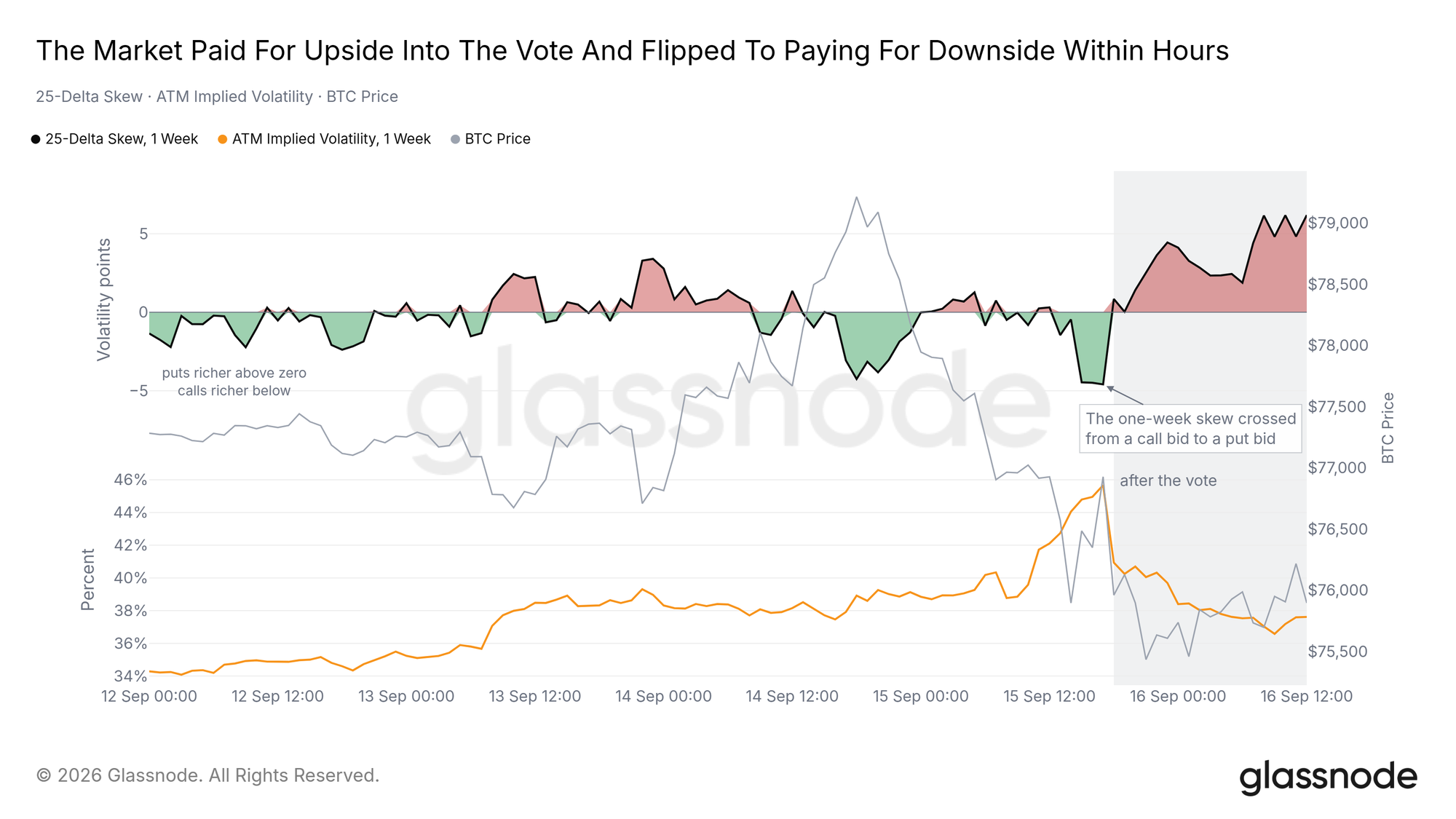
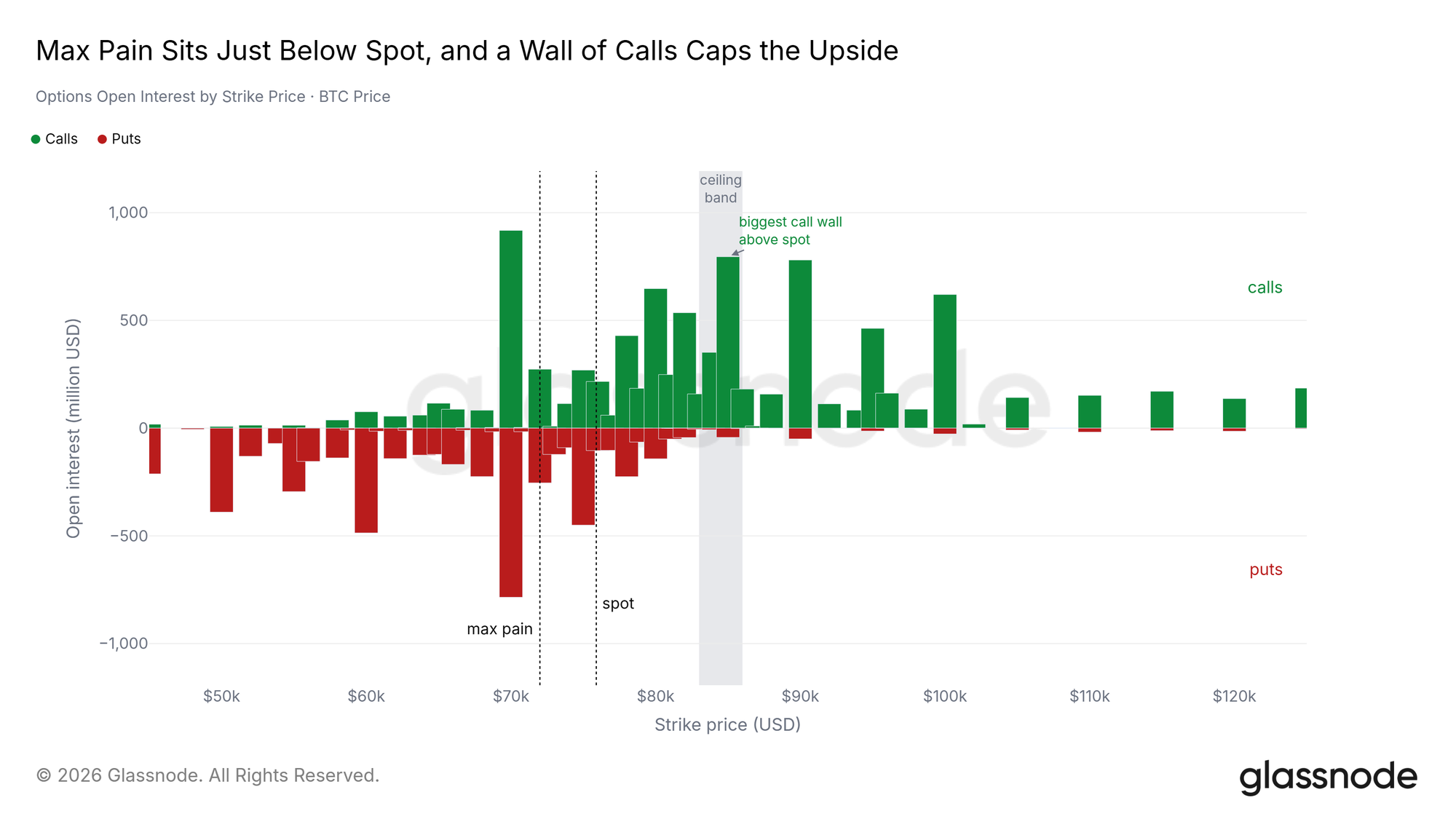
- Options flipped to paying for downside within hours of the vote; max pain sits at $72K and a wall of calls at $85K caps the upside.
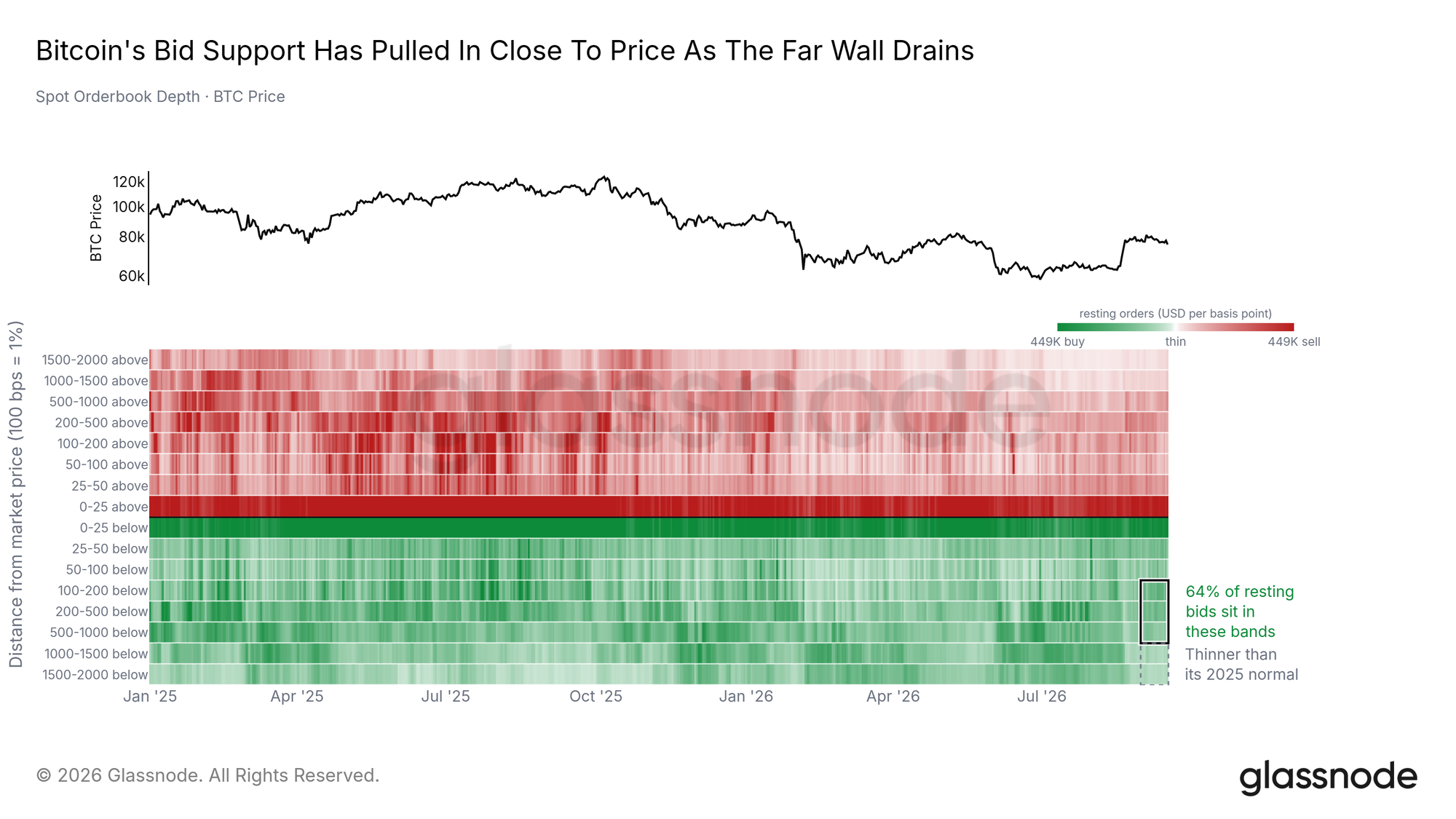
- Most resting bids sit within 10% of price and the book thins below; a lost range points to $71.3K, then $62K to $65K.
Ready to get ahead of markets and sharpen your foresight? Try Glassnode. Sign up or talk to sales.
Below the Range, Still Standing
Back Under the True Market Mean
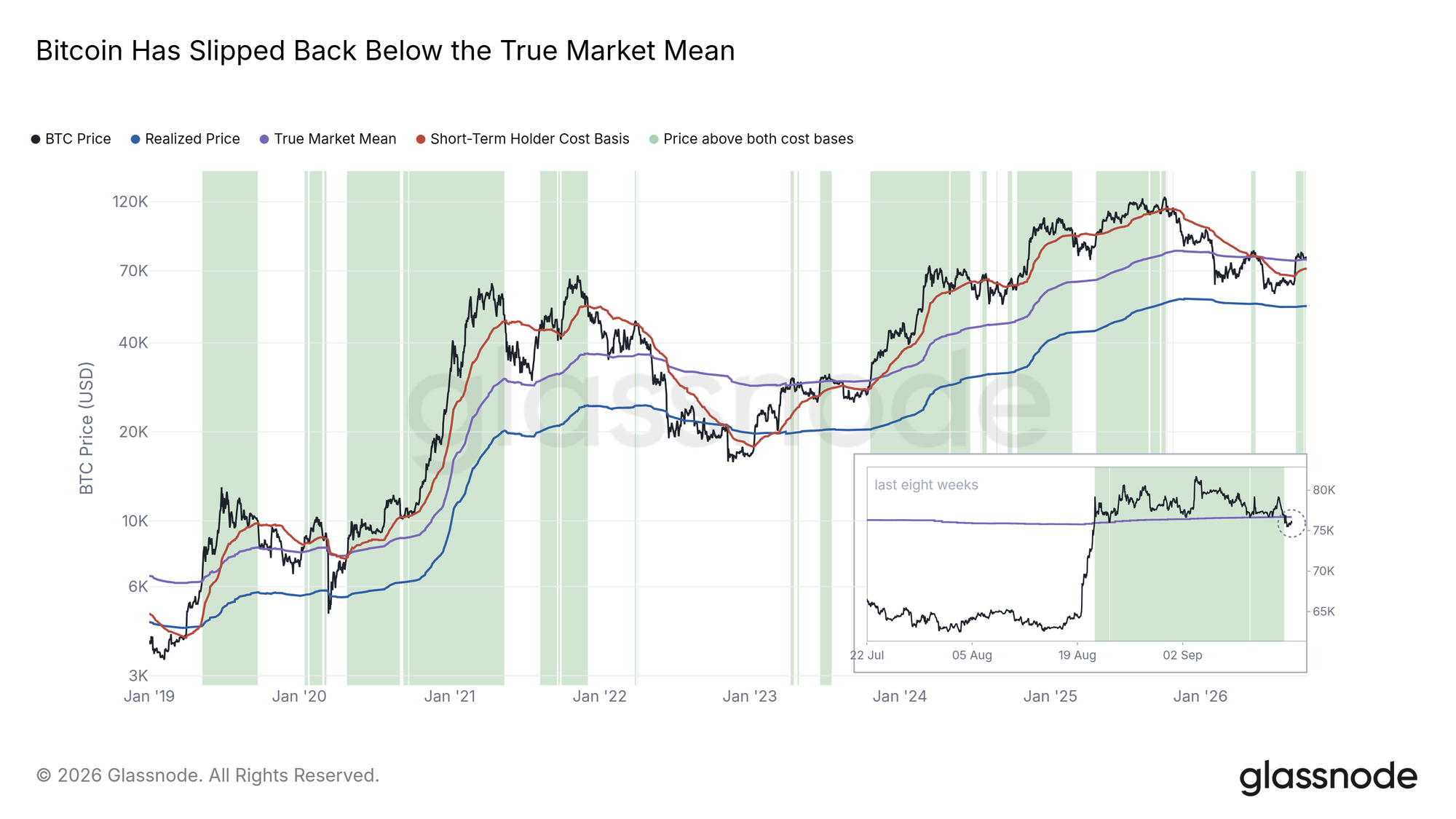
Bitcoin traded near $76K at the latest settled hour, down about 4.6% on the week. That leaves price just under the bottom of the range it has held since late August. It is also about 1% below the True Market Mean at $76.7K, the average price paid by investors who are still active. The range low sits within a hundred dollars of that mean, so one line does both jobs. Price lost it in the hour of the Senate vote and has stayed below since.
Given the news, the fall is small. The Senate vote on the CLARITY Act, the crypto market-structure bill, failed on September 15, 2026. The bond market has priced a rate hike for today. Altcoins sold off harder than Bitcoin. A slip this small has reversed before: the same level was pierced on August 23, 2026 and on September 10, 2026, and it held both times. Price closed below it on September 15, 2026 for the first time; a second close below would turn the slip into a break. The next cost basis down is the Short-Term Holder Cost Basis at $71.3K, the average price paid for coins bought in the last five months.
Tighter Policy Without a Move
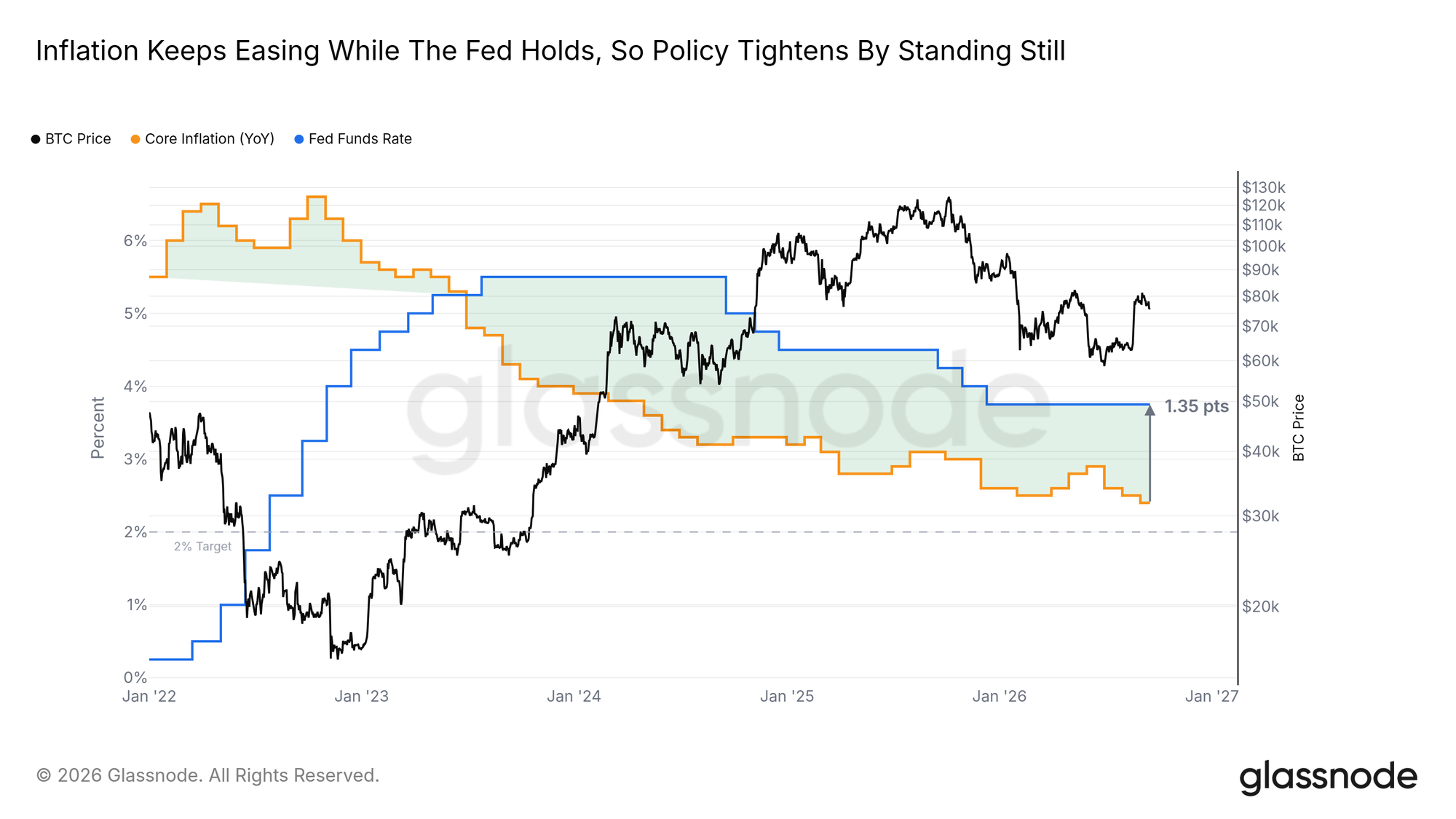
The Fed decides later today, September 16, 2026, and the market expects a hike. Even without one, policy has been tightening on its own. US Core Inflation has fallen to 2.4%, its lowest since 2021, while the Fed Funds Rate has sat at 3.75% since December 2025. The gap between the two, the real policy rate, has widened to 1.35 points with no change in policy at all.
The bond market wants more. The 2-Year Treasury yield sits almost a full point above the Fed's rate, which is how the bond market prices a hike before it happens. Either outcome leaves Bitcoin facing a tighter backdrop than it had at the range high two weeks ago. A hike confirms what the 2-year already prices; a hold leaves real rates rising anyway as inflation cools.
The Buyers Have Gone Quiet
Capital Inflow Has Stalled
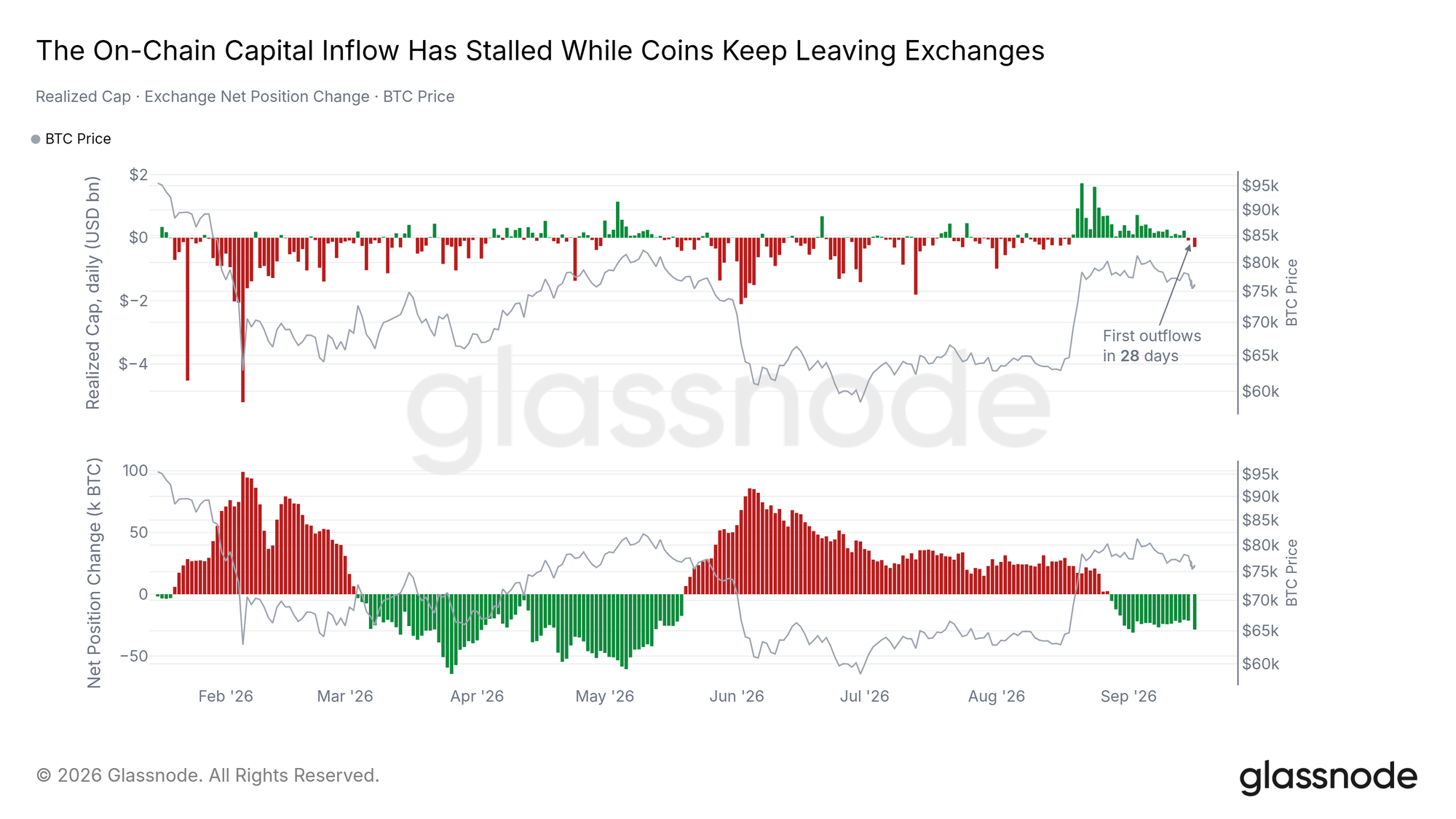
The rally into the range was funded by new capital arriving on-chain. Realized Cap, the value of every coin at the price it last moved, rose on 27 straight days through September 14, 2026. That run has ended: the September 15 reading is the first outflow in 28 days, and the unfinished September 16 print is running negative too.
Exchange flows have not reversed. Exchange Net Position Change, the 30-day change in coins held on exchanges, is still a net outflow, and the exchange balance is lower than a month ago. Coins keep leaving exchanges while the capital that was buying them has paused. The US spot ETFs tell the same story: net flows turned negative in the week before the vote, an outflow of about $334M over September 8 to 14, 2026, after nearly $1B of inflows in the first days of the month. That looks like a market waiting. A return to positive daily Realized Cap changes would say the buyers are back; a run of outflows while price sits under the mean would mean the range's buyers have started to give up.
No New Cash on the Sidelines
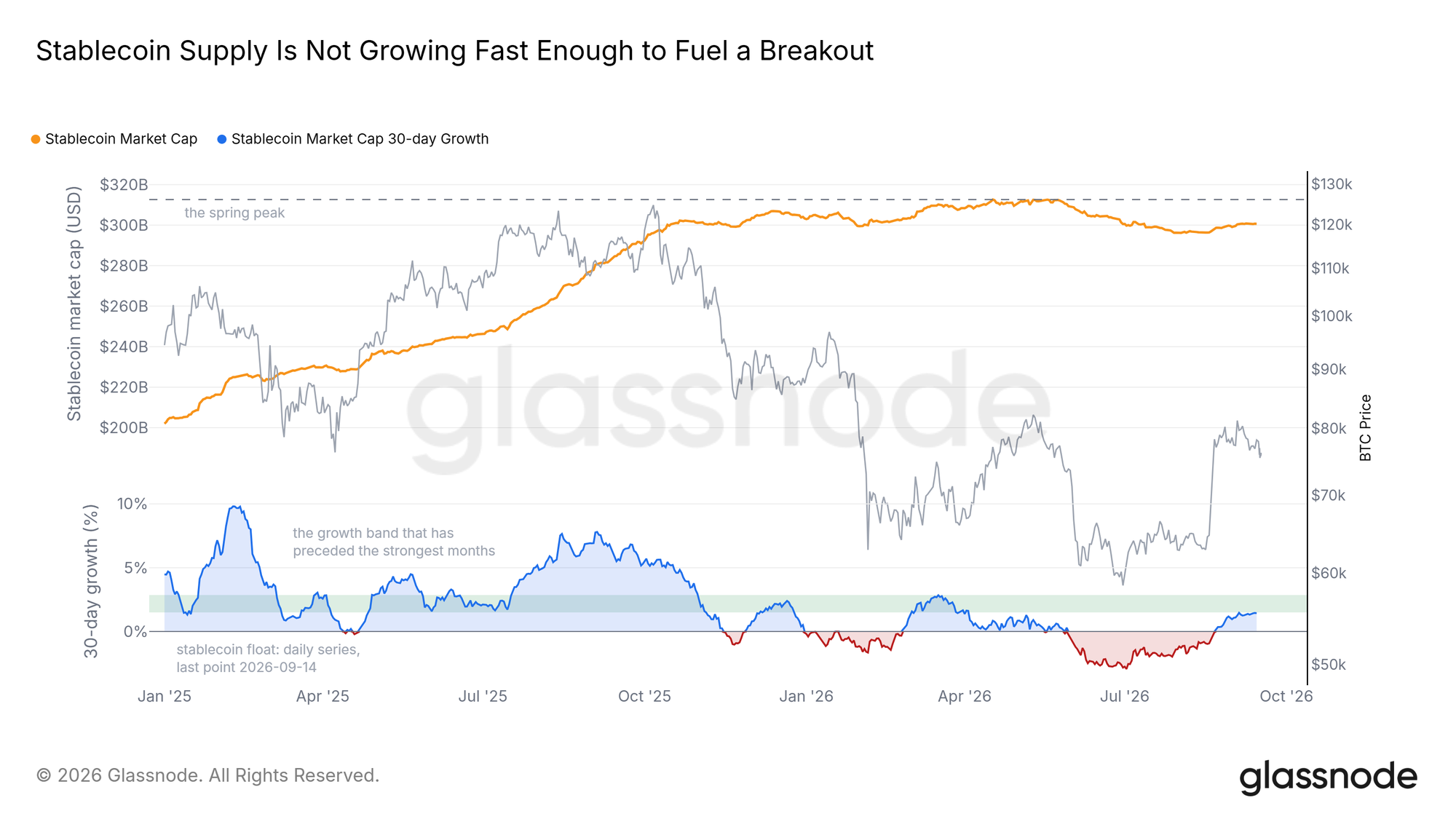
Stablecoins are the cash that funds the next leg, and the pool is not growing. Stablecoin Market Cap sits near $301B, flat on the week and about 4% below its April 2026 peak. Its 30-day growth rate is just under the 1.5% to 2.9% band marked on the chart. When growth sat inside that band, Bitcoin's next month was its strongest on average; the fastest growth spells were followed by losses.
Growth has recovered from the negative readings of the summer, so the sideline cash is no longer shrinking. It is not being built either. A breakout needs new dollars, and the supply has not made a new high in five months. The band is the level to watch: growth back inside it would be the first sign of new fuel.
Treasuries Stopped Buying
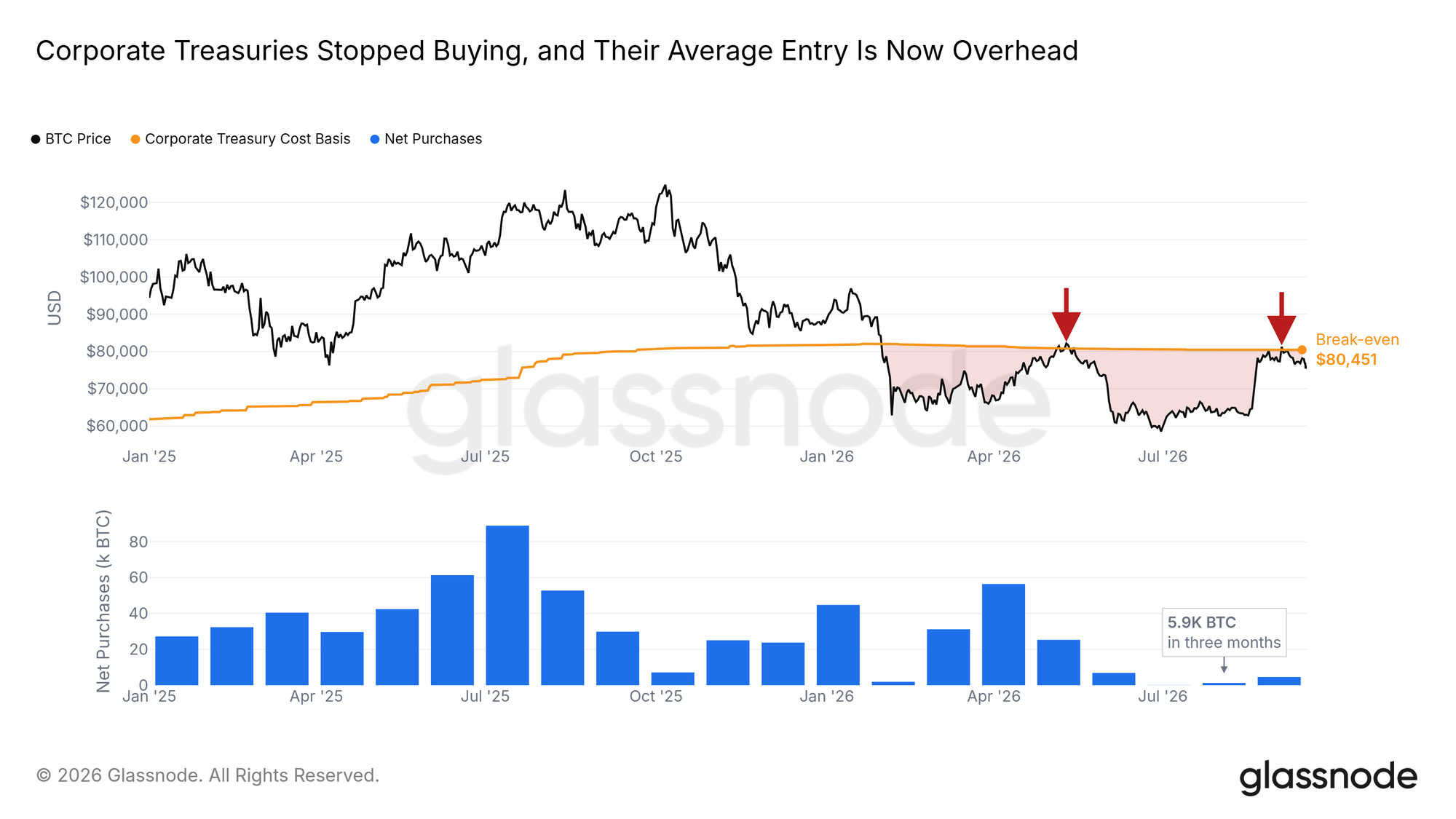
Corporate treasuries were a big buyer through 2025, and they have stepped back. Net purchases by listed companies total about 5.9K BTC over the past three months, against 89K BTC in July 2025 alone. Their average entry, the Corporate Treasury Cost Basis, sits at $80.5K, about 6% above spot, so the group as a whole is under water.
Price has tested that line twice since it fell below it in January 2026: in May, and again on September 3, 2026. It turned down both times. A buyer that has stopped buying and holds a paper loss is not support. A reclaim of $80.5K would put the treasuries back in profit and remove one layer of overhead supply; until then their entry is one more ceiling.
Altcoins Roll Over First
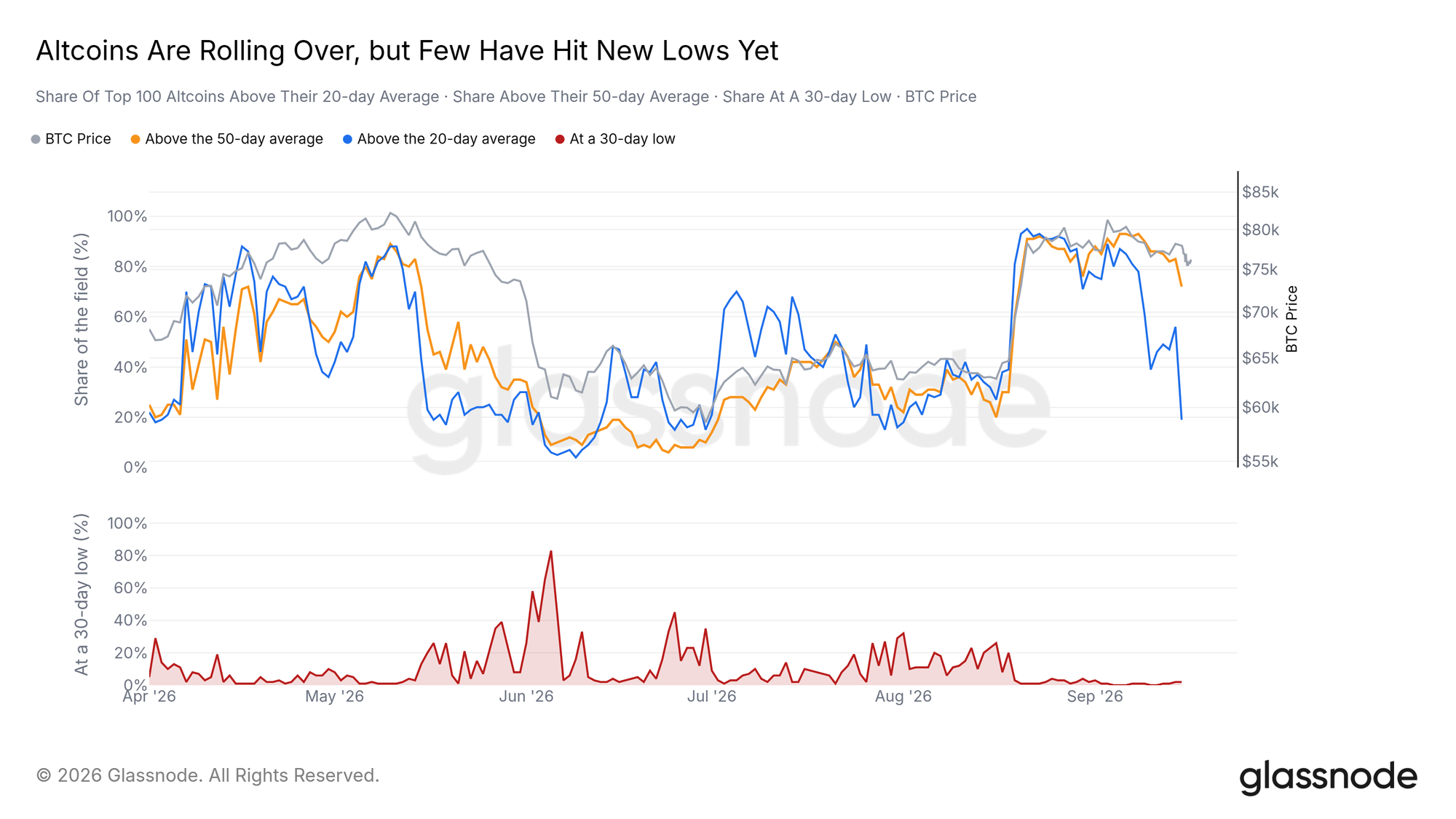
The altcoin market took the vote harder than Bitcoin. Measured from the last close before the vote, the median top-100 coin fell about two points more than Bitcoin. The share of the field above its 20-day average dropped from 56% to 19% in one session.
The longer trend bent without breaking. Most of the top 100 still trade above their 50-day average, and almost none sit at a 30-day low. At the May 2026 top the 50-day share halved within a week; this week it slipped only modestly. Altcoins have rolled over, but they have not started a new leg down. A fall in the 50-day share on the scale of May's would mark that turn.
Options Lean Down and Cap the Upside
Paying for Downside Since the Vote
Into the vote, options traders were paying up for upside. The one-week 25-Delta Skew measures the price gap between puts and calls at the same distance from spot. In the hour before the Senate vote it sat well below zero: calls, the options that pay in a rally, cost more than puts, the options that pay in a fall. Within hours of the result it crossed above zero, and it has kept climbing since.
One-week implied volatility, the price of options overall, spiked into the vote hour and fell straight after. The market has not sold that downside protection back. The line to watch is zero: a return of the one-week skew below it before the Fed decision would show the market buying its upside back.
Max Pain Below, Calls Above
The standing options book adds a ceiling. The September 25, 2026 expiry is the quarter's largest. Its max pain, the price at which the most options expire worthless, sits at $72K and has not moved up with spot. Max pain marks where the expiry's weight sits, below the market. The single biggest bar on both sides is the $70K strike, where the heaviest call and the heaviest put of the expiry both sit.
Above spot the book is stacked with calls. The biggest call strike above spot is $85K, with a second wall at $90K. Those strikes sit inside and just above the $83K to $86K ceiling that this report drew last week from long-term holder supply. The option market and the spot market agree on where the upside is capped.
Where a Retrace Would Go
Support Sits Close, Then Thins Out
The order book shows how far a retrace would run if the range is lost. Resting bids, the buy orders waiting in the book, have pulled in toward price. Nearly two thirds of the bids resting within 20% of price now sit between 1% and 10% below it, up from about half at the start of the year. In the zone from 10% to 20% under price, the buy wall that stood through 2025 has drained to well under its normal depth.
In price terms the near bids reach down to about $68K; below that the book is thin until about $61K. That thin zone is no man's land. The Short-Term Holder Cost Basis at $71.3K sits inside the near block, so a retrace that stops there would be a normal test of the bids close to price. If the range breaks and those bids are used up, the next floor is the on-chain one at $62K to $65K, where the heaviest block of supply below the market was last bought.
Conclusion
Bitcoin's range has failed at the bottom, but the break is not confirmed: price sits about 1% under the True Market Mean at $76.7K after a shallow drop through a bad news week. Resilience is the bull case; the bear case is that nothing feeds it. On-chain and ETF inflows have stopped, stablecoin supply is flat, treasuries are under water and not buying, altcoins have rolled over, and options pay for downside under a wall of calls. Two daily closes back above $76.7K with Realized Cap growing again would restore the range. A second close below it would confirm the break; then the near bids, $71.3K and the $62K to $65K floor decide how deep the retrace runs.
Data as-of September 16, 2026 for price, options and order-book series at the latest settled hour, September 15, 2026 for daily on-chain series, and September 14, 2026 for the ETF, stablecoin and treasury series; the options strike book is a snapshot from the morning of September 16, 2026; the most recent daily points remain subject to revision.
Disclaimer: This report does not provide any investment advice. All data is provided for informational and educational purposes only. No investment decision shall be based on the information provided here, and you are solely responsible for your own investment decisions.
Exchange balances presented are derived from Glassnode’s comprehensive database of address labels, which are amassed through both officially published exchange information and proprietary clustering algorithms. While we strive to ensure the utmost accuracy in representing exchange balances, it is important to note that these figures might not always encapsulate the entirety of an exchange’s reserves, particularly when exchanges refrain from disclosing their official addresses. We urge users to exercise caution and discretion when utilizing these metrics. Glassnode shall not be held responsible for any discrepancies or potential inaccuracies.
Source: Glassnode