


FILTERED RESULTS
FILTERS
MCap $2.7T +3.7%24h Vol $84.2B +59%Fear & Greed 57/100Alts Index 27/100
BTC.D 58.7% -0.3%Stable.D 9.8% -0.3%ETH.D 11.5% -0.1%Others.D 20.0% +0.7%
BR$0.5024+93.84%•CAP$0.0582+23.47%•SENT$0.0164+13.7%•ZCAT$0.1092+13.63%•UB$0.1360+13.62%•PENDLE$2.364+11.04%•PONS$0.6203+9.79%•NPC$0.0220+9.53%•B$0.2378+9.23%•NEAR$2.535+8.7%•
LSK$0.4280-28.45%•STONK$0.1954-25.23%•MINA$0.0821-17.17%•牛来$0.1059-13.02%•FF$0.1266-11.93%•MARSCOIN$0.0921-10.43%•MET$0.2185-6.35%•XTZ$0.2737-5.01%•AI$0.2382-4.46%•APEPE$0.00000124-4.24%•
•
·
·
FILTERED RESULTS
UK regulators to develop tokenization roadmap after industry feedback
Trump's WLFI Holdings Enter Lock-Up Agreement with Future Sale Timeline
Bitcoin Miner Indicator Triggers Buy Signal After 58.6% Median Returns
SEC Clears Near 24-Hour Wall Street Trading as Binance Flags Overnight Demand
$INDEX added to Robinhood assets
XRP Price Prediction After CLARITY Act Vote Tomorrow
Trump's $800 million stake into World Liberty Financial's token now has a timeline to becoming sellable
Coinbase CEO Confident in CLARITY Act Passage and Bitcoin Market Recovery
Swiss Bitcoin Pay Just Went Dark After a Mysterious Intruder
Microsoft Unveils 'Humanist AI' Code of Conduct, Asks the Public to Poke Holes in It
18 State Attorneys General Urge Senate to Reject Clarity…
Robinhood to Introduce Share Redemption and Voting Rights for Stock Tokens
SEC Proposes Regulation Crypto Assets: A Tailored Offering Regime for Covered Investment Contracts
Bitcoin tops $79K, oil falls as Trump says Iran war could end
18 Attorneys General Challenge CLARITY Act Ahead of Senate Vote
Can Circle’s Arc Repeat Robinhood Chain’s Meme Coin Boom?
a16z’s Miles Jennings Urges Senate to Advance CLARITY Act
CLARITY Act’s ‘final’ deal is already breaking down before tomorrow’s Senate vote
The Standard Reserve Is Building a New Kind of Bank Onchain
Analyst Predicts Bullish Stock Will Thrive Amid Upcoming Crypto Legislation Vote
Crossover Markets Achieves $2 Billion in Trades via BitGo’s Go Network
White House crypto adviser says Trump gave up 'historic' ethics powers in compromise
U.S. House Financial Services Committee to Review Strategic Bitcoin Reserve Bill
Strategy Completes $139 Million Stock Repurchase of STRC
Capital B Adds 4 BTC Through Equity Raise as Corporate Accumulation Methods Differ
White House crypto adviser Patrick Witt says he is feeling "very good" ahead of a
Trump Says He’s the Only ‘Guardrails’ AI Needs, Attacks Anthropic and Defends Data Centers
NVIDIA's Transformer Engine Boosts MoE Training in JAX by 10x
Claude AI Launches Tools for Financial Advisors to Streamline Workflows
Leopold Aschenbrenner is back to losing money in AI stocks
Strategy Inc. Completes $139 Million Preferred Stock Buyback Amid Rising Share Prices
NYSE and Korea Exchange Sign MOU to Enhance Market Access
Final CLARITY Act Packs 126 Changes Requested by Senate Democrats
DFDV Adds 55,491 SOL, Sets Up $300M CHAD ATM
Bitfinex Alpha: ETH ETF Inflows Outpace Bitcoin as Traders Use ETF Positions as Collateral for CME...
New York AG Letitia James and 17 other attorneys general urge Congress to reject the CLARITY...
Aerodrome Achieves Milestone in Spot FX Volume on Base Network
OCC grants preliminary charter approval for digital-asset-focused de novo national bank
Sui (SUI) Flashes a Buy Signal After a 10% Weekly Drop: What Are the Potential Targets?
Strive adds 469 Bitcoin to reach 25,000 BTC treasury
$55 million Aave stablecoin pool sees just $4.4 million available for withdrawals
What happened to HTX’s 700 million missing TRX?
250,000,000 $USDC (250,025,062 USD) minted at USDC Treasury...
CrowdStrike (CRWD), Cyber Security Stocks Surge on AI Warnings
Senate Officially Schedules CLARITY Act Cloture Vote For Tuesday
Treasury Secretary Bessent says passing the crypto Clarity Act is essential for the US to ...
Big week loading in NYCThe Starting Block will broadcast live from Avalanche Summit in New
Banks escalate stablecoin rewards fight as Senate prepares for a Clarity Act vote
BTC Breaks Through $79,000, Up 0.55% in 24 Hours
White House Crypto Advisor Challenges Banking Lobby Over Stablecoin Concerns
250,000,000 $USDC (249,995,124 USD) minted at USDC Treasury...
Iran states it does not seek negotiations with the United States....
U.K. Bitcoin reserve firm Satsuma to delist from London Stock Exchange
CLARITY Act faces state AGs opposition ahead of key Senate vote
Bitcoin Climbs as AI Slowdown Calls Sink Nvidia, Intel and Other Chip Stocks
Wyoming Stable Token Commission Switches to Chainlink CCIP Citing Security Concerns with LayerZero
$INDEXCO added to Robinhood assets
Bitcoin Price Reclaims $78K as CLARITY Act Talks Heat Up
US Treasury Secretary Advocates for Crypto Clarity Act Amid Global Competition
Swiss Bitcoin Pay Shuts Down Servers After Suspected Hack
Treasury Secretary Bessent says passing the crypto Clarity Act is...
Crypto Market Has 'Definitely Not Priced In' Clarity Act Surprise, Says Bernstein
Swiss Bitcoin Pay Shuts Down Servers After Suspected Security Breach
Trump Says AI Needs No More Guardrails, Slams Anthropic’s Amodei
AG Letitia James Leads 18-State Bipartisan Push to Reject the CLARITY Act
US Spot Bitcoin ETFs Experience $463 Million in Outflows Amid Market Challenges
U.S. 10-Year Treasury Yield Hits 5.012%, Highest Intraday Level Since 2007, as Oil Surge Fuels...
CryptoQuant says Bitcoin Bull Score Index jumps to 80 as eight of ten on-chain demand indicators ...
Crypto’s Clarity Act Advances Amid GOP Concessions
India’s tokenized bond pilot starts with institutions, with retail access planned next


India’s securities regulator has launched a pilot that places corporate bonds and their cash settlement on linked digital rails, moving ₹1,025 crore through the first three issuances while preserving the securities’ existing legal and economic terms.
The Securities and Exchange Board of India announced Demat 2.0 on Sept. 10 after REC Limited, L&T Limited and IIFL completed tokenized bond issues on Sept. 7 and Sept. 9. The transactions comprised ₹500 crore from REC, ₹500 crore from L&T and ₹25 crore from IIFL, according to SEBI’s release. Further Stage I issuance is ongoing.
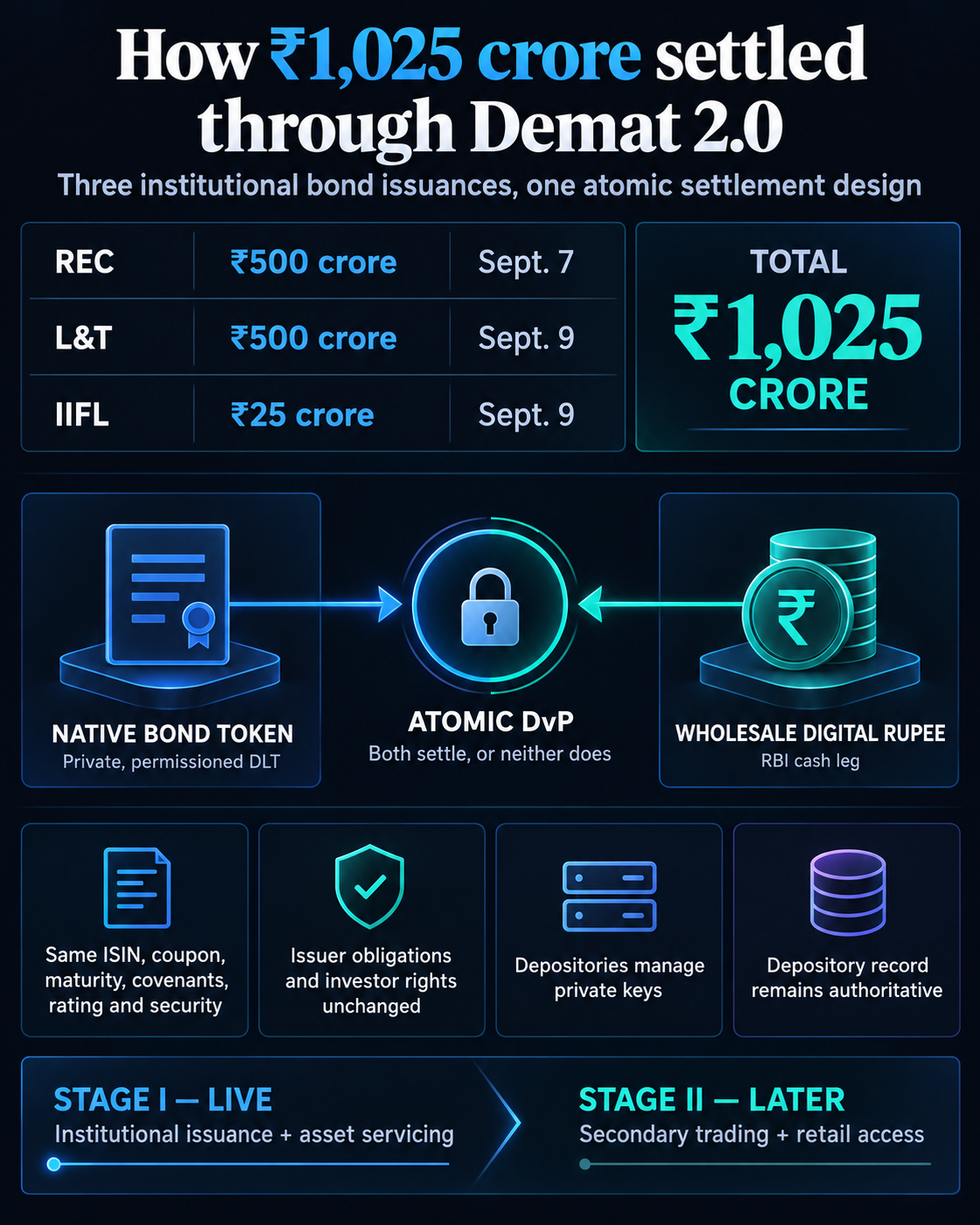
The central change is how the security and payment meet. A corporate bond is issued as a native digital token on a private, permissioned distributed ledger, while payment uses the Reserve Bank of India’s wholesale digital rupee, a central bank currency designed for financial institutions.
SEBI’s technical FAQ says the two legs are linked for atomic delivery-versus-payment. Either the bond and cash both settle, or neither does. That synchronization removes the interval in which a buyer could send funds before receiving the security, or a seller could deliver the bond before receiving payment. Issuer credit risk remains unchanged.
The token is the bond itself, rather than a digital claim on a conventionally held security. It keeps the same ISIN identifier, coupon, maturity, covenants, rating and security as a conventional dematerialized bond. Issuer obligations, investor rights and regulatory treatment also stay the same.
The network is private and institutionally controlled. India’s depositories own it and remain the statutory, authoritative records of beneficial ownership. Market infrastructure institutions developed and operate the system, with depositories and stock exchanges initially running the network’s validating computers. Depositories also hold and manage investors’ private keys, preserving an intermediated custody model.
That structure leaves the familiar custody chain in place. Investors gain access to the tokenized ledger without managing the bond tokens’ private keys or replacing the depository record that establishes ownership.
Secondary trading comes later
The live first stage covers institutional issuance and ledger-based asset servicing. SEBI reserves tokenized secondary-market trading and retail participation for Stage II.
During the interim, an investor may exit through a peer-to-peer or demat-to-demat transfer handled by depositories. Payment for that transfer may occur outside the atomic setup through the digital rupee or conventional banking channels.
The first deals show how regulated securities records and central bank money can be synchronized at issuance. The larger test for Stage II is whether the same architecture can support routine liquidity and a broader investor base after the bond has been issued.
Source: CryptoSlate