


FILTERED RESULTS
FILTERS
MCap $2.6T -1.5%24h Vol $89.5B -1.7%Fear & Greed 69/100Alts Index 27/100
BTC.D 58.5% -0.1%Stable.D 10.0% +0.1%ETH.D 11.4% -0.1%Others.D 20.1% +0.1%
BR$0.5368+74.14%•ZCAT$0.1237+41.96%•CAP$0.0645+28.08%•AI$0.3128+13.43%•龙虾$0.1577+11.38%•NPC$0.0230+10.51%•PONS$0.6083+7.82%•AKE$0.0158+5.81%•PENDLE$2.348+5.8%•XLM$0.1924+4.88%•
LSK$0.3601-41.11%•BTW$0.6128-15.12%•STONK$0.2056-11.54%•FIL$0.8883-11.04%•UAI$0.4453-9.92%•ZRO$0.9462-7.86%•VET$0.00738627-6.91%•QTUM$0.8990-6.7%•XTZ$0.2612-6.24%•ICP$2.590-5.86%•
•
·
·
FILTERED RESULTS
NEW: Revolut handed data belonging to 680 customers to scammers posing as government officials,
Hong Kong crypto exchange CoinEx to cease operations after 9 years in business
XRP Rallies 9.8% on CLARITY Hopes; Prediction Markets Aren’t Buying It
Bitcoin short-term holders hit 30-day profit streak as bull-market odds improve: CryptoQuant
Bitcoin’s $77K Standoff: Spot Deleveraging Meets Political Binary
Strive buys 469 Bitcoin, lifting total holdings to 25,000 BTC...
Ethereum Wallet Loses $7.8 Million in rsETH Exploit
Ethereum Price Analysis: What Could Break ETH’s $2500 Consolidation
XRP Price at $1.40 Before the CLARITY Act Cloture Vote:…
CLARITY Act vote set for today at 17:15 UTC; Republicans need 7 Democratic votes to...
Solana triples transaction size limit with mainnet upgrade....
The US Allows Perps, but Onchain Perps Are Still a Different MatterOn September 7, 2026, Jake...
Morgan Stanley Starts Heavily Accumulating Bitcoin (BTC)
Update on the Collateral Ratio Under Cross Margin and Portfolio Margin (2026-09-18)Binance will upda...
Strive's Bitcoin Stash Hits an Even 25,000 BTC After $36.6 Million Buy
Multicoin Sends 441,000 HYPE to Coinbase Prime in Past 6 Hours, Worth Approximately $35.31 Million
FCA Weighs Tokenised Gold Carve-Out to Defend London's Gold Crown
CoinEx Cashes Out: Hong Kong Crypto Exchange to Shut After Nine Years
Bitcoin self-custody creates a massive cost-basis blind spot on your 2026 crypto tax forms
Robinhood Will Add Stock Token Redemptions for Real Shares and Voting Rights
Top 3 Altcoins To Watch Ahead Of Today’s CLARITY Act Vote
Filecoin Price Prediction 2026,2027-2030: Is a Trend Reversal Ahead for FIL?
DeFi Provisions Gutted In Latest CLARITY Act Draft, Critics Say
US seeks $61M in USDT allegedly tied to sanctioned Iranian oil sales
U.S. House committee to vote on the ARMA bill on a bitcoin reserve on September 16
Matrixport(@BITofficial_EN) deposited 1,400 $BTC($107.8M) to #Binance and withdrew 10,000...
Binance Launches Binance Points Rewards Program
How and Why Crypto Exchanges Share User Data: Lawyers Explain
1,000 $BTC (76,868,173 USD) transferred from unknown wallet to #Binance...
Galaxy CEO Mike Novogratz says if Clarity Act fails to advance in Tuesday's Senate
Coinex Is Closing After 9 Years, and Its Founder Won’t Sell It
ByteDance Secures $29.6 Billion Loan From Nearly 30 Banks to Fund AI Buildout
CLARITY Act: Democrats Send Counterproposal Hours Before Senate Cloture Vote
41 Wins in 42 Bets, All on KPMG Clients: Prediction Markets…
Solana more than triples transaction size limit with mainnet upgrade
okx TO LIST $PONS FOR SPOT TRADING ...
MakerDAO and Real World Assets: How RWA Became the Biggest Collateral
Bitcoin and Ether ETFs Pull In $281 Million as…
UAE Central Bank Law Grace Period Ends as Financial Firms…
$PONS listed on OKX spot
World Liberty Financial Unveils Token-Lock Rewards to Boost Governance Turnout
Guide to the Claude + Unreal Engine 5.8 Setup
Balancer Plans to Return Treasury Assets to BAL Holders with Winddown
CLARITY Act Senate Vote Today: Here’s Everything We Know
Robert Kiyosaki Warns “Biggest Crash IN History Has Started”
CoinEx to Shut Down After Nearly Nine Years as Crypto…
A STH Signal That's Historically Marked The End of Bear Markets“The bear market trend only truly...
An unidentified Safe wallet user lost about $7.73 million worth of rsETH in an Ethereum
CLARITY Act vote is scheduled today at 17:15 UTCRepublicans need at...
The US Justice Department Has Sought the Forfeiture of $61M in Cryptocurrency From the Sale of Iranian Oil
House Financial Services Committee to Vote on Strategic…
Jensen Huang Predicts China Will Achieve Advanced Lithography by 2030
US House Crypto Tax Bill Spares Fees Under $10, but Not Heavy Traders
Ethereum and Base Split, Leaving Wallets to Juggle Two Account Standards
Notice Regarding Termination of an Independent Contractor Relationship
CoinEx Exchange Announced It Will Cease Operations by December 2026
Jiangsu Securities Regulatory Bureau Warns Against Illegal RWA Financing Activities
Axis Robotics Launches Pre-Registration for AXIS Token Community Sale
OKX Introduces Venice (VVV) Spot Trading
FT: CEE Energy Giant Orlen Lost $424 Million in Venezuela Oil Deal Involving USDT PaymentsPolish...
Zama expands confidential Morpho lineup after first vault hits $40 million, launches
Bitcoin Retreats on US Crypto Bill Uncertainty, Rates Outlook
$VVV listed on OKX spot
Circle's Arc Blockchain Set to Launch with High USDC Demand
CLARITY Act Hits Final Stretch as Democrats Push Back Before Senate Vote
Bitwise Shuts Dogecoin ETF While XRP and Solana Funds Pull In $3 Billion
Dogecoin Price Could Be Ready for a Breakout as Whales Accumulate 240M DOGE
South Korea's KOSPI Index Declines 0.85% While Nikkei 225 Sees Minor Drop
S&P Global Leads $110 Million Round for Crypto Data Provider Kaiko
Proposed stablecoin rules might guarantee your dollar while making you wait a week to spend it


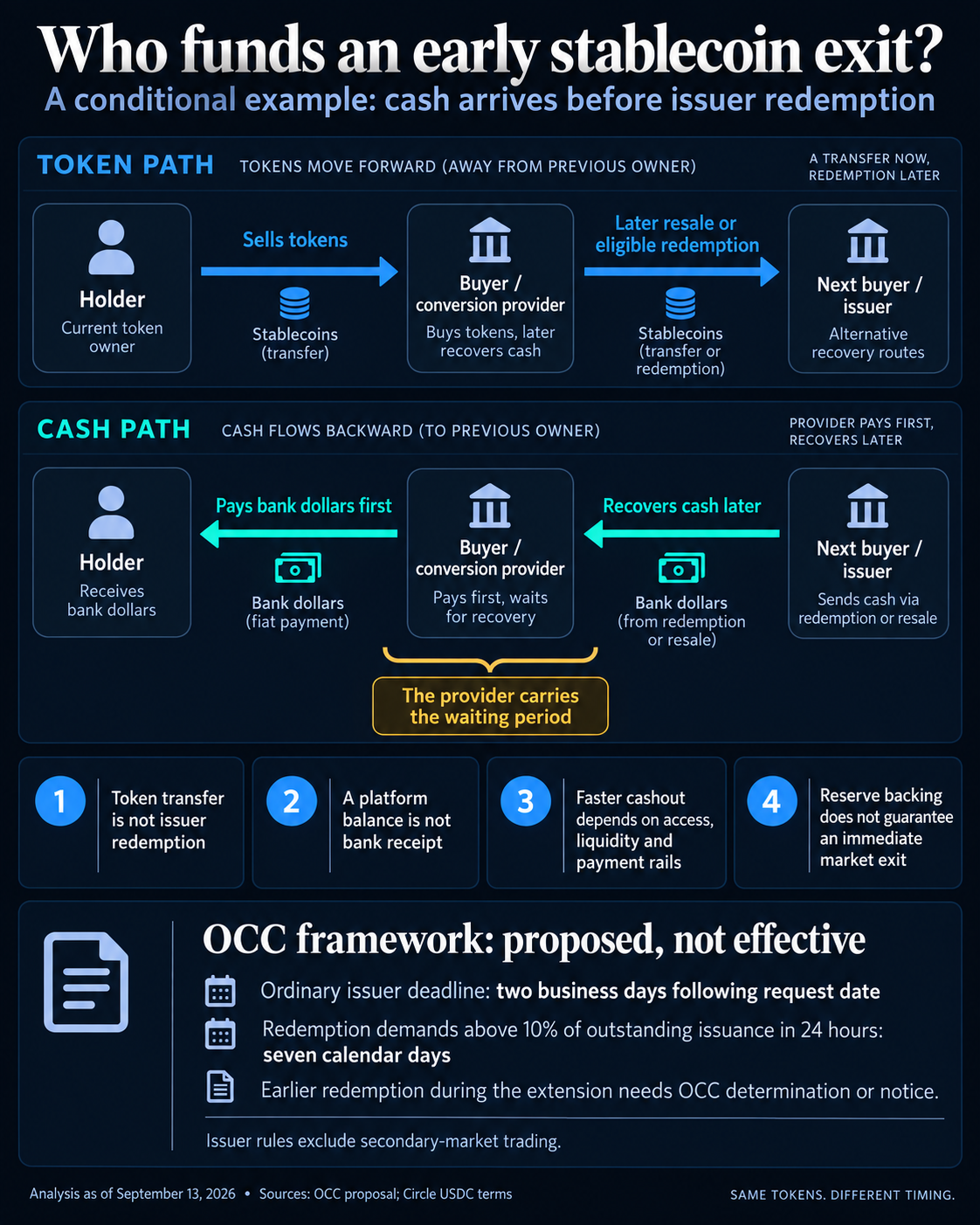
When a stablecoin holder receives spendable bank dollars before the issuer redeems the token, a buyer or conversion provider has funded the early exit. If that party keeps the token, it must wait until resale or redemption to get its cash back.
The Office of the Comptroller of the Currency's proposed redemption framework could give an issuer time to sell reserves in an orderly way while allowing secondary-market trading to continue.
A Sept. 4 Federal Reserve staff analysis clarifies the issue by separating round-the-clock blockchain payment functionality from conversion into bank dollars. Its authors describe redemption timeframes as unsettled.
The practical question for households and businesses is what happens between transferring a token and receiving money they can spend through their bank.
A longer redemption window leaves trading open
The OCC's proposed section 15.12 would set an ordinary redemption deadline of two business days following the request date, keeping faster redemption possible.
However, demands exceeding 10% of outstanding issuance value in one 24-hour period would automatically extend the period to seven calendar days for outstanding and subsequent requests.
During that extension, earlier redemption would require an OCC determination that it could proceed in an orderly, fair and transparent way, or notice that the extension no longer applied. The OCC could also extend the period for specified safety, stability or public-interest reasons.
The agency says the provisions cover issuer redemption, including entities acting on an issuer's behalf, but exclude secondary-market trading. The proposal applies to entities within OCC jurisdiction, and its stated rationale is orderly reserve liquidation with less price disruption from sudden sales.
As of Sept. 13, the measure remained on the OCC's proposed-issuance list, with a March 2 opening and a May 1 comment deadline. No corresponding rule appeared on its 2026 final-issuance list.
For a holder selling before issuer redemption, the immediate source of cash is the buyer or service completing the conversion. The issuer's reserves remain separate from the transaction chain, so a sale changes who holds the token.
If a provider uses available dollars to pay a departing holder and retains the acquired tokens, it has exchanged cash for an asset it must either hold, resell, or redeem. If it resells to another willing buyer, the exposure moves again. If it waits for issuer redemption, its cash remains committed through that interval.
This is why an issuer delay need not translate into an equally long customer delay. A provider with available cash and willing counterparties could continue offering conversion. For the customer, the bridge may be almost invisible: the token leaves, and the bank payment arrives before the issuer pays the provider.
A longer interval could require more funding for the same pace of payouts, or reduce a provider's willingness to hold additional tokens, and quotes and fees could respond.
That mechanism explains where the waiting exposure goes when an earlier exit succeeds.
A redemption right still needs an access route
Circle's USDC terms for holders outside the European Economic Area distinguish token ownership from direct redemption access. The terms require an eligible Circle Mint account in good standing. A holder receiving USDC acquires a conditional redemption right, but holding the token alone does not make that direct route immediately available.
The same terms commit to one dollar per USDC on redemption, subject to the terms, applicable law, and fees. They do not guarantee that third-party platforms will quote USDC at one dollar.
An issuer's contractual conversion value and a buyer's executable price answer different questions.
For a holder using a platform, the relevant sequence includes access to that platform, a conversion at the available price, and a final payment into the bank account. Success at one step does not establish the timing of the next. A completed token trade can leave the customer with a platform balance while the cashout process is still under way.
These particular Circle terms expressly exclude EEA holders, and they support an analysis of the specified non-EEA route.
Existing service descriptions give reasons an issuer's ordinary processing interval may not dictate a customer's experience.
Circle's 2025 Form 10-K described institutional onboarding and two redemption options: basic redemption initiated within two business days and standard redemption initiated nearly instantly. It also described banking infrastructure with multiple rails, including round-the-clock funds-flow capabilities where available.
Coinbase's instant-cashout guidance describes US customers withdrawing from US dollars or USDC balances to eligible US bank accounts connected to Real Time Payments. It specifies a $100,000 limit per transaction for instant bank cashouts and requires an eligible, verified payment method.
Its general guidance says instant cashouts typically take around 30 minutes but can take up to 24 hours depending on the bank or card provider. That broader timing guidance should not be read as a separate guaranteed delivery time for every RTP transaction.
These routes weaken any blanket claim that stablecoin holders must always wait for an issuer's full redemption window. They also make the limits concrete: eligibility, transaction size, and payment arrangements matter. A documented service can provide a usable exit without establishing unlimited capacity during a surge in demand.
Stablecoin reserve liquidity and market liquidity do different jobs
The proposal also contemplates qualifying Treasury-bill repo borrowing to support redemptions. That provides a potential source of issuer liquidity alongside liquid reserves, while permission to borrow does not establish an actual counterparty commitment, nor does a funding mechanism by itself remove the proposed conditions for redeeming early during the seven-day extension.
Circle's terms say that affiliate trading activity supporting USDC is optional and may stop. That qualification concerns those activities, and leaves a meaningful difference between a functioning secondary market and an obligation to keep buying tokens under all conditions.
For a business that needs bank money before an issuer pays, the useful distinction is whether its conversion route has both an executable price and a payment arrangement that meets its deadline. Reserve backing alone cannot answer that operational question, nor can the speed at which the token changes blockchain addresses.
The Fed staff note offers a reason to keep these functions separate: transferring value and converting it into dollars can follow different timelines.
As the OCC framework develops, the terms of any final redemption extension will determine the issuer's permitted timetable. An earlier customer exit will depend on a provider's willingness, available liquidity, eligibility rules, and payment settlement.
When that bridge works, the holder exits and another party carries the interval. When it is unavailable, sound backing alone does not bring the bank payment forward.
Source: CryptoSlate