


FILTERED RESULTS
FILTERS
MCap $2.7T +2.3%24h Vol $71.7B +35%Fear & Greed 57/100Alts Index 27/100
BTC.D 58.4% -0.6%Stable.D 9.8% -0.3%ETH.D 11.3% -0.3%Others.D 20.5% +1.2%
BR$0.5024+93.84%•CAP$0.0718+54.57%•ZCAT$0.1092+13.63%•UB$0.1360+13.62%•FIL$1.020+12.99%•B$0.2293+10.86%•NPC$0.0220+9.53%•LIT$4.436+8.71%•BTW$0.6994+8.2%•ANTFUN$0.0907+7.74%•
LSK$0.4166-51.77%•STONK$0.1954-25.23%•MINA$0.0802-19.17%•MARSCOIN$0.0927-14.15%•牛来$0.1059-13.02%•FF$0.1266-12.65%•MET$0.2141-12.46%•GLM$0.1175-10.81%•ATH$0.00452789-7.14%•SKR$0.0177-6.14%•
•
·
·
FILTERED RESULTS
US Crypto Bill Gains Momentum, Boosting Market Confidence
Consensus to Be Held in Hong Kong in Early February 2027, Focusing on Digital Assets and AI
Bitcoin Options Traders Turn Bullish for the First Time in 12 Months
BIS Highlights Systemic Risks from Hedge Funds Following Situational Awareness Incident
Consensus heads to Hong Kong for third year with expanded focus on AI
Morning Minute: Clarity Act Odds Soar as Trump Agrees to Ethics Provisions
Don’t let perfect be the enemy of Clarity
U.S. 10-year Treasury yield hits 5%, its highest level since October...
DeFi Development Corp. said its treasury holdings have grown by 55,491 SOL to
Swiss Bitcoin Pay Temporarily Shuts Down Servers Due to Malicious Intrusion
Here is the revised Clarity Act ethics provision Donald Trump has agreed to
18 State AGs Push Back on CLARITY Act Ahead of Key Senate Vote New York Attorney General Letitia...
Stablecoin Supply Declines by $414 Million Amid Rising DEX Trading Volumes
Centrifuge to Release Report on Structural Differences in Tokenized Money Market Funds
US Senate Schedules Cloture Vote on Clarity Act for Wednesday at 2:15 AM Beijing Time
UAE Moves National ID System to Avalanche Blockchain (AVAX)
Sky Ecosystem Completes First Token Burn, Reducing Supply by 2.86 Million SKY Tokens
Binance and Robinhood Collaborate to Expand Ecosystem Integration
Lisk Initiates Burn of 100 Million LSK Tokens to Reduce Total Supply
Trump says his administration has stopped AI figures like Anthropic’s...
U.S. Senate to Vote on Clarity Act for Cryptocurrency Regulation
Cathie Wood (Sister Wood) Adds $27.9 Million in Meta Stock
Swiss Bitcoin Pay Shuts Down Servers Following Suspected Data Breach
Crypto Rises as Long-Shot US Bill Gains Better Odds of Passage
NVIDIA Expands CUDA-Q Platform With Fault-Tolerant Quantum Tools
Ether, XRP and Solana Record Weekly Gains as Bitcoin ETFs Lose $463M
From Tokenless to TGE: How Crypto Projects Time Their Token…
US-listed cryptocurrency concept stocks strengthen, Bullish up over 8%
Kaiko extends Series B funding round to $110 million with S&P Global, BNP Paribas
Nike Downgraded While Affirm Receives Upgrade Amid Analyst Calls
New York AG Letitia James led a letter, along with 17 other attorneys general, telling
Sept 7–Sept 13, 2026 #LookonchainWeeklyReport
MetaMask Adds New Wallet Protections Against Crypto Scams
The Weekly MA50 Is Holding Bitcoin (BTC) Back – Here Are the Levels to Watch
Strategy Stays on the Sidelines Again but Strive Buys More Bitcoin
Another Bitcoin liquidity test arrives with Tuesday’s US tax deadline
Fed data shows hedge funds added $400 billion before Bitcoin’s September rate test
Coinbase Partners with Moov to Enhance Stablecoin Access for Community Banks
Strive slowed its bitcoin buying last week, adding 469 $BTC to bring its holdings to an
Jumper vs. Li.Fi vs. Socket: Cross-Chain Aggregators…
Sept 14 Update:#Bitcoin ETFs:1D NetFlow: -933 $BTC(-$72.67M)7D NetFlow: -5,892...
UAE Integrates Avalanche Blockchain Into National Digital ID Platform
Satsuma Technology Liquidates Bitcoin Holdings, Returns £31.9 Million to Shareholders
Public company insider sells outweighed buys 10-to-1 in August
Symbiosis Recovers 15 Bitcoin After Native Bridge Exploit
S&P Global Leads $110M Kaiko Round Backed by Nasdaq, BNP Paribas and Coinbase
PayPilot Review: Cryptocurrency, a Card, and a Fiat Account in One App
25,474 $ETH (63,826,023 USD) transferred from unknown wallet to #Coinbase...
HYPE price could suffer as Binance takes its revenue: Alice Liu
Kaito Launches Browser Extension for Zero-Knowledge Verification on X
Strategy’s Bitcoin War Chest Sat Still While Saylor Defended STRC
DeFi Development Corp. Increases SOL Holdings and Launches $300 Million Preferred Stock Program
Trump Agrees to 80% of Stricter Ethics Rules Tied to…
Nvidia, Palantir, and Booz Allen to Restrict Use of Anthropic and OpenAI Models
Bitcoin Price Holds $77,650 Going Into a Fed Hike Priced at…
Avalanche Now Powers UAE PASS Digital Vault Used by 12 Million People
Community-Built Explorers Launch for Robinhood Chain
Media: Democrats Are Preparing Large-Scale Investigations into Trump if They Win the Election
What we know about the Revolut customer data leak
etherscan INTRODUCES RobinhoodCrypto CHAIN EXPLORER "ROBINSCAN"...
Bitmine adds $68 million in ether as Tom Lee sees more upside catalysts ahead
Galaxy Digital’s Alex Thorn Flags CLARITY Act’s Missing Criminal Shield for Developers
Wall Street braces for a Monday meltdown – so why is Bitcoin holding near $78,000?
S&P 500 Free Cash Flow Yield Reaches Lowest Level Since Dot-Com Bubble
Key Economic Events to Watch This Week: CLARITY Act, FOMC, Japan CPI
BitMine Expands Ethereum Holdings to Nearly 6 Million
Tom Lee's Bitmine $BMNR acquired 27,180 ethereum:native over past week, bringing its
Former Alameda Research CEO Caroline Ellison Has Joined Manifund
An address suspected of selling $8.4 million worth of ETH
Bitcoin Knots is trying to fork Bitcoin again after its last chain died in two blocks


Bitcoin Knots is preparing a Sunday rehearsal for a BLAKE2b fork after its previous breakaway BIP-110 chain stalled.
On Aug. 29, Bitcoin developer Luke Dashjr told SHA-2 miners to stop mining ahead of an Aug. 30 test that would replace Bitcoin’s SHA-256d proof of work with BLAKE2b on the proposed breakaway network.
Dashjr said Bitcoin Knots 29.4.1rc4 would establish the final SHA-2 block before the switch. If the rehearsal succeeds, a final 29.4.1 release could preserve the new chain on Sept. 1. However, problems would trigger another release candidate and a reset to the last SHA-2 block.
The attempt comes three weeks after BIP-110 split from the dominant Bitcoin chain and stalled after producing only two blocks. The new proposal seeks to avoid another dependence on existing Bitcoin miners by permanently moving the breakaway network to hardware using BLAKE2b proof of work.
But the weekend test begins with several questions still unresolved. As of Aug. 29, the public Bitcoin Knots release page did not show rc4 or a final 29.4.1 build, while key proof-of-work changes remained open.
The proposal had also not publicly identified a major exchange, wallet, custodian, explorer, or Lightning implementation committed to supporting the new chain.
A successful BLAKE2b block would therefore show that the fork can run. However, it would not establish that enough miners, infrastructure providers, and users are prepared to keep it economically viable.
BLAKE2b tries to solve the miner problem
The central change addresses the weakness that crippled the earlier BIP-110 branch.
Instead of asking SHA-256d miners securing Bitcoin to continue producing blocks for a minority fork, the new chain would reject SHA-256d blocks after activation and rely on BLAKE2b hardware.
Backers say machines originally built to mine Sia, including Bitmain’s Antminer A3 and Goldshell SC5 models, can support the new proof-of-work system. Testnet4 mining instructions and a compatible DATUM Gateway fork have also been published.
Whether enough miners will actually participate remains unclear.
A reviewer of the open implementation calculated that one version of the proposed initial difficulty would require roughly 870 terahashes per second to maintain 10-minute block intervals. Measured testnet4 capacity was estimated at only 50 to 70 TH/s.
Those figures were based on unfinished code and are not final launch parameters. But they expose the problem facing Sunday’s test: compatible mining machines do not guarantee committed hash rate. The public discussion did not disclose how much capacity operators had pledged to the mainnet fork.
That makes block production one of the first measures of whether the new design has improved on BIP-110 rather than simply replacing one mining constituency with another.
The fork still needs final consensus rules
Bitcoin Knots also has to settle exactly which rules participating nodes will enforce.
The BLAKE2b implementation and a related reduced-data proposal were still open as of Aug. 29, while the reviewed public materials had not yet fixed the mainnet activation height.
There was also a discrepancy over the temporary block-weight limit.
The proposal’s FAQ and pull request described a 700,000-weight-unit cap, while a pinned source commit set the limit at 800,000. Nodes enforcing different values could disagree over whether a block is valid, making the final rc4 configuration critical before participants attempt to follow the same chain.
The proof-of-work change itself would be permanent. The reduced-data restrictions, including the smaller block cap, are scheduled to expire in 2027.
Sunday’s rehearsal should therefore clarify the activation height, block limit, and other parameters that determine whether participating nodes can remain on one ledger.
A working chain still needs an economy
Even if miners produce blocks under a common ruleset, the harder coordination test begins outside Bitcoin Knots.
The proposed fork changes the block header to a 164-byte format using BLAKE2b, while existing Electrum-style clients expect Bitcoin’s 80-byte SHA-256d headers.
That means light wallets, indexers, explorers, and related infrastructure may need changes before they can follow the new ledger. Dashjr said light-client compatibility falls outside Bitcoin Knots’ scope.
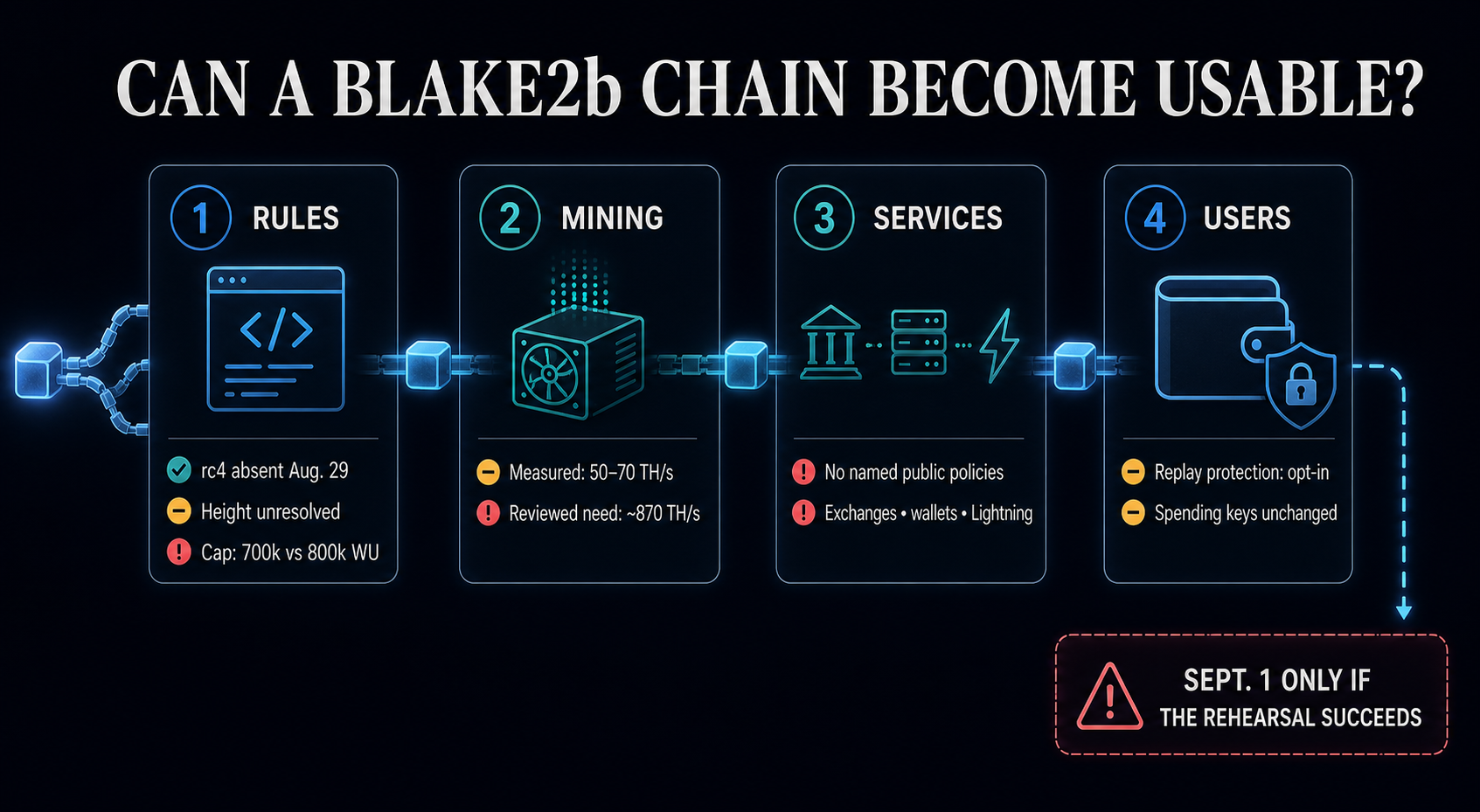
The project’s FAQ tells exchanges to pause deposits and withdrawals around the split and announce which chain they will recognize. Lightning channels created before the fork would also exist on the BLAKE2b chain, requiring both peers to use compatible software and agree on the same ledger.
The two networks would also inherit the same pre-fork transaction history and coin balances.
That creates replay risk because a transaction spending pre-fork coins could potentially be valid on both chains.
Bitcoin Knots has proposed a SIGHASH_UNIFIED signing mode that can provide directional replay protection when explicitly selected, but it would not automatically protect every existing wallet or transaction.
The switch to BLAKE2b also addresses only proof of work. It does not replace Bitcoin’s existing addresses, private keys, or transaction signatures, meaning it does not make ownership keys quantum-safe.
The immediate question this weekend is whether Bitcoin Knots can produce and maintain a BLAKE2b chain after BIP-110 failed.
The larger test begins if it succeeds: whether miners keep producing blocks and exchanges, wallets, custodians and users recognize enough economic value in the new ledger to keep it alive.
Source: CryptoSlate