


FILTERED RESULTS
FILTERS
MCap $2.6T +0.6%24h Vol $97.2B +6.3%Fear & Greed 50/100Alts Index 37/100
BTC.D 58.5% +0.1%Stable.D 10.0% -0.1%ETH.D 11.4% +0.1%Others.D 20.1% -0.1%
STONK$0.2315+35.74%•DRV$0.2331+32.7%•KSM$4.789+31.76%•ZCAT$0.1314+30.61%•BULLA$0.1071+27.95%•MARSCOIN$0.1133+24.61%•CASHCAT$0.1942+22.73%•UNI$7.362+19.33%•UAI$0.3993+18.88%•NEAR$2.935+18.35%•
LSK$0.4608-41.87%•AKE$0.0213-23.22%•BTW$0.6826-11.15%•STABLE$0.0236-10.65%•CAP$0.0549-7.19%•FF$0.1276-6.06%•KITE$0.1053-4.35%•SOSO$0.2962-4.3%•GOMINING$0.3397-2.07%•RAIN$0.0131-2.03%•
•
·
·
FILTERED RESULTS
Solana Fundamentals Strengthen Despite Recent Price Setback
Blockchain Dead Drops Surge 440% as State-Linked Actors Expand Use
100,000,000 $XRP (129,636,949 USD) transferred from #Uphold to unknown wallet...
The SEC’s Innovation Exemption sets four key conditions for Tokenized Securities Venues (TSVs):1....
Circle Launches Arc Blockchain with $649 Million in USDC and $7 Million in EURC
Financial Data Giant S&P Global Moves Deeper Into Crypto With OpenZeppelin Deal
Bitcoin coils near $76.5K as US stocks rebound from Fed rate hike
US SEC Commissioner: Will Not Predetermine TSV or Liquidity Providers as "Exchanges" or "Dealers"
100,000,000 $XRP (129,686,601 USD) transferred from #Uphold to unknown wallet...
S&P Global to Acquire OpenZeppelin in Push Into Onchain Finance
Strategy (MSTR) Launches AI Forum Amidst Mixed Market Performance
SEC Introduces Innovation Exemption for Tokenized Stocks in the U.S.
100,000,000 $XRP (130,276,973 USD) transferred from #Uphold to unknown wallet...
Uniswap Founder Highlights SEC's Innovation Exemption for Decentralized Systems
Coinbase Launches Tokenized Stocks and Bonds, Aiming for Global Accessibility
Apollo Plans to Increase SoftBank Loan to $9 Billion to Support Its Investment in OpenAI
WisdomTree, MoonPay Expand Push Into Tokenized Fund Market
Bitcoin Life Introduces Regulated Bitcoin Insurance Bonds in the UK
Virtuals Protocol Launches Skill-Based Markets with Overcall Token on Robinhood Chain
1,720 $BTC (131,865,141 USD) transferred from Coinbase Institutional to unknown new...
Mintlify Report Reveals AI Agents Now Lead in Reading Company Documentation
Coinbase CEO Discusses Impact of Failed Clarity Act on Crypto Industry
SEC Commissioner Raises Concerns Over Extended Trading Hours in U.S. Stock Market
U.S. Senate Falls Short on Procedural Vote to Advance the Digital Asset Market Clarity Act
3,321 $BTC (254,613,131 USD) transferred from unknown wallet to unknown wallet...
AI-enabled fraud is rising fast – what the latest UK economic crime reports tell us
Expect Focus - Volume III, September 2026
CFTC has issued a "no-action position" for software developers, saying that
5,000 $BTC (383,852,238 USD) transferred from unknown wallet to unknown wallet...
US Senate Rejects Clarity Act, Coinbase CEO Discusses Implications
Securitize's Market Cap on Avalanche Reaches $770 Million Amid Significant Growth
DeepLearning.AI Founder: Fear of AI Causing Human Extinction Is Pure Science Fiction
CFTC allows developers to build passive crypto derivatives software and...
Ethereum Price Eyes Breakout as Exchange Supply Falls—Can ETH Reach $3,000?
SEC’s ‘Innovation Exemption’ Excludes The Synthetic Tokens Fueling Crypto’s Stock Craze
XRP News: Garlinghouse Says XRP and Ripple’s Business Unaffected by Failed Clarity Act Vote
SpaceX Discussing Purchase of AI Model Data from Failed Startup
Trump-Backed ABTC Stock Jumps 9% as BTIG Sets $15 Target
XRP Open Interest Plunges 32% on Binance as Spot Sellers Beat Buyers
1,757 $BTC (134,944,910 USD) transferred from unknown wallet to Coinbase...
268,000,000 $USDC (268,214,400 USD) transferred from Coinbase Institutional to...
MarsCat’s MCAT Surges 186% as Trading Activity Jumps
FCA Targets Three More London Sites Over Unregistered P2P Crypto Trading
5,584 $BTC (429,292,850 USD) transferred from unknown wallet to unknown wallet...
Live from Avalanche Summit in New York - Day 2
ZEC Futures Open Interest Rises 29% Amid Concentrated Long Positions
Hewlett Packard Enterprise Shares Rise 9% Amid AI Hardware Surge
U.S. Defense Secretary Pete Hegseth says classified Bitcoin and crypto...
Pentagon Advances Classified Bitcoin and Crypto Projects for 'Strategic Advantage'
Waters Slams CLARITY Act Over Trump’s Crypto Interests
1,188,752 $SOL (120,044,730 USD) transferred from unknown wallet to unknown wallet...
Clarity Act Faces Urgent Need for Passage Amid Regulatory Developments
UK signals end of 'light-touch' era with multi-agency raid on peer-to-peer crypto hubs
U.S. SEC begins prepping for around-the-clock trading that crypto treats as the norm
Nvidia To Build For Apple? How Will The Stock Market React?
ZEC Cryptocurrency Surges Over 15% to Reach $1,443
Former SEC Chair Gary Gensler Identifies Bitcoin as the Only Commodity-like Cryptocurrency
Onchain Credit Reaches Record High as DeFi Lending Surpasses $41 Billion
U.S. CFTC ISSUES NO-ACTION POSITION TO PROVIDERS OF PASSIVE SOFTWARE"THE LETTER STATES...
Bitcoin Price Prediction: Is BTC About to Break Above $80K or Crash Below $72K?
35,565 $ETH (87,895,321 USD) transferred from Coinbase Institutional to unknown new...
1win Adds Provably Fair Technology to Its Crypto Games
House Tax Panel Fast-Tracks Crypto Tax Bill a Day After Clarity Act's Senate Defeat
SEC Approved Limited Onchain Trading of Tokenized Stocks
Crypto for Advisors: Beyond bitcoin and ether
SEC Grants Five-Year Exemption for Tokenized U.S. Stock Trading
Lawmakers pass bill to freeze federal Bitcoin holdings for two decades
Vitalik Says AI Could Strengthen Cybersecurity
SEC Clears a Path for Tokenized Stocks After Clarity Act Stumbles
Cardano’s Splash fix patches the exploit, but leaves 2.4M ADA missing and holders trapped


Three days after Splash’s Cardano-based ADA/OADA StableSwap pool was drained, OADA holders still faced a problem that corrected code alone could not solve: the pool had lost the ADA that provided their meaningful route out of the token.
Splash’s incident report said one actor used two transactions on Sept. 13 to remove 2,434,648 ADA and 1,988,222 OADA. After subtracting the attacker’s 9,870 ADA deposit, but before network fees, the ADA drain was 2,424,778.
Why a code patch is not a liquidity fix
The pool’s validator calculated a “tradable” reserve by subtracting accrued protocol fees from its real balances. According to Splash, it did not require that reserve to remain positive, bounded fee changes only from below and did not enforce the direction of a swap.
Those missing checks allowed the validator to accept a transaction after the tradable ADA reserve had turned negative. Splash said a reserve-domain check or a two-sided fee bound would have stopped the reconstructed attack.
Either fix would close the documented exploit path. Neither would return the ADA that had already left the pool. Immediately after the drain, the pool held 10 ADA and about 1.44 million OADA, while its tradable ADA reserve was negative and its LP token balance was unchanged.
The balance-sheet damage matters because Splash’s Sept. 13 snapshot said OADA had no protocol-level redemption. Other OADA venues in the report were close to empty at that time, with the listed pools holding only single- or double-digit ADA balances.
The attacker’s OADA sale created another constraint. At 14:53 UTC on Sept. 13, a Minswap V2 OADA/FLDT pool held 1,763,923 OADA against 45,751 FLDT. Splash said new ADA/OADA liquidity could be arbitraged against that inventory, allowing discounted OADA to compete for any fresh ADA placed in a reopened pool.
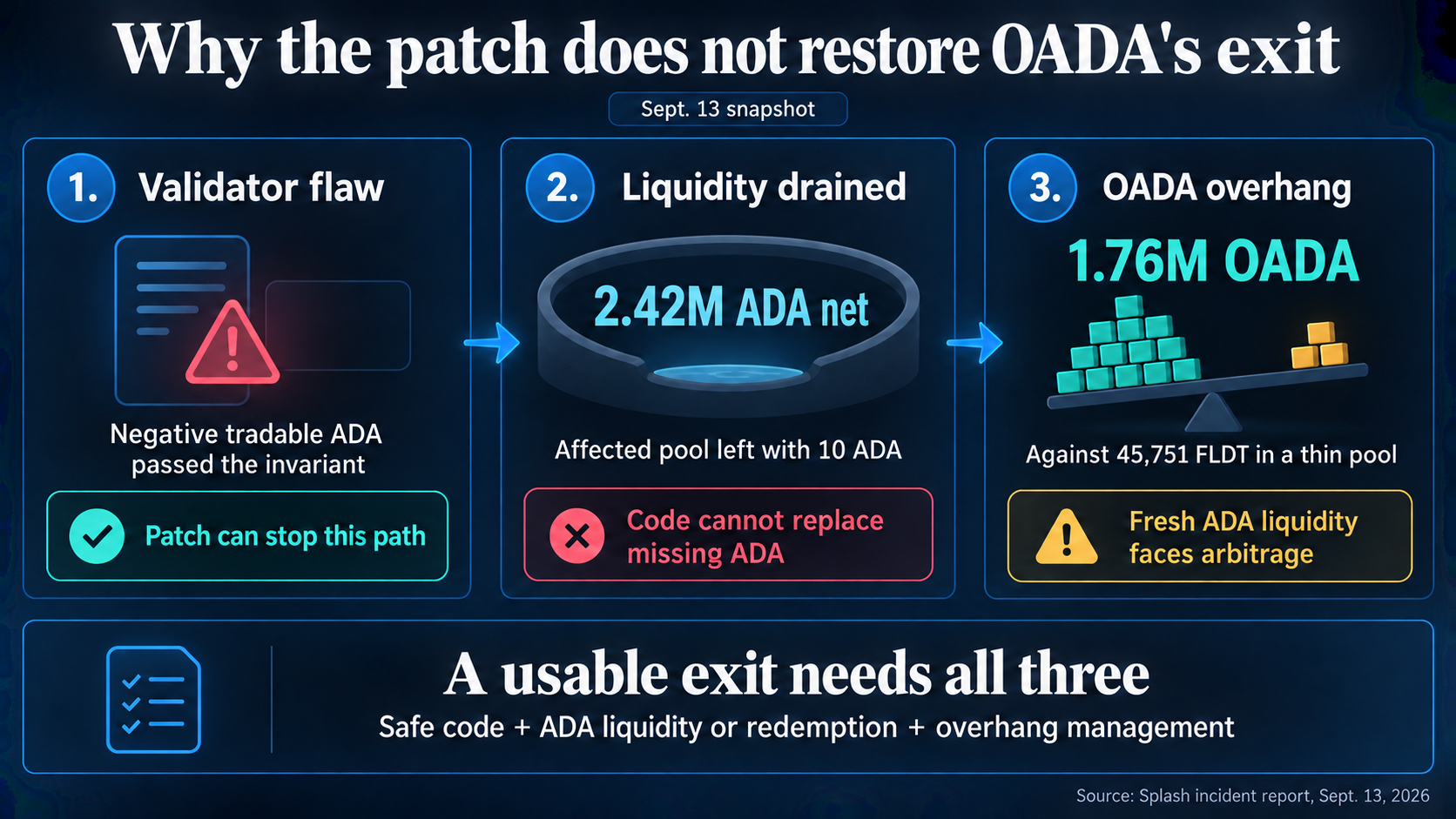
A code patch can stop the documented exploit path, but restoring an OADA exit also requires ADA liquidity or redemption and management of the thin-pool OADA inventory.
A usable relaunch would therefore require more than corrected validator logic. It would need replenished ADA liquidity or a protocol redemption mechanism, along with a way to address the OADA inventory in the thin secondary market.
Optim Finance said on Sept. 13 that its protocol was paused, remaining liquidity had been removed and OADA-to-ADA swaps were unavailable. In a Sept. 15 update, it said it was indexing the chain and compiling a full accounting of impacted addresses and assets while working toward a resolution. That update did not announce restored liquidity, redemption or operations.
Source: CryptoSlate