


FILTERED RESULTS
FILTERS
MCap $2.7T +4.2%24h Vol $88.2B +66%Fear & Greed 57/100Alts Index 29/100
BTC.D 58.5% -0.5%Stable.D 9.7% -0.4%ETH.D 11.6% 0%Others.D 20.2% +0.9%
BR$0.5024+93.84%•CAP$0.0586+24.5%•ZCAT$0.1092+13.63%•UB$0.1360+13.62%•PONS$0.6396+12.59%•B$0.2401+10.8%•ZEC$1,218.20+10.75%•PENDLE$2.365+10.56%•NEAR$2.580+10.31%•NPC$0.0220+9.53%•
LSK$0.4054-33.42%•STONK$0.1954-25.23%•MINA$0.0837-15.53%•牛来$0.1059-13.02%•FF$0.1266-11.84%•MARSCOIN$0.0926-10.4%•XTZ$0.2773-8.41%•AI$0.2382-4.46%•APEPE$0.00000124-4.24%•XMR$515.02-3.46%•
•
·
·
FILTERED RESULTS
Morgan Stanley Endorses Bitcoin as Digital Gold in New Research
Bank of America CEO Predicts Flat Trading Revenue for Q3 2026
Ethereum Q2 Revenue Jumps 112% as Active Addresses Fall 30%
Sam Bankman-Fried Says Judge Blocked $10B FTX Loss Response as Supreme Court Weighs Appeal
How Trump Rejecting AI Guardrails Impacts Crypto and DeFi Security
WLFI Launches Governance Proposal for Holder Voting Incentives
Cornelis Networks Secures $205 Million to Compete with Nvidia in AI Networking
Top Trending Coins (Today) 1. PONS 2. ZEC 3. LSK 4. NEAR 5. BTC 6. STONK 7. LAPTOP 8. ENA 9. PENGU ...
Trump Says He 'Likes' Flock Surveillance Cameras Amid Bipartisan Pushback
3,790 Sleeping Bitcoin Moved This Month, 62% on Weekends
StoneX says Robinhood Chain’s rapid growth has been driven by brokerage’s strong
Kraken Lets Users Earn DeFi Yield on Nvidia and ETF xStocks
White House’s Patrick Witt Calls Bank ‘Deposit Flight’ Claim a Myth Ahead of Clarity Act Vote
Ethereum L1 and Base Split on Account Abstraction Standards After EIP-8130 and EIP-8141...
UK regulators to develop tokenization roadmap after industry feedback
Trump's WLFI Holdings Enter Lock-Up Agreement with Future Sale Timeline
Bitcoin Miner Indicator Triggers Buy Signal After 58.6% Median Returns
SEC Clears Near 24-Hour Wall Street Trading as Binance Flags Overnight Demand
$INDEX added to Robinhood assets
XRP Price Prediction After CLARITY Act Vote Tomorrow
Trump's $800 million stake into World Liberty Financial's token now has a timeline to becoming sellable
Coinbase CEO Confident in CLARITY Act Passage and Bitcoin Market Recovery
Swiss Bitcoin Pay Just Went Dark After a Mysterious Intruder
Microsoft Unveils 'Humanist AI' Code of Conduct, Asks the Public to Poke Holes in It
18 State Attorneys General Urge Senate to Reject Clarity…
Robinhood to Introduce Share Redemption and Voting Rights for Stock Tokens
SEC Proposes Regulation Crypto Assets: A Tailored Offering Regime for Covered Investment Contracts
Bitcoin tops $79K, oil falls as Trump says Iran war could end
18 Attorneys General Challenge CLARITY Act Ahead of Senate Vote
Can Circle’s Arc Repeat Robinhood Chain’s Meme Coin Boom?
a16z’s Miles Jennings Urges Senate to Advance CLARITY Act
India’s tokenized bond pilot starts with institutions, with retail access planned next
CLARITY Act’s ‘final’ deal is already breaking down before tomorrow’s Senate vote
The Standard Reserve Is Building a New Kind of Bank Onchain
Analyst Predicts Bullish Stock Will Thrive Amid Upcoming Crypto Legislation Vote
Crossover Markets Achieves $2 Billion in Trades via BitGo’s Go Network
White House crypto adviser says Trump gave up 'historic' ethics powers in compromise
U.S. House Financial Services Committee to Review Strategic Bitcoin Reserve Bill
Strategy Completes $139 Million Stock Repurchase of STRC
Capital B Adds 4 BTC Through Equity Raise as Corporate Accumulation Methods Differ
White House crypto adviser Patrick Witt says he is feeling "very good" ahead of a
Trump Says He’s the Only ‘Guardrails’ AI Needs, Attacks Anthropic and Defends Data Centers
NVIDIA's Transformer Engine Boosts MoE Training in JAX by 10x
Claude AI Launches Tools for Financial Advisors to Streamline Workflows
Leopold Aschenbrenner is back to losing money in AI stocks
Strategy Inc. Completes $139 Million Preferred Stock Buyback Amid Rising Share Prices
NYSE and Korea Exchange Sign MOU to Enhance Market Access
Final CLARITY Act Packs 126 Changes Requested by Senate Democrats
DFDV Adds 55,491 SOL, Sets Up $300M CHAD ATM
Bitfinex Alpha: ETH ETF Inflows Outpace Bitcoin as Traders Use ETF Positions as Collateral for CME...
New York AG Letitia James and 17 other attorneys general urge Congress to reject the CLARITY...
Aerodrome Achieves Milestone in Spot FX Volume on Base Network
OCC grants preliminary charter approval for digital-asset-focused de novo national bank
Sui (SUI) Flashes a Buy Signal After a 10% Weekly Drop: What Are the Potential Targets?
Strive adds 469 Bitcoin to reach 25,000 BTC treasury
$55 million Aave stablecoin pool sees just $4.4 million available for withdrawals
What happened to HTX’s 700 million missing TRX?
250,000,000 $USDC (250,025,062 USD) minted at USDC Treasury...
CrowdStrike (CRWD), Cyber Security Stocks Surge on AI Warnings
Senate Officially Schedules CLARITY Act Cloture Vote For Tuesday
Treasury Secretary Bessent says passing the crypto Clarity Act is essential for the US to ...
Big week loading in NYCThe Starting Block will broadcast live from Avalanche Summit in New
Banks escalate stablecoin rewards fight as Senate prepares for a Clarity Act vote
BTC Breaks Through $79,000, Up 0.55% in 24 Hours
White House Crypto Advisor Challenges Banking Lobby Over Stablecoin Concerns
250,000,000 $USDC (249,995,124 USD) minted at USDC Treasury...
Iran states it does not seek negotiations with the United States....
U.K. Bitcoin reserve firm Satsuma to delist from London Stock Exchange
CLARITY Act faces state AGs opposition ahead of key Senate vote
TRON’s quantum plan could leave some wallets able to pay but unable to replace their keys


TRON’s draft quantum-signature design could leave some migrated accounts unable to replace their keys after network governance disables the signing scheme they depend on. Some of those accounts could still make payments through a separate permission.
The design includes a possible recovery route through a second quantum-resistant signature scheme. To use it, holders would need the surviving keys to meet the account’s existing owner threshold, the level of authority required to change permissions. A backup key authorized only for payments would leave that repair power out of reach.
That is the practical question behind Justin Sun’s quantum push. On Aug. 8, 2026, @justinsuntron said his goal was for TRON to become the first quantum-resistant blockchain network and referred to testing on the Nile test network. That dated statement of ambition provides the backdrop to a migration design whose governance switches can later withdraw approval for a signing scheme.
As of Sept. 12, TIP-899 remains labeled Draft. Nile’s June 30 software release included implementations of Falcon-based FN-DSA-512 and ML-DSA-44, each subject to its own activation setting. Each implementation still needs its own governance approval before the network accepts its signatures.
A Sept. 12 check of the Nile parameter endpoint returned getAllowFnDsa512 with a value of 1. The ML-DSA setting appeared without a value, providing no affirmative activation reading. The mainnet response contained neither setting. Developers had said in their July 15 call that mainnet timing was undecided; the current checks do not establish mainnet activation.
A network switch meets an account threshold
TIP-899 lets governance enable or disable each proposed scheme separately. TRON’s 27 elected Super Representatives govern through on-chain proposals. The proposed switches belong to that process.
The activation settings have also been renumbered. TIP-899 and the Nile implementation use codes 1000 and 1001, while the earlier migration discussion still contains 99 and 100. The July 1 developer call explains that the larger numbers were chosen to avoid conflicts with future mainnet numbering. Those numbers identify the proposed settings; activation requires a separate governance decision.
At account level, the question is which signatures remain acceptable. TRON assigns keys weights and requires a selected permission’s valid signers to meet or exceed its threshold. The proposed quantum-signature path uses that same permission calculation.
There is a consequential detail in the reference transaction verifier: a signature from a disabled scheme triggers rejection. A working fallback transaction must therefore use accepted signatures and omit the disabled scheme’s signature, even if the remaining keys carry enough weight.
Turning off a scheme can consequently remove a signing route without changing the account’s configured threshold. Nothing in that switch automatically grants another key the missing authority.
TRON’s permission documentation separates owner authority from active permissions. Owner permission can authorize any contract type and change the account’s permissions. An active permission is limited to the operations assigned to it, such as transfers.
A permission update must be signed under the existing owner permission. That makes owner configuration central to recovery: a key capable of sending a payment does not necessarily have the power to replace the account’s keys.
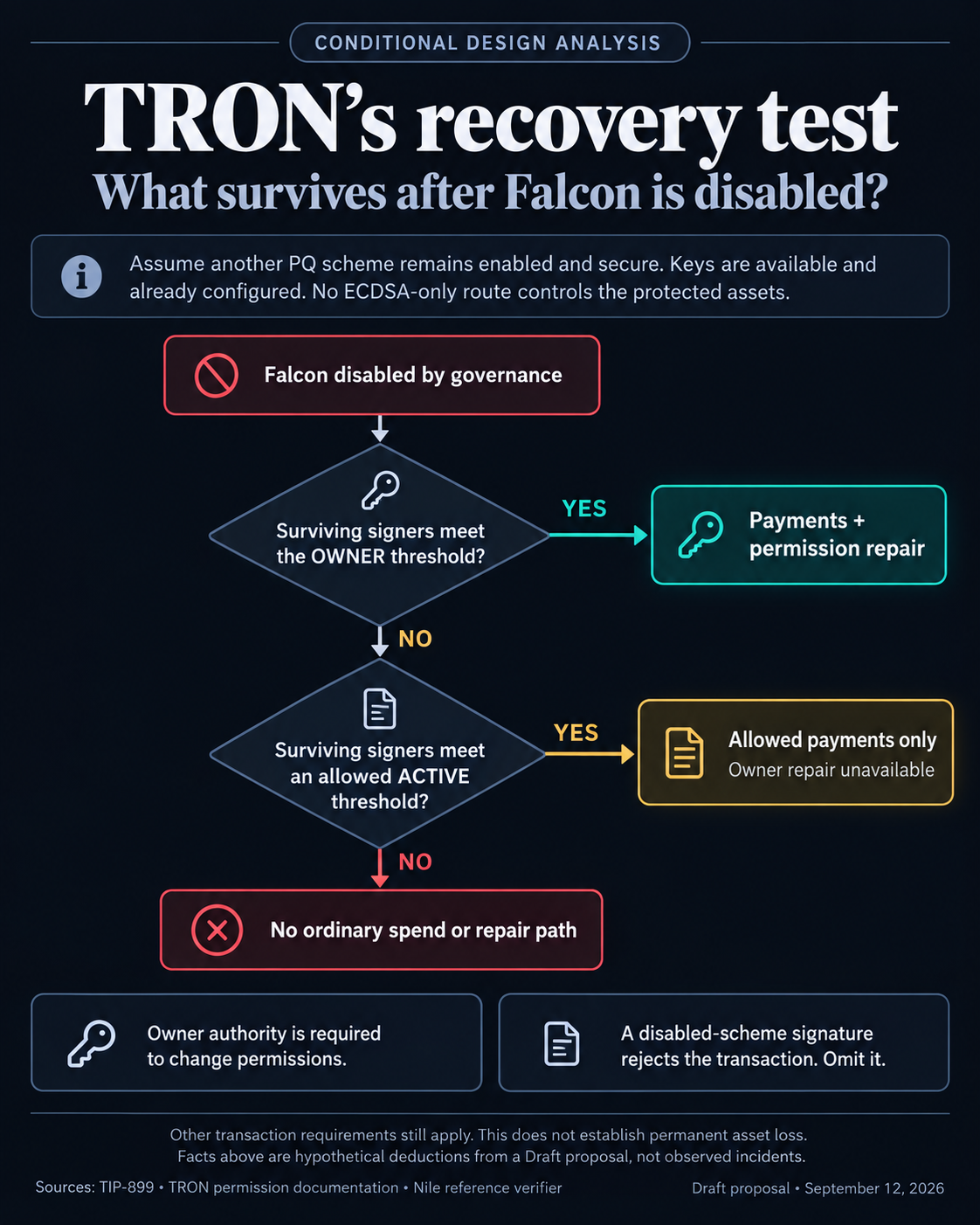
Consider an owner permission containing only a Falcon key with weight 1 and threshold 1. While Falcon is disabled, that owner permission cannot authorize a transfer or a permission update. A separately configured active permission might still permit transactions, so this does not necessarily make the entire account unable to spend.
Keeping a key for TRON’s existing ECDSA signing method alongside Falcon does not always restore access. With ECDSA weight 1, Falcon weight 1 and threshold 2, both signatures are required. After Falcon is disabled, the remaining ECDSA weight cannot meet the threshold.
The following examples apply the proposed rules to hypothetical configurations. They show deductions from the documented permission and verification rules; no observed lockout or executed rollback test underlies these examples. Assume Falcon has been disabled, any ML-DSA keys were configured beforehand, ML-DSA remains enabled and secure, and the holder can still use those keys.
| Existing permission configuration | Spending after Falcon is disabled | Changing permissions |
|---|---|---|
| Falcon-only owner: weight 1, threshold 1 | Owner cannot authorize; a separate active permission may still work | Unavailable through that owner |
| Owner: ECDSA weight 1 plus Falcon weight 1, threshold 2 | Owner cannot meet threshold; separate active permissions must be assessed | Unavailable through that owner |
| Owner: Falcon weight 1 plus ML-DSA weight 1, threshold 1; no ECDSA keys | ML-DSA owner signature can authorize | ML-DSA owner signature can authorize |
| Owner: Falcon weight 1 plus ML-DSA weight 1, threshold 2 | Owner cannot meet threshold; separate active permissions must be assessed | Unavailable through that owner |
| Falcon-only owner plus a viable ML-DSA active permission | Only operations allowed by that active permission | Active permission cannot repair the owner |
These outcomes concern signature authority; other transaction requirements still apply. The distinction works in the other direction too. A surviving ML-DSA owner permission could authorize transactions directly and replace a disabled Falcon active permission.
A second quantum key helps only if it can act
The two-scheme owner example preserves a quantum-resistant route to permission repair if either key can independently meet the owner threshold. Requiring both keys creates a dependency on both schemes remaining available. The threshold determines which of those properties an account has.
Nor does a classical recovery route preserve the same security objective. The migration proposal explicitly says that adding a quantum-resistant key provides no quantum protection if an ECDSA-only signing set can still meet the threshold. An ECDSA-only owner route can also replace a quantum-protected active permission.
The relevant configuration is therefore broader than the key used for routine payments. Owner authority and every active route capable of moving the protected assets have to be considered together.
An either-scheme configuration also has a limit: it preserves an alternative after a scheme is disabled, but it does not protect against a compromised scheme while that scheme remains enabled and independently authorized. Availability after disablement and resistance to a still-accepted compromised key are separate properties.
ML-DSA’s standards status helps explain its place in the design. NIST finalized FIPS 204, which specifies ML-DSA, on Aug. 13, 2024. NIST still describes Falcon standardization as underway. TIP-899 presents ML-DSA as an implemented alternative to Falcon’s standardization and audit risk. That provides an alternative algorithm, rather than automatic recovery permission.
The remaining work extends beyond adding a signing button. TIP-899 calls for external cryptographic and implementation auditing, public audit material and bug-bounty coverage before mainnet activation. The reviewed proposal materials do not provide a completed independent audit report.
The proposal and July 15 developer discussion also identify wallet derivation, keystore, SDK and hardware-wallet adaptation work. Testnet implementation and key-generation tools do not establish that consumer wallets or custodians can already perform every migration and recovery operation.
A useful testnet demonstration would follow the permissions through the failure: disable the scheme, construct a transaction using only surviving signatures, show which transfers remain authorized, and show whether the existing owner can replace the affected keys. The outcome would need to match the configuration users actually hold.
If both proposed quantum schemes were disabled and no valid signing set could meet the owner or relevant active threshold, the described rules would provide no immediate ordinary path to spend or rotate keys. That does not establish permanent loss. Governance reactivation or a later protocol change would be a different recovery route; the faster emergency channel and zero-knowledge recovery ideas remain outside this proposal’s current scope.
For wallets and custodians, payment continuity alone would leave the central recovery question unanswered. A migration configuration needs a surviving owner-authorized path to replace keys as well as a way to move funds, with both paths preserving its quantum-resistance objective.
Source: CryptoSlate