


FILTERED RESULTS
FILTERS
MCap $2.7T +2.7%24h Vol $91.3B +72%Fear & Greed 57/100Alts Index 27/100
BTC.D 58.7% -0.3%Stable.D 9.9% -0.2%ETH.D 11.5% -0.1%Others.D 19.9% +0.6%
BR$0.5368+74.14%•ZCAT$0.1237+41.96%•CAP$0.0639+36.11%•PONS$0.6562+19.93%•PENDLE$2.388+14.59%•SENT$0.0160+13.49%•AI$0.3128+13.43%•龙虾$0.1577+11.38%•NPC$0.0230+10.51%•JTO$0.4579+10.17%•
LSK$0.3854-40.9%•MINA$0.0812-15.6%•BTW$0.6128-15.12%•STONK$0.2056-11.54%•FF$0.1269-10.83%•UAI$0.4453-9.92%•USELESS$0.1964-9.4%•MARSCOIN$0.0922-7.26%•RAIN$0.0143-5.53%•XTZ$0.2701-4.25%•
•
·
·
FILTERED RESULTS
SEC's Atkins backs Clarity Act but says agency will keep pushing crypto rules without it
Grayscale Launches 4 Crypto Portfolios for Financial Advisors
Balancer Proposes Liquidation and Treasury Distribution to BAL Holders
USDC Achieves $100 Trillion in On-Chain Transaction Volume
$16.6 Billion in Bitcoin and Ethereum Options Set to Expire in September 2026
Vitalik Buterin Says Crypto Anti-Collusion Rules Could Apply to AI Safety
Coinbase CEO Draws Line Between Real Tokenized Stocks and…
Gulfport Man Wins $1M on a $30 Scratch-Off: Seven Top Prizes Remain
KULR Technology Completes Bitcoin Liquidation, Exits Crypto Strategy
Banking Associations Critique Circuit Breaker Mechanism in Clarity Act
U.S. Senator Lummis says Democrats won't quit asking for more on crypto Clarity Act
Sen. Kirsten Gillibrand (D-N.Y.) is privately urging other Democrats to...
Jim Cramer says “market goes higher...” ...
Aptos Implements Major Tokenomics Overhaul with New Supply Cap and Increased Fees
Bulgaria Passes Law Granting Tax Officials Full Crypto Data Access
Senate Democrats to meet tonight on crypto CLARITY Act...
XRP holders could earn new yield, but getting out may take up to 60 days
Banks Want More: Trade Groups Demand Stricter Stablecoin Limits in Clarity Act
Bamboo Insurance Plans $700 Million IPO Amid Investor Cash-Out
Swiss Bitcoin Pay Says No Evidence Merchant Bitcoin Wallets…
After months of negotiations, Clarity Act is finally headed for an initial Senate
UAE Taps Avalanche to Secure Digital Identity for 12.5M People
OpenAI’s Sam Altman Warns Humans Could Lose Control of AI
Ethereum L1 Processes Record 203.9 Million Transactions in Q2 2026 as Average TPS Hits All-Time...
Robinhood plans share redemptions, voting rights for stock tokens, after criticism
Three Signals to Watch as Solana Pushes 24/7 Tokenized Stock Trading
Encrypted USB Drives for Crypto: How FIPS 197 Hardware…
Dogecoin Price Eyes $0.093 as Open Interest Hits $1.26B
Aave V4 proposal would put DAO funds first in line to absorb lending losses
Federal Tax Guidance for Crypto: What the IRS Rules…
As Revolut Attackers Make Threats, Here’s How You Can Lower KYC Risks
Morgan Stanley Endorses Bitcoin as Digital Gold in New Research
Bank of America CEO Predicts Flat Trading Revenue for Q3 2026
Ethereum Q2 Revenue Jumps 112% as Active Addresses Fall 30%
Sam Bankman-Fried Says Judge Blocked $10B FTX Loss Response as Supreme Court Weighs Appeal
How Trump Rejecting AI Guardrails Impacts Crypto and DeFi Security
WLFI Launches Governance Proposal for Holder Voting Incentives
Cornelis Networks Secures $205 Million to Compete with Nvidia in AI Networking
Top Trending Coins (Today) 1. PONS 2. ZEC 3. LSK 4. NEAR 5. BTC 6. STONK 7. LAPTOP 8. ENA 9. PENGU ...
Trump Says He 'Likes' Flock Surveillance Cameras Amid Bipartisan Pushback
3,790 Sleeping Bitcoin Moved This Month, 62% on Weekends
StoneX says Robinhood Chain’s rapid growth has been driven by brokerage’s strong
Kraken Lets Users Earn DeFi Yield on Nvidia and ETF xStocks
White House’s Patrick Witt Calls Bank ‘Deposit Flight’ Claim a Myth Ahead of Clarity Act Vote
TRON’s quantum plan could leave some wallets able to pay but unable to replace their keys
Ethereum L1 and Base Split on Account Abstraction Standards After EIP-8130 and EIP-8141...
UK regulators to develop tokenization roadmap after industry feedback
Trump's WLFI Holdings Enter Lock-Up Agreement with Future Sale Timeline
Bitcoin Miner Indicator Triggers Buy Signal After 58.6% Median Returns
SEC Clears Near 24-Hour Wall Street Trading as Binance Flags Overnight Demand
$INDEX added to Robinhood assets
XRP Price Prediction After CLARITY Act Vote Tomorrow
Trump's $800 million stake into World Liberty Financial's token now has a timeline to becoming sellable
Coinbase CEO Confident in CLARITY Act Passage and Bitcoin Market Recovery
Swiss Bitcoin Pay Just Went Dark After a Mysterious Intruder
Microsoft Unveils 'Humanist AI' Code of Conduct, Asks the Public to Poke Holes in It
18 State Attorneys General Urge Senate to Reject Clarity…
Robinhood to Introduce Share Redemption and Voting Rights for Stock Tokens
SEC Proposes Regulation Crypto Assets: A Tailored Offering Regime for Covered Investment Contracts
Bitcoin tops $79K, oil falls as Trump says Iran war could end
18 Attorneys General Challenge CLARITY Act Ahead of Senate Vote
Can Circle’s Arc Repeat Robinhood Chain’s Meme Coin Boom?
a16z’s Miles Jennings Urges Senate to Advance CLARITY Act
India’s tokenized bond pilot starts with institutions, with retail access planned next
CLARITY Act’s ‘final’ deal is already breaking down before tomorrow’s Senate vote
The Standard Reserve Is Building a New Kind of Bank Onchain
Analyst Predicts Bullish Stock Will Thrive Amid Upcoming Crypto Legislation Vote
Crossover Markets Achieves $2 Billion in Trades via BitGo’s Go Network
White House crypto adviser says Trump gave up 'historic' ethics powers in compromise
Circle’s Arc launch ties Wall Street firms to the network without making them its safety net


Circle is tying major financial institutions to its Arc blockchain as operators, investors, and future users ahead of its Sept. 16 mainnet launch.
BlackRock, DTCC, Visa, Mastercard, and ICE are among 11 outside institutions Circle named as founding validators, alongside Circle itself, giving some prospective users a direct role in finalizing transactions. More than 100 institutional and ecosystem builders are already working on Arc’s private mainnet.
The relationships extend beyond network operations. BlackRock was among investors in Circle’s private sale of ARC tokens and is expected to deploy its BUIDL money-market fund on Arc. DTCC is both a founding validator and a planned integration partner, with a connection targeted for the second half of 2027 that would bring DTC-custodied assets onto the network.
Circle’s structure puts prospective customers inside infrastructure they may later depend on. It also creates a boundary for users: validators help determine which transactions become final, but their participation does not make third-party applications safe or create a claim against those institutions when an application fails.
Arc’s launch disclosures say neither Arc Network Services LLC nor its permissioned validators is responsible for the content, legality, or functionality of third-party applications and warn that blockchain use can involve transaction errors or losses without recourse.
Validator role stops at settlement
Arc is designed around deterministic finality, aimed at financial firms that need a precise point when a transaction can be treated as completed.
Its Malachite consensus engine uses a permissioned Proof-of-Authority model. A rotating validator proposes a block, and the validator set votes in two stages. More than two-thirds must pre-commit to the same block before it is finalized, after which Arc says the transactions cannot be reorganized or reversed at the consensus layer.
That gives BlackRock, Visa, DTCC, and other operators a role in maintaining a common transaction history. Responsibility for smart contracts, wallets, and financial products running on top remains separate.
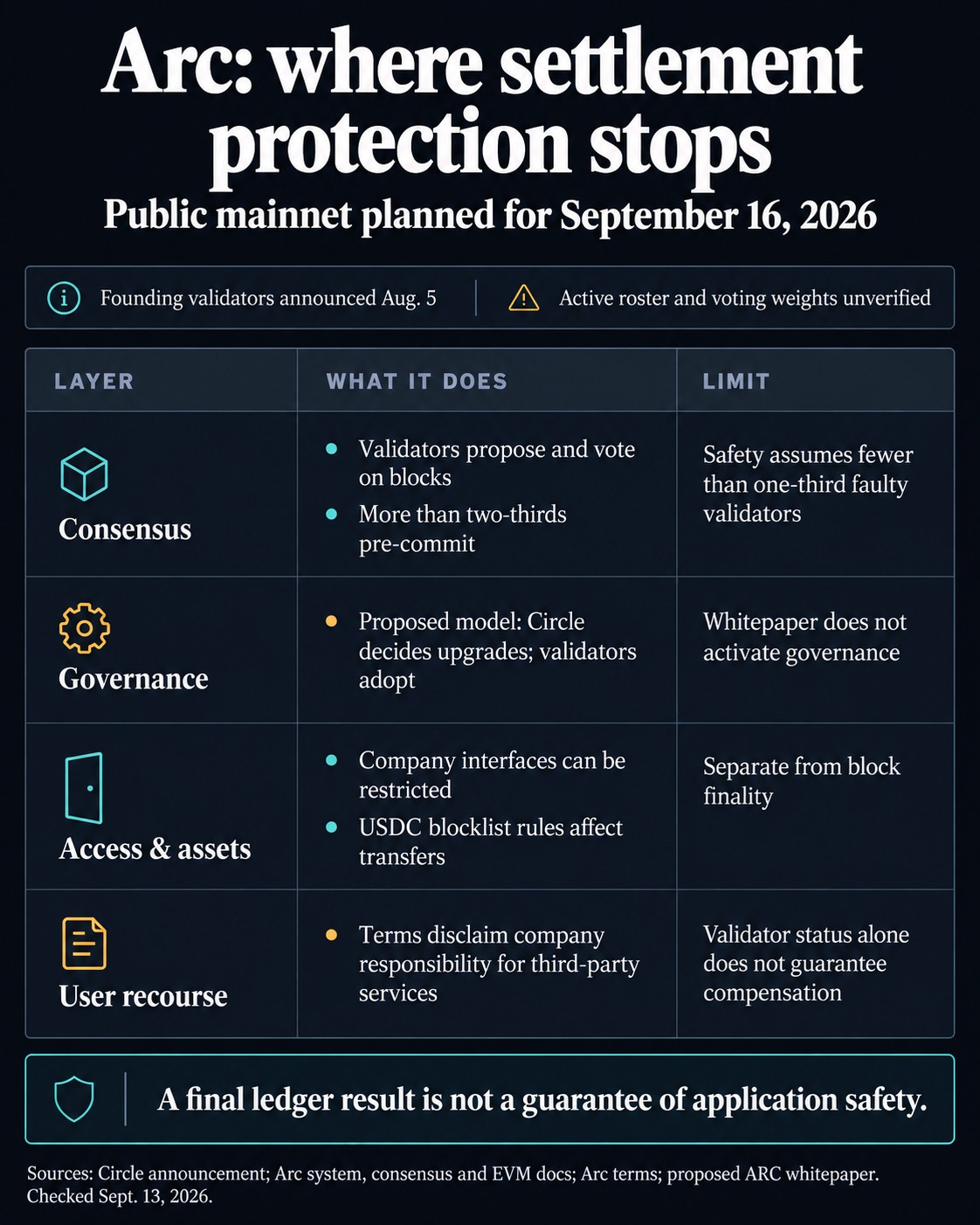
The distinction matters because Arc combines permissionless application access with permissioned validation. Developers can deploy contracts and users can submit transactions without joining the validator set, while vetted institutions continue to produce blocks.
Circle’s documentation says the launch configuration is expected to use about 20 SOC 2-certified validators across multiple regions, more than the 12 organizations publicly identified in the founding cohort, including Circle.
Circle has said validator voting power is assigned through governance, but its public launch materials do not list individual weights for the announced institutions. The precise concentration of consensus power should become clearer once the public mainnet is live.
DTCC’s planned integration shows why validator status and user protection should be separated. Circle says DTC-tokenized assets would retain the protections, rights and safeguards associated with traditionally held assets. Those protections are tied to the planned DTCC structure rather than every application running on Arc.
Circle retains a controlled launch as ARC transition looms
Arc’s institutional model leaves another question beyond transaction safety: how control over the network changes after launch.
Circle is starting Arc with a permissioned validator set while allowing developers and users open access. The company has said it ultimately wants broader participation and distributed governance, including a possible transition from Proof-of-Authority to a permissioned Proof-of-Stake model.
The economic stakes around that transition have grown. Circle agreed during the second quarter to sell 807.5 million ARC tokens to institutional investors at 30 cents each, generating about $242.2 million in gross proceeds and implying a $3 billion fully diluted network valuation.
BlackRock, Apollo, ARK Invest, ICE and Standard Chartered’s venture arm were among investors Circle named in the original presale cohort.
The ARC token has not yet launched. Circle’s whitepaper describes the token as a possible coordination asset for staking, governance and fee mechanics, while warning that its timing and final structure remain subject to change.
The presale agreements put a firmer date around that roadmap. Circle’s regulatory filings say purchasers holding a majority of the presale allocation may be able to demand repayment if the tokens are not delivered or Arc has not transitioned to Proof-of-Stake or delegated Proof-of-Stake by May 2028, subject to the agreements’ conditions.
That gives Circle a financial incentive to move beyond the launch-day structure while preserving the institutional accountability it has used to pitch Arc to banks and market infrastructure firms.
Launch turns announced relationships into a live test
The first measure on Sept. 16 will be whether the validator network operates as described and which institutions are active when public access opens.
The larger commercial test will take longer. BlackRock’s BUIDL deployment remains expected rather than completed, while DTCC’s tokenization connection is scheduled for the second half of 2027.
Their arrival would deepen the overlap Circle is creating at launch: institutions securing the network while also moving assets and financial activity across it.
That overlap could help Arc solve an infrastructure problem by giving large prospective users a reason to trust the settlement layer they help operate. It also segments responsibility. A validator can help make a transaction final while the application provider, asset issuer or custodian remains responsible for what the transaction represents.
Circle now has to turn its announced validator cohort into an operating network, then show that those relationships produce real settlement activity.
The next disclosures around active validator participation, voting power and ARC’s transition path will determine how much of Arc’s trust model rests on the institutions operating the network and how much remains with Circle.
Source: CryptoSlate