


FILTERED RESULTS
FILTERS
MCap $2.6T +0.2%24h Vol $91.6B +0.1%Fear & Greed 50/100Alts Index 37/100
BTC.D 58.4% 0%Stable.D 10.1% 0%ETH.D 11.3% 0%Others.D 20.2% 0%
CASHCAT$0.1983+25.35%•DRV$0.1748+25.23%•HNT$0.4666+18.33%•NEAR$2.780+14.98%•USELESS$0.2706+14.27%•MINA$0.0936+13.88%•LIT$4.865+13.57%•VVV$25.124+13.13%•KMNO$0.0277+11.66%•CC$0.1011+11.06%•
AI$0.2684-16.48%•STONK$0.1705-13.09%•STABLE$0.0236-12.23%•牛来$0.1078-9.28%•CAP$0.0564-6.87%•ZCAT$0.1006-4.71%•SKY$0.0568-3.98%•APEPE$0.00000117-3.46%•JLP$4.309-2.34%•PI$0.0820-2.25%•
•
·
·
FILTERED RESULTS
Zcash Surges Past $1,300: What Catalysts Are Really Driving ZEC Price?
SwissBorg Enables Direct USDC Deposits on Arc Network, Eliminating Bridge Fees
Bitwise CIO Matt Hougan says Clarity Act's failure may matter less for crypto
Bitget Launches $88,000 Promotion to Celebrate 8th Anniversary
LaunchOnSF FLIPS ponsdotfamily IN 24H REVENUE ...
Warren Buffett’s Apple Bet Turned $10,000 Into $122,400
Goldman Sachs Predicts Federal Reserve Interest Rate Hike in October
Notice on New Stocks on Binance Stock Recurring Buy - 2026-09-17To expand the list of trading choice...
Jack Dorsey Criticized Idea of Slowing Down AI Development
Bitcoin holds $76,000 after Fed rate hike, but 4 demand signals flash warning
Celsius Sues BitMEX Over $495M Bitcoin Liquidations in 2020
A Crypto Trader Lost Around $600,000 After a Fake Cloudflare Verification
Grayscale's Zach Pandl says he still believes bitcoin bitcoin:native bottomed at $58,000
Draftkings CEO Says Prediction Market Wins Are Sinking His Own Stock
Warsh's First Shot: How the Fed's Hike Is Repricing Crypto Markets
Huawei Unveils New Computing Architecture for the AI Era: Peerium Computing Architecture
United States Urges Mexico to Regulate Chinese AI Hardware Exports
Binance Alpha to List APM at 21:00 Today; Users with 235 Points Can Claim 5,000 Airdrop Tokens
Bitcoin treasuries buy just 5.9K BTC in three months as paper losses linger
Dash Price Prediction 2026, 2027 – 2030: Forecast, Targets & Growth Potential
Bitcoin (BTC) Reacts to Fed Rate Hike: Analysts Split on What Comes Next
BlackRock and Visa Help Secure Circle's New Arc Blockchain
Chainflip to reset TRON USDT provider balances to zero following $736,000 exploit
Vitalik Buterin said Ethereum is moving toward AI-assisted verification of entire
Bitcoin miner Bitdeer $BTDR produced 1,310 bitcoin:native in August, up 249% year over
NEW: Polymarket is paying NBA star LeBron James $15 million a year under its recently announced
Bitcoin faces 2022 parallels as federal reserve resumes rate hikes
Zcash Surges 2,500% in a Year: ZEC Price Hits $1,400, Market Cap Topps $23 Billion
Dogecoin Price Prediction: Crash to $0.07 Incoming? Why Traders Are Buying Pepeto Instead
Harmony Price Prediction 2026, 2027-2030: ONE Token Outlook and Future
Zcash Price Rally Accelerates Past $1,300 as Whale Activity Adds to Market Momentum
Kraken Parent Payward to Launch US Onchain Perpetuals
BlackRock Acquires $1.5 Billion in Ethereum Over 20 Days
CryptoQuant Analysis Indicates Bear Market Cycle Unlikely Despite Economic Challenges
Ostium $15M Loan Dispute Reaches NY Federal Court Today After July $23.75M Oracle Exploit
Strategy Inc. Surpasses Berkshire Hathaway in Daily Trading Volume
Moscow Exchange to Launch Perpetual Crypto Futures on…
Vanar: VANRY Token Migration Completed, L1 to Gradually Shut Down on September 18
One Account Does Not Yet Mean One Market
A Return to a Bear Cycle Is Becoming Increasingly Unlikely“Looking at previous market cycles,...
$5.68B Across 384 Deals: Galaxy Research Recorded Recovery in Crypto Venture Market in Q2
Ripple Expands Developer Toolkit to Support AI Payment Standards
Ethereum Price Prediction: ETH Holds $2,400 as Analyst Forecasts $10,000 by End of Year
Bitcoin Survives First Fed Rate Hike in 3 Years, Zcash Explodes Again: Market Watch
Ripple Launches XRPL AI Starter Kit for Autonomous Payments
Ripple adds XRP payments to Stripe and Tempo’s AI standard in new developer kit
The Fed Raised Interest Rates for the First Time Since 2023. Bitcoin Held Near $76,000
Stellar Lumens Draws Global Capital as U.S. Bank Rolls Out USDC on Stellar; CEO Discusses XLM’s Rise
Solana and XRP ETFs Attract Inflows Amid Significant Outflows for Bitcoin and Ethereum
Binance Will Support the SPDR S&P 500 ETF (SPY) Cash Dividend Distribution via bStocksBinance wi...
ByteDance Appoints Kai Jiang to Lead Hong Kong Investment Team Focused on AI
Is the CLARITY Act Really (Not) Needed for Bitcoin Price to Rally?
Zcash Has Risen 2564% In 1 Year: Why Is ZEC So Popular Now?
Bitmine CEO on Why Ethereum Could Reach $6,000 By the End of 2026
U.S. diesel prices hit record high as bitcoin and gold struggle
US Crypto Reserve Bill Passes House Financial Services Committee
Revolut Hackers Demand $3M in XMR, Give 24 Hours to Pay
Chainlink and Litecoin Slip, But This Presale Token Is Eyeing 20x Gains by October
With Quantum Computers a Threat to Bitcoin After 2030, Developers Unveil a Quantum-Resistant Roadmap
Ethiopia’s Power Crisis Puts Bitcoin Mining Boom Under Pressure
Henley & Partners Report Reveals 290 Individuals Hold Over $100 Million in Cryptocurrency
Deutsche Bank Steps Into Crypto Custody as Europe's Rules Firm Up
Spot Bitcoin ETFs See $746M Outflow During CLARITY Act and FOMC Pressure
Only 290 People Worldwide Hold $100 Million or More in Crypto, Henley SaysAn estimated 290 people...
Elon Musk Relocates to RV Near xAI Data Center in Memphis
Huawei Announces Early Release of Ascend 960 Chip
What Is Bitcoin? How It Works, Who Controls It and Why the…
South Korea Probes 26 Polymarket Users Over 17.6B Won Bets
BlackRock ETF Clients Withdraw $110 Million from Ethereum Amid Broader Crypto Fund Outflows
Solana stakers face yield cuts as a treasury firm fights to protect 99.4% of its revenue


Solana’s live monetary-policy vote is forcing the network to confront a basic governance question: what happens when the validator setting a default vote for delegated stake has a disclosed interest in preserving staking yield?
Solana Company provides the clearest test case. The Nasdaq-listed SOL treasury company and validator operator announced on Aug. 21 that it would oppose SGP-0002, a proposal to accelerate disinflation. Its earlier financial results showed that staking on company-held SOL produced $2.512 million of its $2.526 million in second-quarter revenue, or 99.4%.
Under Solana’s new governance design, delegated stake follows a validator’s position by default. A native staker can override that position for an individual stake account before the validator votes, after it votes or when it abstains from voting. This makes the company’s position influential while preserving a direct choice for the owners of its delegated stake.
On Aug. 23, SGP-0002 remained in voting with about 5.27 million SOL For, 547,019 SOL Against and zero Abstain across 24 votes. For represented about 90.6% of decisive stake at that moment. This was a timestamped snapshot, and the totals were already changing.
The public voter table and decoded Against ballots showed no vote attributable to Solana Company, HSDT or its validator operation at that observation. Unknown address labels limit entity-level attribution, so the record establishes the company’s announced intention rather than a verified company ballot.
An accepted SGP would record a directional mandate. Protocol implementation and activation require later technical work, which means the live tally measures stakeholder preference rather than an immediate change to SOL issuance.
The validator’s stake in the result
Solana Company says predictable inflation and staking yield help institutions model returns and adopt SOL. Its opposition follows the economics described in its own financial statements, while its advance disclosure lets delegators decide whether that default position matches their own preference.
The company’s second-quarter results classify $2.512 million as GAAP staking revenue on company-held SOL. Cash flow and validator commission revenue are separate measures. The company also said the 31,200 SOL earned as quarterly staking rewards were automatically restaked.
Its income statement reported a $32.7 million operating loss and a $30.3 million net loss, including $25.4 million of realized digital-asset losses. These figures describe different parts of the company’s finances. Together, they show why the staking-revenue share cannot serve as a direct estimate of the proposal’s effect on cash or profitability.
Timing adds another boundary. The 99.4% share covers the quarter ended June 30, while the company’s own validator cluster launched in July. Its quarterly filing says a portion of company SOL depends on third-party custody, staking or infrastructure providers. By the filing date, outside parties had delegated roughly 500,000 SOL to the new cluster.
The headline number therefore measures the company’s exposure to staking economics. Revenue from operating its own validator remains a separate question. Any future effect from faster disinflation would vary with its SOL balance, staking participation, commissions, SOL price, fees, MEV and activation timing.
Delegators hold the practical check on that alignment. Solana’s documentation says a native staker can override a validator’s position without undelegating. The override reallocates the stake account’s effective vote while leaving the economic delegation in place.
That mechanism was already in use. One override recorded at 14:52:53 UTC on Aug. 23 directed 15.585838993 SOL For SGP-0002. Its size confirms only that the path was functioning; it offers no basis for inferring broad delegator resistance.
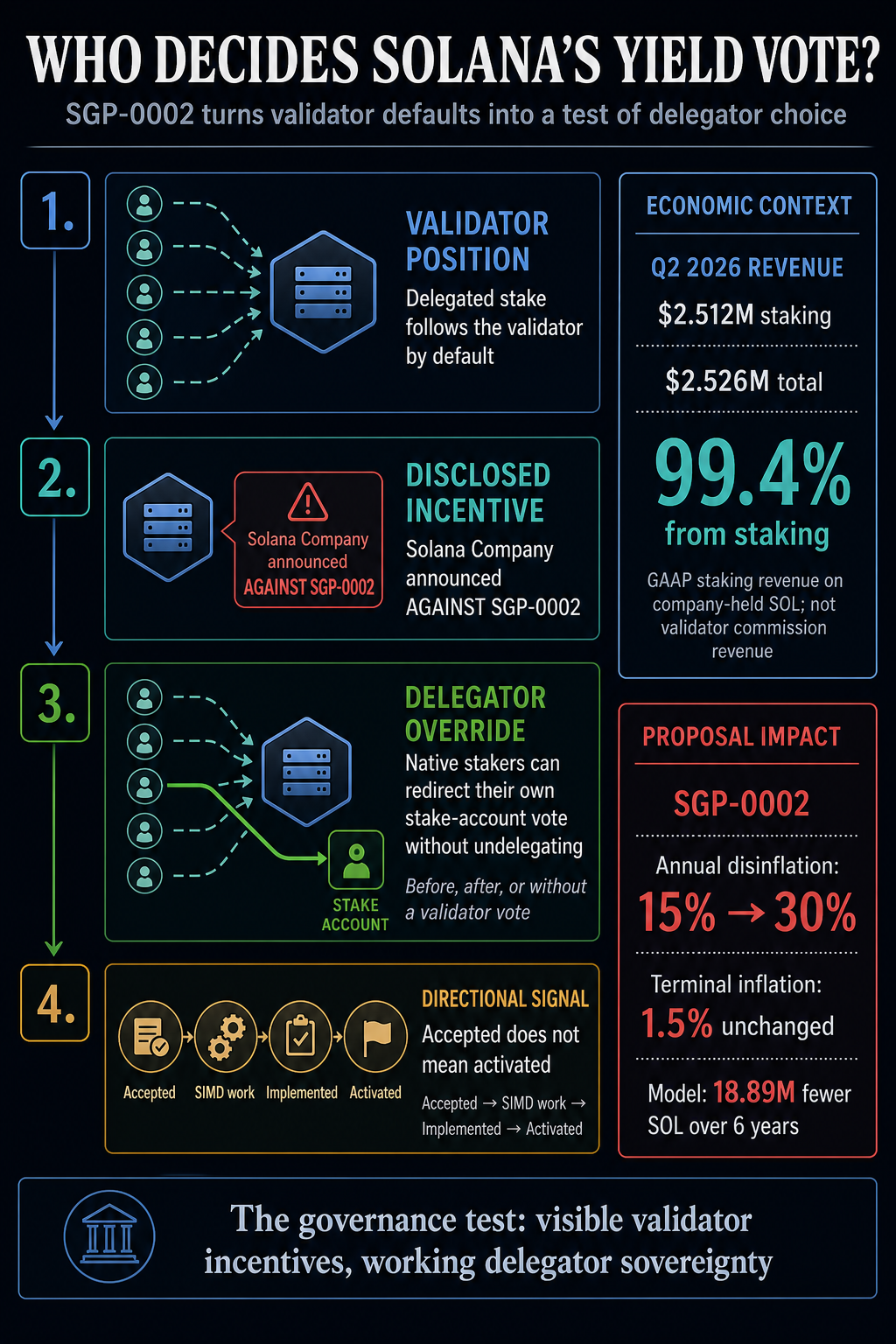
Solana Company highlighted the same power in its announcement, saying holders could override an operator and that it disclosed its positions so delegators could act. The governance design surfaces a validator’s economic alignment and lets stake owners separate their governance choice from their staking relationship.
What SGP-0002 can actually change
SGP-0002 asks Solana to double annual disinflation from 15% to 30% while leaving the 1.5% terminal inflation rate unchanged. The related SIMD-0550 model estimates about 18.89 million fewer SOL issued over six years under the faster schedule.
At the model’s 68% staking-participation assumption, nominal staking yield moves from 5.84% under the current schedule to 4.34% in the first year of the faster path, followed by 3.00% and 2.25% in years two and three. These are proposal scenarios. Solana Company’s realized revenue could differ because the model excludes validator commissions and additional yield sources such as MEV and block rewards.
Faster disinflation reduces issuance and nominal staking yield relative to the current schedule. The resulting company-level effect has no fixed percentage because stake balances, prices, fees, participation, commissions and implementation timing can all change.
Solana’s public materials also conflict on the rule used to judge the live result. The governance proposal repository policy says there is no quorum and approval requires For stake to equal at least two-thirds of For plus Against. The governance FAQ and dashboard display a one-third participation requirement alongside a two-thirds approval threshold. Current finalization code locks and records the totals after the end epoch without resolving that policy conflict.
Voting runs through epoch 1023 and closes at the epoch-1024 boundary. Solana Developers estimated that boundary for Thursday at approximately 15:30 UTC, with live slot timing determining the actual wall-clock close.
A successful vote would move the proposal into an Accepted state. Solana’s governance policy separates that state from Implemented and Activated, with technical work normally proceeding through one or more Solana Improvement Documents.
The immediate test is therefore institutional. Solana has made validator preferences visible and given native stakers a working override. Credibility now depends on whether that mechanism keeps the governance choice with delegators when a validator’s economic interest is plain.
Source: CryptoSlate