


FILTERED RESULTS
FILTERS
MCap $2.7T +2.7%24h Vol $91.3B +72%Fear & Greed 57/100Alts Index 27/100
BTC.D 58.7% -0.3%Stable.D 9.9% -0.2%ETH.D 11.5% -0.1%Others.D 19.9% +0.6%
BR$0.5368+74.14%•ZCAT$0.1237+41.96%•CAP$0.0639+36.11%•PONS$0.6562+19.93%•PENDLE$2.388+14.59%•SENT$0.0160+13.49%•AI$0.3128+13.43%•龙虾$0.1577+11.38%•NPC$0.0230+10.51%•JTO$0.4579+10.17%•
LSK$0.3854-40.9%•MINA$0.0812-15.6%•BTW$0.6128-15.12%•STONK$0.2056-11.54%•FF$0.1269-10.83%•UAI$0.4453-9.92%•USELESS$0.1964-9.4%•MARSCOIN$0.0922-7.26%•RAIN$0.0143-5.53%•XTZ$0.2701-4.25%•
•
·
·
FILTERED RESULTS
SEC's Atkins backs Clarity Act but says agency will keep pushing crypto rules without it
Grayscale Launches 4 Crypto Portfolios for Financial Advisors
Balancer Proposes Liquidation and Treasury Distribution to BAL Holders
USDC Achieves $100 Trillion in On-Chain Transaction Volume
$16.6 Billion in Bitcoin and Ethereum Options Set to Expire in September 2026
Vitalik Buterin Says Crypto Anti-Collusion Rules Could Apply to AI Safety
Circle’s Arc launch ties Wall Street firms to the network without making them its safety net
Coinbase CEO Draws Line Between Real Tokenized Stocks and…
Gulfport Man Wins $1M on a $30 Scratch-Off: Seven Top Prizes Remain
KULR Technology Completes Bitcoin Liquidation, Exits Crypto Strategy
Banking Associations Critique Circuit Breaker Mechanism in Clarity Act
U.S. Senator Lummis says Democrats won't quit asking for more on crypto Clarity Act
Sen. Kirsten Gillibrand (D-N.Y.) is privately urging other Democrats to...
Jim Cramer says “market goes higher...” ...
Aptos Implements Major Tokenomics Overhaul with New Supply Cap and Increased Fees
Bulgaria Passes Law Granting Tax Officials Full Crypto Data Access
Senate Democrats to meet tonight on crypto CLARITY Act...
XRP holders could earn new yield, but getting out may take up to 60 days
Banks Want More: Trade Groups Demand Stricter Stablecoin Limits in Clarity Act
Bamboo Insurance Plans $700 Million IPO Amid Investor Cash-Out
Swiss Bitcoin Pay Says No Evidence Merchant Bitcoin Wallets…
After months of negotiations, Clarity Act is finally headed for an initial Senate
UAE Taps Avalanche to Secure Digital Identity for 12.5M People
OpenAI’s Sam Altman Warns Humans Could Lose Control of AI
Ethereum L1 Processes Record 203.9 Million Transactions in Q2 2026 as Average TPS Hits All-Time...
Robinhood plans share redemptions, voting rights for stock tokens, after criticism
Three Signals to Watch as Solana Pushes 24/7 Tokenized Stock Trading
Encrypted USB Drives for Crypto: How FIPS 197 Hardware…
Dogecoin Price Eyes $0.093 as Open Interest Hits $1.26B
Aave V4 proposal would put DAO funds first in line to absorb lending losses
Federal Tax Guidance for Crypto: What the IRS Rules…
As Revolut Attackers Make Threats, Here’s How You Can Lower KYC Risks
Morgan Stanley Endorses Bitcoin as Digital Gold in New Research
Bank of America CEO Predicts Flat Trading Revenue for Q3 2026
Ethereum Q2 Revenue Jumps 112% as Active Addresses Fall 30%
Sam Bankman-Fried Says Judge Blocked $10B FTX Loss Response as Supreme Court Weighs Appeal
How Trump Rejecting AI Guardrails Impacts Crypto and DeFi Security
WLFI Launches Governance Proposal for Holder Voting Incentives
Cornelis Networks Secures $205 Million to Compete with Nvidia in AI Networking
Top Trending Coins (Today) 1. PONS 2. ZEC 3. LSK 4. NEAR 5. BTC 6. STONK 7. LAPTOP 8. ENA 9. PENGU ...
Trump Says He 'Likes' Flock Surveillance Cameras Amid Bipartisan Pushback
3,790 Sleeping Bitcoin Moved This Month, 62% on Weekends
StoneX says Robinhood Chain’s rapid growth has been driven by brokerage’s strong
Kraken Lets Users Earn DeFi Yield on Nvidia and ETF xStocks
White House’s Patrick Witt Calls Bank ‘Deposit Flight’ Claim a Myth Ahead of Clarity Act Vote
TRON’s quantum plan could leave some wallets able to pay but unable to replace their keys
Ethereum L1 and Base Split on Account Abstraction Standards After EIP-8130 and EIP-8141...
UK regulators to develop tokenization roadmap after industry feedback
Trump's WLFI Holdings Enter Lock-Up Agreement with Future Sale Timeline
Bitcoin Miner Indicator Triggers Buy Signal After 58.6% Median Returns
SEC Clears Near 24-Hour Wall Street Trading as Binance Flags Overnight Demand
$INDEX added to Robinhood assets
XRP Price Prediction After CLARITY Act Vote Tomorrow
Trump's $800 million stake into World Liberty Financial's token now has a timeline to becoming sellable
Coinbase CEO Confident in CLARITY Act Passage and Bitcoin Market Recovery
Swiss Bitcoin Pay Just Went Dark After a Mysterious Intruder
Microsoft Unveils 'Humanist AI' Code of Conduct, Asks the Public to Poke Holes in It
18 State Attorneys General Urge Senate to Reject Clarity…
Robinhood to Introduce Share Redemption and Voting Rights for Stock Tokens
SEC Proposes Regulation Crypto Assets: A Tailored Offering Regime for Covered Investment Contracts
Bitcoin tops $79K, oil falls as Trump says Iran war could end
18 Attorneys General Challenge CLARITY Act Ahead of Senate Vote
Can Circle’s Arc Repeat Robinhood Chain’s Meme Coin Boom?
a16z’s Miles Jennings Urges Senate to Advance CLARITY Act
India’s tokenized bond pilot starts with institutions, with retail access planned next
CLARITY Act’s ‘final’ deal is already breaking down before tomorrow’s Senate vote
The Standard Reserve Is Building a New Kind of Bank Onchain
Analyst Predicts Bullish Stock Will Thrive Amid Upcoming Crypto Legislation Vote
Crossover Markets Achieves $2 Billion in Trades via BitGo’s Go Network
Treasury proposed GENIUS change forces US exchanges to audit foreign stablecoin or face delisting


Treasury’s proposed rules under the GENIUS Act, the new US stablecoin law, would let US exchanges and other digital-asset service providers keep offering some foreign-issued payment stablecoins, but only if they can defend why they trusted the issuer’s promise to comply with lawful US orders.
Under the proposed rule, a provider could rely on a foreign issuer’s representation that it has the technology and intent to comply with lawful orders, such as valid orders to freeze or seize tokens where applicable, and reciprocal arrangements only after conducting reasonable due diligence. Reliance would be barred when the platform knows, has reason to know or should know that the representation is false or the issuer cannot or will not comply.
Treasury says that diligence should, at minimum, confirm the issuer is not subject to a public GENIUS Act prohibition on secondary trading. That check would not be enough on its own. Platforms would also need to consider all reasonably available information about the issuer.
That standard shifts the access decision to the businesses that list, sell, custody or otherwise make stablecoins available to US customers. The proposal does not identify qualifying tokens or decide whether USDT or any other named stablecoin can remain available.
Two gates for foreign issuers
The proposal has two timing points. Treasury expects the Act’s general regime to take effect on Jan. 18, 2027, unless final implementing rules trigger an earlier date under the statute. A stricter offering limit would begin July 18, 2028.
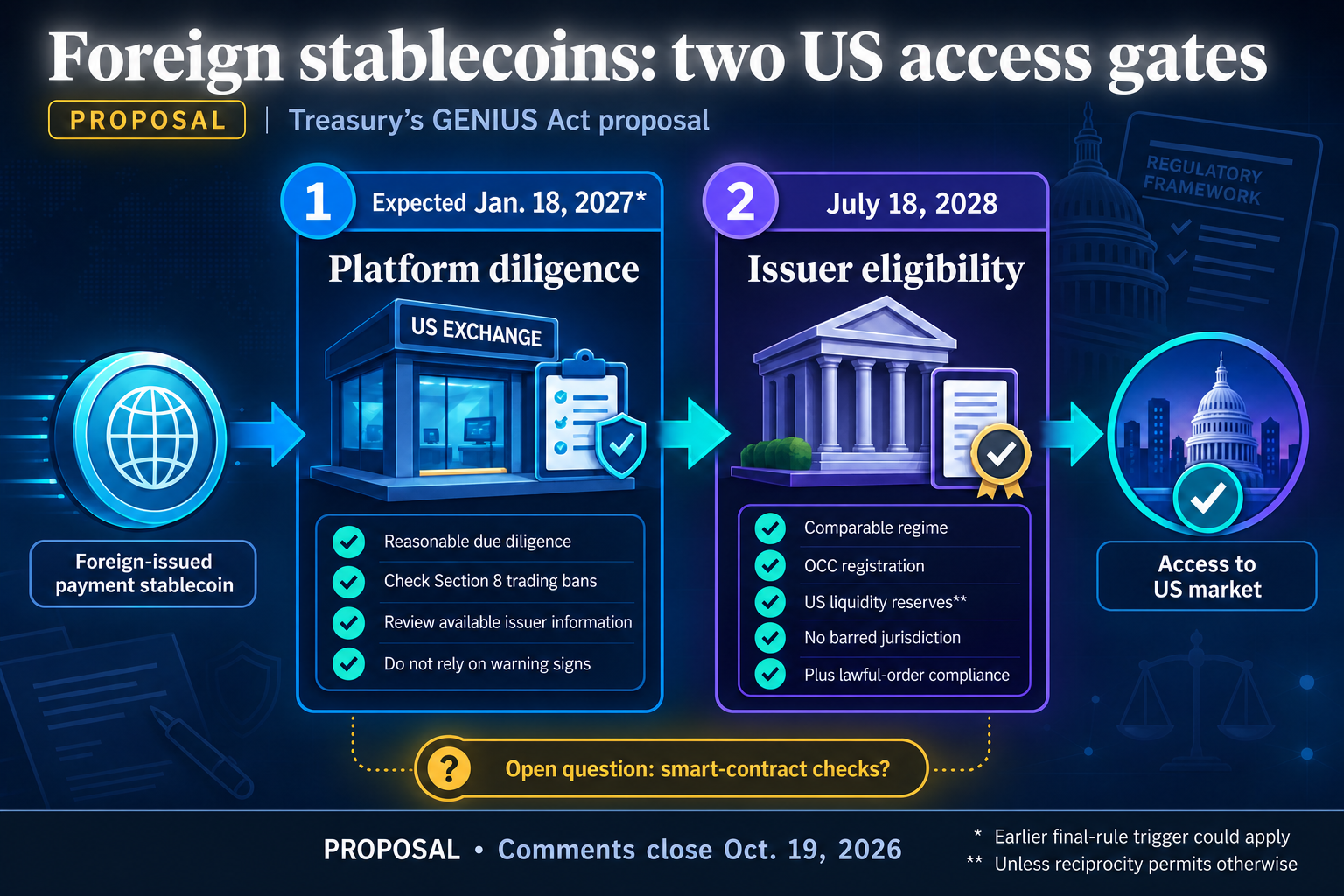
From that later date, a covered provider generally could offer or sell a payment stablecoin to someone in the US only if it came from a permitted US issuer or a foreign issuer meeting Section 18 requirements. A qualifying foreign issuer would need supervision under a regime Treasury finds comparable, registration with the Office of the Comptroller of the Currency and sufficient reserves at a US financial institution for US customer liquidity unless a reciprocal arrangement provides otherwise. Its jurisdiction also could not be under comprehensive US sanctions or designated a primary money laundering concern.
Those issuer-level tests would sit alongside the platform’s diligence over lawful-order compliance. Even a foreign issuer with a potential Section 18 route would not receive an automatic pass from the exchange carrying its token.
The proposal is not a blanket ban on holding or directly transferring foreign stablecoins. Its exemptions include lawful direct transfers between individuals without an intermediary, certain same-parent transfers between an individual’s US and foreign accounts, and transactions through software or hardware wallets used for the individual’s own custody.
What counts as adequate platform diligence remains unsettled. Treasury is asking whether the final rule should require written or regularly updated issuer representations, record retention, smart-contract review, or checks of seize, freeze and burn functions. Those are questions, not current mandates.
Comments on the Federal Register proposal close Oct. 19, 2026. Until Treasury finalizes the standard and regulators make issuer-specific decisions, US availability will depend on categories and compliance evidence rather than a published list of approved foreign stablecoins.
Source: CryptoSlate