


FILTERED RESULTS
FILTERS
MCap $2.6T -2.3%24h Vol $89.4B -1.9%Fear & Greed 69/100Alts Index 31/100
BTC.D 58.4% -0.2%Stable.D 10.0% +0.1%ETH.D 11.4% -0.1%Others.D 20.2% +0.2%
AKE$0.0273+78.56%•AI$0.3214+35.32%•龙虾$0.1779+19.42%•PONS$0.6516+18.8%•牛来$0.1189+11.99%•FF$0.1515+11.62%•LAPTOP$0.2390+9.71%•CASHCAT$0.1608+6.81%•XCN$0.00424142+6.24%•USELESS$0.2046+5.8%•
UAI$0.3767-28.04%•LSK$0.3402-26.2%•CAP$0.0620-12.18%•RAIN$0.0132-12.14%•FIL$0.8806-11.48%•B$0.2037-10.89%•THETA$0.1823-7.78%•ZRO$0.9391-7.59%•XTZ$0.2576-6.87%•SYRUP$0.2004-6.76%•
•
·
·
FILTERED RESULTS
Clarity Act Disagreements Continue With Just Hours Till Vote: Punchbowl ...
Morning Minute: Clarity Act Odds Slump After Democrat Pushback
CoinShares Reports Irreversible Shift of Bitcoin Miners to AI Technologies
Polish Energy Company Faces $230 Million Loss in Failed Oil Deal Involving USDT
Abraxas Capital Expands Holdings with Significant ETH Purchase
Cathie Wood's Ark Invest Sells Cryptocurrency Stocks Amid Price Surge
Bitcoin Price Analysis: BTC Tests Key Support Ahead of Crucial FOMC Decision
Huge Day for XRP: CLARITY Act Vote Could Spark the Next Big Move
Republicans are not buying into a counteroffer from Democrats to revise parts of
Bitcoin Mining Sector Faces Tightest Margins Since the 2024 Halving
US House to Vote on Strategic Bitcoin Reserve Bill on September 16
XRP’s path back to $2 now hinges on whether the Senate passes the CLARITY Act
Federal Reserve Expected to Raise Interest Rates Amid Rising Inflation and Oil Prices
853 $BTC (65,047,692 USD) transferred from unknown wallet to Coinbase Institutional...
Aster (ASTER) Price Prediction 2026, 2027 – 2030: Will ASTER Price Reach New Highs In the Coming Years?
Next PEPE Coin? 3 Cheap Meme Coins Set for 15,000% Rallies in 2026
ARB Price Could Surge 70x to $10 by 2030 – Says Standard Chartered
Abraxas Capital bought another 13,700 $ETH ($34.24M) spot today.Their short positions on...
Republicans Reject Democrats' Counterproposal to CLARITY Act, Key Vote Imminent
Republicans rejected Democrats’ CLARITY Act counteroffer ahead of today’s 17:15 UTC...
CoinShares says exodus of bitcoin miners to AI has reached point where even a
Hong Kong Cryptocurrency Exchange CoinEx Announces Shutdown After Nine Years
Republicans rejected Democrats’ CLARITY Act counteroffer ahead of...
A hacker turned 25 cents of bitcoin into 46 billion fake BTC tokens on a DeFi bridge
US seizes $61M of Iranian crypto profits allegedly laundered through Binance
Stablecoin payments startup Velocity has raised a $10 million Series A extension from
Sept 15 Update:#Bitcoin ETFs:1D NetFlow: +1,917 $BTC(+$147.42M)7D NetFlow: -4,372...
Kamino Appoints Michael Weisz as CEO to Drive Institutional Growth
U.S. stocks open, Dow down 0.33%
Balancer DAO Moves to Shut Down Protocol After $128M Exploit
Micron Technology to Begin Mass Production of 512GB DDR5 Memory Module in 2027
Declining Odds for Clarity Act Passage Ahead of U.S. Senate Vote
Bitcoin and Crypto Gives Back Monday Rally Ahead of Clarity Act Cloture
KuCoin Wealth Adds RWA and Crypto Multi-Strategy Products
Standard Chartered expects Arbitrum's ARB rising 70-fold to $10 citing Robinhood Chain revenue
IOTA Price Prediction 2026, 2027 – 2030: Will IOTA Price Achieve $0.1?
What Is Cryptocurrency Mining? How Bitcoin Miners Earn,…
Solana Dominates x402 Transactions Amid Declining Market Activity
Cornyn Signals He May Side With Banks as CLARITY Faces 60-Vote Test
U.S. Senate to Vote on Crypto Clarity Act Affecting Major Digital Assets
Kraken Adds Onchain Yield to SPYx, QQQx and NVDAx
Cathie Wood Sells Over $60 Million in Cryptocurrency Stocks Ahead of Clarity Act Vote
Bitcoin’s Price Is Sitting on Support After a Brutal $79K Rejection
Banks Say Stablecoin 'Circuit Breaker' Is No Safeguard as Senate Vote Nears
Why an AI Slowdown Could Collapse Under Commercial and US-China Pressure
Bitcoin Miners Pay to Exit as Average Mining Cost Hits $75.5K per BTCCoinShares said listed Bitcoin...
Senate Tests CLARITY Act at 2:15 p.m. ET: What Today’s Cloture Vote Can Change, and What It Cannot
Standard Chartered Initiates Arbitrum Coverage, Sees ARB Price at $10 by 2030
A DeFi giant that once held $3 billion is now proposing to wind itself down
Coinbase (COIN) Stock Price Prediction 2026, 2027, 2030 – 2040: Is COIN a Long-Term Buy?
CryptoQuant became a lot more powerful 1-minute data now makes it possible to build intraday...
Stock Futures Decline Amid Rising Oil Prices and Mixed Tech Performance
US Identifies $1.5B Crypto Pipeline Tied to Iranian Oil…
White House Puts Stablecoin Yield Ban’s Lending Gain at 0.02% Ahead of CLARITY Vote
Broadridge Brings Crypto and Tokenized Assets Into US…
Strategy copycat Satsuma crashed 99%, liquidated treasury
U.S. ADP Employment Sees Increase of 16,250 in Late August
NEW: White House plans to launch an interactive tool on Tuesday aimed at countering banking
Strategy (MSTR) Gets $160 Price Target From Barclays as Its Balance Sheet Matures
Balancer Proposed Winding Down the Protocol and Distributing the Treasury Among BAL Holders
CoinEx is shutting down after nearly 9 years, joining a wave of exchange closures in 2026....
Bank of America Survey Reveals Declining Confidence in Risk Assets
Bitget Wallet Introduces Tokenized U.S. Stocks from Reality
Nigel Farage-backed bitcoin treasury firm Stack BTC is proposing to acquire UK gold
US House Files 114-Page Crypto Tax Bill With $10 Fee Break Before Sept. 16 Vote
MetaMask has launched protection against “romance” and investment scams
Could XRP Price Be About to Repeat a Historic Rally?
PANews: Ethiopia Cuts Bitcoin Miners' Power Supply by 75% Due to Hydropower Shortage, Currently Delivering Only 23% of Contracted Volume, According to Bloomberg
Ethereum Holders Are Pulling ETH Off Exchanges at a Historic Pace
Ethereum wants to hide your trades from bots before they can attack


Ethereum developers are weighing a new defense against predatory trading bots that exploit pending transactions before they reach the blockchain.
The problem stems from Ethereum’s public mempool, a transparent waiting room where transactions can be inspected before execution. That visibility lets automated traders spot profitable orders and place their own transactions around them, extracting value from users before a trade settles.
The practice has become most closely associated with sandwich attacks. A bot spots a pending swap, buys the same asset first to move the price against the user, then sells immediately after the victim’s trade executes at the worse price.
While estimates suggest losses from such attacks have declined from earlier peaks, the problem has not disappeared. In April, Ethereum co-founder Vitalik Buterin was himself targeted when the notorious Jaredfromsubway.eth bot front-ran and back-ran a small swap from one of his addresses.

Developers are now exploring whether encryption can remove the informational advantage that makes those attacks possible.
Protocol researchers are scheduled to discuss the issue during an Aug. 19 “Encrypt the Mempool” call, where they will examine proposals designed to conceal transaction contents until their position in a block has already been committed.
The effort targets a long-running tradeoff for Ethereum users. Traders can already bypass the public mempool by routing transactions through private relays, reducing their exposure to front-running. But that protection comes with dependence on intermediaries that control transaction inclusion and availability.
An encrypted public mempool would attempt to preserve permissionless access to blockspace while preventing builders and bots from seeing the underlying trade before its ordering is fixed.
One leading proposal is EIP-8184, known as LUCID. The draft would require block builders to commit to sealed transactions containing a chargeable ticket and encrypted payload without knowing what the transaction does. Only after the commitment is made would the sender, or an off-protocol key publisher, release the information needed to decrypt it.
While that design closes one avenue for exploitation, it also creates another problem Ethereum developers have yet to solve.
The decryption dilemma
A fully enshrined encryption scheme would need to satisfy a difficult set of constraints at Ethereum's scale.
EIP-8184's authors list small public keys, non-interactive decryption, no trusted setup, practical ciphertext sizes, strong chosen-ciphertext security and a credible route to quantum safety among the requirements.
They say no known cryptographic construction currently satisfies the entire set at Ethereum's scale.
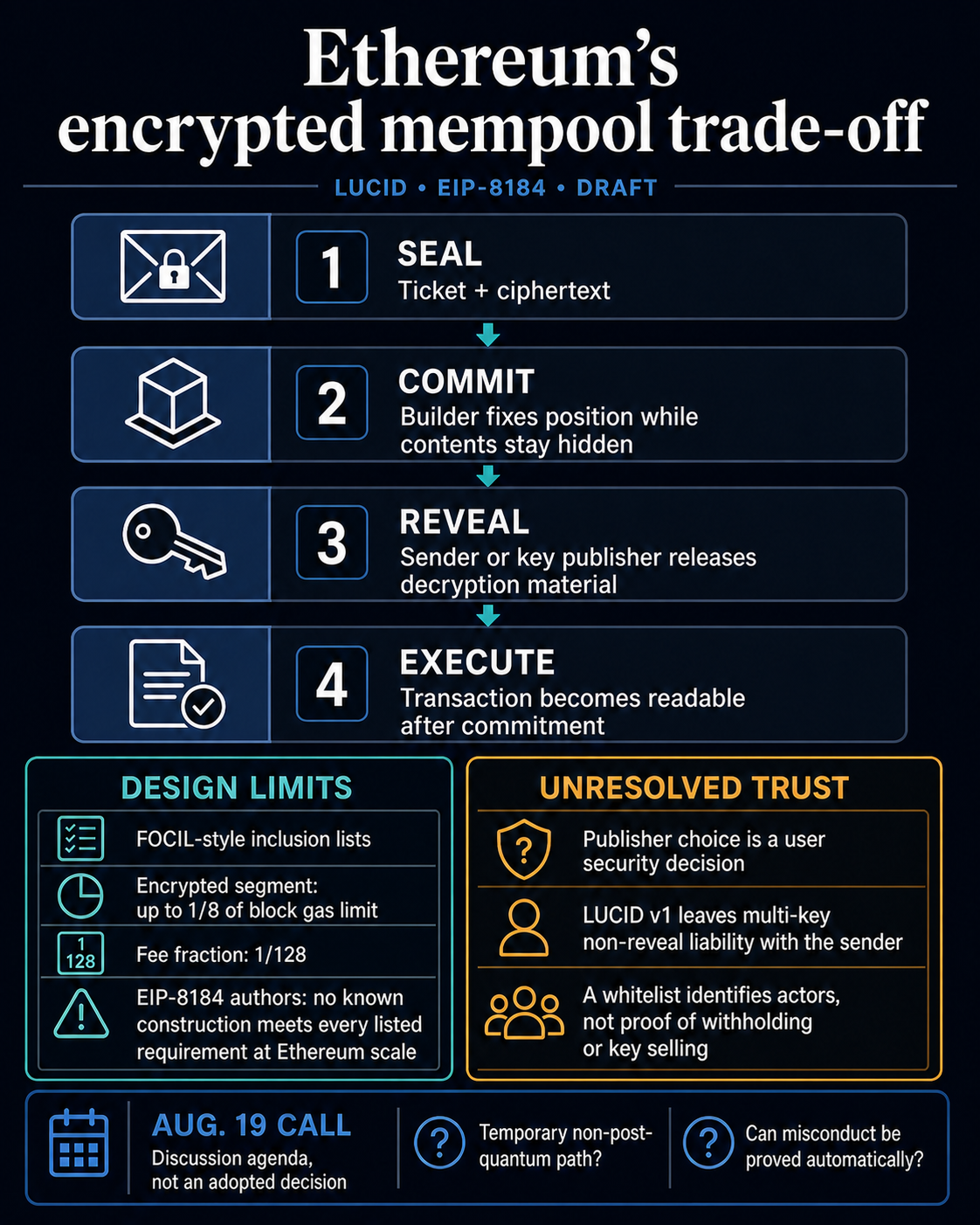
LUCID therefore leaves the decryption construction outside the core protocol, allowing senders to manage their own key release or follow instructions from a key publisher. That preserves flexibility for stronger cryptography later, but EIP-8184's security considerations explicitly make publisher selection part of the user's security model.
The design also creates financial liabilities.
If a key is withheld or fails to arrive on schedule, LUCID's initial draft leaves the protocol-level penalty for a failed multi-key reveal with the transaction sender rather than automatically transferring it to the third-party key provider.
To put an economic cost on failed reveals, LUCID caps its encrypted top-of-block segment at one-eighth of the block gas limit and uses a reservation fee. Most of that amount can be returned after successful decryption, while the full reservation can be lost when the reveal fails.
That makes failed or selective releases expensive, but it cannot establish why a key failed to arrive or determine whether a publisher deliberately leaked it early.
The authors have described an off-protocol sponsorship arrangement where a publisher funds a transaction inside the bundle and absorbs the loss if it remains sealed. Ethereum itself would not enforce that pledge.
Trading intermediaries and network scaling
Wednesday's agenda will ask developers whether a temporary, non-post-quantum cryptographic solution is acceptable.
It also targets the deeper enforcement problem: how withholding or early key selling by members of a validator whitelist could be proved and whether those proofs could be automated.
A whitelist can establish who is authorized to publish keys. It cannot by itself distinguish deliberate misconduct from software failure, network latency, or a missed deadline.
An alternative proposal, EIP-8105, uses a directed trust graph where registered providers identify other providers they trust. Providers can establish their own withholding conditions, leaving incentives, reliability systems, and potential punishment mechanisms outside Ethereum's consensus rules.
Other approaches introduce their own costs. Threshold decryption distributes control among multiple participants but adds timing pressure. Trusted hardware can shorten the path to a key while introducing new hardware and operator dependencies.
Any production deployment would also need to coordinate with Ethereum's broader roadmap. LUCID is designed to extend the inclusion-list pipeline associated with FOCIL, or EIP-7805, which gives multiple validators a role in identifying transactions a builder must include.
Ethereum's security roadmap currently targets FOCIL as a consensus-layer priority for the Hegotá upgrade in 2027, while broader post-quantum infrastructure milestones sit further out.

Source: CryptoSlate