


FILTERED RESULTS
FILTERS
MCap $2.7T +2%24h Vol $65.8B +24%Fear & Greed 57/100Alts Index 29/100
BTC.D 58.5% -0.5%Stable.D 9.9% -0.2%ETH.D 11.5% -0.1%Others.D 20.1% +0.8%
CAP$0.0650+39.64%•FIL$0.9905+18.95%•BTW$0.6373+15.22%•IOTA$0.0464+14.66%•ZCAT$0.0961+11.41%•AR$2.819+10.44%•龙虾$0.1492+10.06%•LIT$4.499+9.91%•PENDLE$2.329+9.56%•B$0.2239+9.53%•
UAI$0.5143-35.35%•AI$0.2490-27.54%•MINA$0.0812-21.51%•LSK$0.4968-21.47%•LAPTOP$0.2994-18.09%•MARSCOIN$0.0916-15.18%•STONK$0.2623-11.11%•USELESS$0.1976-10.74%•MET$0.2142-8.37%•SKR$0.0174-7.18%•
•
·
·
FILTERED RESULTS
An address suspected of selling $8.4 million worth of ETH
Abraxas Capital now holds over $980M in short positions on Hyperliquid!This includes shorts on...
Abraxas Capital Holds Over $980 Million Short Position on Hyperliquid
BitMine Buys 27,180 ETH, Bringing Holdings to 5.96M ETH BitMine said it acquired 27,180 ETH over...
S&P Global led a strategic investment in crypto data provider Kaiko, extending its
Bitcoin’s Price Refused to Break at $76K, but $79K Won’t Give
Michael Saylor’s Strategy Buys Back $139M in STRC, Skips Bitcoin Purchase
Revolut Hackers Begin Publicly Releasing Files Containing Customer Sensitive Information Including Bitcoin Transaction Records
MemeToro Crypto Presale Publishes First Fair-Launch Escrow…
Dogecoin ETFs struggled for buyers while rival XRP and Solana funds pulled in $3 billion
KULR Technology Group $KULR disclosed that it sold its remaining 764 BTC for
Strive Expands Bitcoin Holdings to Over 25,000 Coins
Strategy Maintains Bitcoin Holdings Amid Share Repurchase and Decreased Dollar Reserves
250,000,000 $USDC (250,013,125 USD) minted at USDC Treasury...
Strive bought 469 bitcoin:native for $36.6M at $77,954 each, bringing...
Binance Pitches AI Agents as a New Class of Crypto Exchange Customer
Strategy Repurchases $139 Million in STRC Shares, Maintains Bitcoin Holdings
Strategy $MSTR repurchased $139.3 million of STRC preferred shares between Sept. 8 and
Strategy Reports $140 Million Decline in USD Reserves Amid Ongoing Financial Obligations
Strategy Skips Bitcoin Buying and Uses $139M to Repurchase STRC Strategy said it neither bought nor...
USDC Treasury Mints Additional 250 Million USDC on Solana Chain
Strive Added 469 Bitcoins for $36.6M Last Week, Total Holdings Rise to 25,000 BTC
Trump agrees to stricter ethics rules to save Clarity Act crypto bill: AP
944 $BTC (73,450,733 USD) transferred from #Kraken to unknown wallet...
Strategy bought no bitcoin:native last week and its USD reserve fell...
Kaiko Secures $110 Million in New Financing Led by S&P Global
Morgan Stanley Raises Tesla Stock Price Target to $840 on Semi
Ripple on the Move: Is XRP Ready for a Double-Digit Pump?
FCA considers exempting tokenized gold from fund rules to defend London market
US House Panel to Review Two Crypto Tax Bills on Sept. 16
Leveraged funds rebuilt 1,669 BTC of Bitcoin futures shorts before Fed
EU Enforces 24-Hour Reporting for Crypto Wallet Vulnerabilities Under Cyber Resilience Act
Kaiko Expands Latest Funding Round to $110M Led by S&P Global as 24/7 Markets Move...
Bitdeer AI Expands Malaysia Campus with 65.1MW Facility, Targets $7B Pipeline
EU cyber rules put crypto wallet makers on 24-hour reporting clock
Live updates: Bitcoin manages small gains as stocks drop on AI concern, oil surges
Ethereum, Solana, and Base Control 92% of Euro Stablecoin Market
Bitget exchange turns eight years old
Nvidia Eyes $10B of Anthropic’s IPO While Polymarket Bets on a $2T Pop
Revolut Hackers Begin Leaking Customer Passports and Selfies, Threaten Daily Dumps
UK Financial Conduct Authority Considers Reforms for Tokenized Gold Products
Sam Altman Warns AI Could ‘Lose Control of the Future’ – Crypto Could Be a Target
Trump Advocates for Clarity Act to Boost Crypto Industry
KULR Sells Last 764 Bitcoin, Exits Bitcoin Treasury Strategy
Crypto market outperforms as call for slower AI development weighs on tech stocks
Centrifuge Launches Tokenized Treasury and CLO Products on OKX's X Layer
Kioxia Holdings Plans $10 Billion IPO in the United States
YieldMax® ETFs Announces Upcoming Distributions
pump.fun Launches Holder Rewards and Cancels Cashback
India Begins Tokenizing Its $620 Billion Corporate Bond Market
Crypto's CLARITY Act Hangs in the Balance Ahead of 15 September Senate Vote
Another public company has abandoned its Bitcoin treasury after selling the last 764 BTC
Seven assets enter Kraken liquidation window after withdrawals close Monday
Ethereum’s 31% Rally: Did Institutional Buying Drive ETH…
Japan's NAND giant Kioxia considers listing in the US, plans to raise $10 billion
Two-way Breakouts and the Fed: a Trader Assessed Scenarios for Bitcoin and Ethereum Price Moves
OldSchoolRS DECLARES "USING CRYPTOCURRENCY OR MEME COINS TO TRADE AGAINST, BET ON, OR...
Samsung Electro-Mechanics and Qualcomm Collaborate on Advanced Packaging Technology
Political Changes May Enhance Support for CLARITY Act Ahead of Senate Vote
TRX Gold Added to MVIS Global Junior Gold Miners Index
XRP Ledger Broke Its Transaction Record, and 20 Wallets Did Most of It
FCA Explores New Rules for Tokenized Gold in UK Markets
Bitcoin Holds Near $78K as Bottom Signals Fade Ahead of Fed Week
TRX Gold Reports Record Gold Production in Q4 2026
ByteDance Secures $29.6 Billion Loan to Boost AI Development
A wallet withdraws 100,000 SOL from Binance and transfers to Coinbase, worth approximately $10.18 million
QCP Market Colour
Bitcoin climbs to $78,000 as crypto sits out the AI selloff
CLARITY Act vote meets Fed rate hike: Five things to know in Bitcoin this week
Trump-backed $4 billion USD1 stablecoin has wallet powers its own GitHub does not show


Justin Sun escalated his public fight with Donald Trump-backed World Liberty Financial on Friday, accusing its USD1 stablecoin of carrying administrative powers that allow privileged operators to move funds from frozen wallets without holder consent.
On Aug. 21, the Tron founder alleged that World Liberty’s published source code does not match the contract currently running on-chain, arguing that the discrepancy amounts to evidence of deceptive deployment and comparing it with techniques used in rug pulls.
Sun said the live USD1 implementation can drain or reallocate balances after an address has been frozen, meaning cold storage or multisignature custody would not prevent intervention at the token-contract level. He also claimed similar privileged functions were added to the WLFI token after the fact.
According to him:
“USD1's highest-level permissions allow the issuer to move USD1 out of YOUR account into its own wallet — or anyone else's — without your consent. Cold wallet? Multisig? Doesn't matter. The authority operates at the token contract level. Nothing you do can stop it.”
What USD1’s live code actually allows
USD1 operates through an upgradeable proxy that moved to its current StablecoinV2 implementation on April 5.
That version contains drain and reallocate functions that apply to frozen accounts. A technical review of the contract found that drain transfers a frozen address’s full balance to the contract owner, while reallocate can move a specified amount from a frozen address to another address.
Neither action requires approval from the affected holder.
That means Sun is correct that a user’s own custody setup cannot override contract-level controls once an address has been frozen.
The functions do not, however, give arbitrary users access to someone else’s USD1 or allow unrestricted transfers from any wallet at any time. They sit behind privileged permissions and operate on frozen balances.
The more difficult issue is the gap between the deployed contract and World Liberty’s own published repository.
The project’s GitHub code includes minting, burning, freezing, and pausing functions, but does not show the drain, reallocate or V2 initializer functions present in the live implementation. The deployed code itself is publicly visible through verified blockchain explorers, so the functions are not hidden from anyone inspecting the active contract directly.
Still, a developer or investor relying on World Liberty’s own repository would not see the full set of administrative powers governing USD1 today.
That distinction is significant because centralized stablecoins routinely retain intervention rights. USDT and USDC issuers can freeze or blacklist addresses, while BitGo, USD1’s current issuer and technical provider, says in its terms that it may freeze or upgrade USD1 and, in some legal or compliance circumstances, render assets permanently unusable.
Those disclosures make the existence of centralized controls less unusual. However, they do not explain why World Liberty’s public repository has not kept pace with its deployed contract.
Sun escalates attack as World Liberty awaits final bank approval
The allegations deepen a dispute between Sun and World Liberty that has been building for months.
Sun was one of the project’s early investors, committing $45 million to WLFI. Their relationship later deteriorated after World Liberty restricted his access to the tokens, accused him of improperly moving assets and participating in activity intended to pressure WLFI’s price, and sued him for defamation. Sun denies the allegations.
The legal fight intensified again on Aug. 20, when Sun claimed he had won a procedural victory that would keep his personal claims against World Liberty in federal court.
A day later, he broadened the dispute to USD1, arguing that the mismatch between World Liberty’s published code and the live contract amounted to evidence of fraudulent deployment.
“Anyone in crypto knows exactly what that pattern is,” Sun said, comparing the discrepancy with techniques used in rug pulls and alleging that World Liberty had previously taken a similar approach with WLFI.
The available evidence does not establish that World Liberty deliberately kept its repository outdated to mislead users or auditors. Nor does the code discrepancy indicate a reserve shortfall, impaired backing, or unauthorized movement of USD1 from holder accounts.
The timing nevertheless raises the stakes for World Liberty.
Sun’s attack came seven days after the Office of the Comptroller of the Currency (OCC) granted preliminary conditional approval to World Liberty Trust Company, a proposed national trust bank that plans to assume USD1 issuance, redemption, and reserve management from BitGo.
The approval remains subject to pre-opening requirements and does not yet authorize the bank to begin operations.
USD1 is also approaching that transition with a smaller supply base. Circulating supply has fallen by more than $1.3 billion from a February peak above $5.3 billion to $4 billion, according to DeFiLlama data.
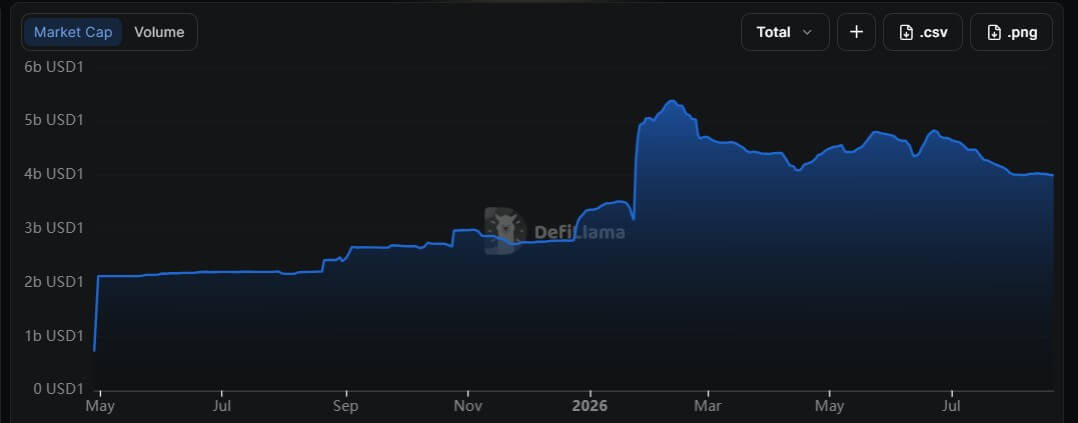
The decline began before Sun’s latest allegations and does not show that holders are redeeming because of the contract dispute. It does, however, leave World Liberty pursuing final bank approval while its flagship stablecoin is below its recent peak.
World Liberty has also challenged Sun’s description of the court fight. Chief Executive Officer Zach Witkoff said Sun’s account of the recent arbitration hearing was “riddled with falsehoods,” arguing that the court had made no ruling and that some claims brought by Sun’s companies belong in arbitration. World Liberty is separately seeking dismissal of Sun’s personal claims.
The dispute therefore leaves a narrower technical issue than Sun’s rhetoric suggests. He has not established that USD1 is a rug pull or that it added its administrative controls for fraudulent purposes.
What remains harder to dismiss is the disclosure gap: USD1’s live contract contains powers that World Liberty’s own public repository does not fully reflect, just as the company seeks final approval for a regulated trust bank that would eventually oversee the stablecoin.
Source: CryptoSlate