


FILTERED RESULTS
FILTERS
MCap $2.6T -1.4%24h Vol $88.7B -2.6%Fear & Greed 69/100Alts Index 29/100
BTC.D 58.5% -0.1%Stable.D 10.0% +0.1%ETH.D 11.4% -0.1%Others.D 20.1% +0.1%
BR$0.5368+74.14%•ZCAT$0.1237+41.96%•PONS$0.6550+18.34%•AI$0.3128+13.43%•龙虾$0.1577+11.38%•NPC$0.0230+10.51%•MINA$0.0887+7.72%•XCN$0.00432819+7.59%•UNI$6.731+6.83%•AKE$0.0158+5.81%•
LSK$0.3434-52.22%•BTW$0.6128-15.12%•FIL$0.8775-12.27%•STONK$0.2056-11.54%•UAI$0.4453-9.92%•IOTA$0.0415-9.91%•B$0.2059-9.05%•ZRO$0.9426-8.92%•XTZ$0.2556-8.63%•ICP$2.562-6.86%•
•
·
·
FILTERED RESULTS
Strategy copycat Satsuma crashed 99%, liquidated treasury
U.S. ADP Employment Sees Increase of 16,250 in Late August
NEW: White House plans to launch an interactive tool on Tuesday aimed at countering banking
Strategy (MSTR) Gets $160 Price Target From Barclays as Its Balance Sheet Matures
Balancer Proposed Winding Down the Protocol and Distributing the Treasury Among BAL Holders
CoinEx is shutting down after nearly 9 years, joining a wave of exchange closures in 2026....
Bank of America Survey Reveals Declining Confidence in Risk Assets
Bitget Wallet Introduces Tokenized U.S. Stocks from Reality
Nigel Farage-backed bitcoin treasury firm Stack BTC is proposing to acquire UK gold
US House Files 114-Page Crypto Tax Bill With $10 Fee Break Before Sept. 16 Vote
MetaMask has launched protection against “romance” and investment scams
Could XRP Price Be About to Repeat a Historic Rally?
PANews: Ethiopia Cuts Bitcoin Miners' Power Supply by 75% Due to Hydropower Shortage, Currently Delivering Only 23% of Contracted Volume, According to Bloomberg
Ethereum Holders Are Pulling ETH Off Exchanges at a Historic Pace
BingX Evolves into a Multi-Asset Trading Platform, Connecting Users to Global Opportunities
To ensure permanent economic innovation, we must pass the Clarity Act now
Bitcoin needs to reach $82,900 to outrun a looming miner margin squeeze
Clearpool Launches Institutional Credit Product on XRP Ledger Using RLUSD
What Time is Clarity Act Vote Today
Bitcoin Price Drops Below $77K Ahead of Tomorrow’s FOMC Meeting
House lawmakers have released a sweeping 114-page crypto tax bill ahead of a Wednesday
University of California Invests $2.5 Billion in New ETF, Setting Record
Binance Alpha Trading Competition: Trade Pieverse (PIEVERSE) and Share $200K Worth of Rewards (2026-...
Velocity Secures $10 Million in Series A Extension, Valuation Reaches $200 Million
Goldman, JPMorgan, BofA, Morgan Stanley and More Expect a Fed Hike Tomorrow
Liquid Network Exploit Explained: Unbacked L-BTC and the $320M Peg-Out
Coinbase Jumped 6% on an Upgrade to a $177 Target, Then…
CLARITY Act Vote Today [LIVE] Updates: Can Democrats Deliver 60 Votes?
Crypto Market Sees $146 Million in Long Positions Liquidated in 24 Hours
Ether, solana, XRP likely to gain if Clarity Act progresses
Broadridge Opens US Wealth Platform to Crypto and Tokenized Assets
Revolut Data Breach Hits 680 Customers, UK Opens Probe as Hackers Demand 10,000 Bitcoin
7⃣ Bybit 7UP #7 is LIVE! 2,000 USDT up for grabs.New to Bybit? This one's for you.1⃣ ...
Dollar Index Hits 99.57 as Fed Rate Hike Bets Mount
Solana Treasury Firm DeFi Dev Corp Rolls Out $300M CHAD to Buy More SOL
Micron, AMD, Nvidia Slide Amid AI Slowdown Fears: What’s Next?
Russia Classifies Crypto as Major Risk to Monetary Sovereignty
Important Pi Network News and PI Price Update: September 15
Crypto Wallet Tonkeeper Rebrands to Keeper, Expands Network Support to 7 Chains
DeFi stalwart Balancer mulls shutdown after $130M hack
Cross-Chain RWA: Bridging Tokenized Assets Across Blockchains
RWA Liquidity Pools: How to Provide Liquidity for Real World Assets
Why banks should stop worrying and learn to love the Clarity Act
Velocity extends Series A to $48M at $200M valuation with backing from Visa, Circle, and Ripple
Altcoins gained 21% and still lost ground to Bitcoin. What would finally turn the tables?
Bitcoin Prices Decline Ahead of U.S. Senate Vote on Clarity Act
Ethereum ETFs Surpass Bitcoin in Inflows for September
Solana Transaction Size Limit Increased Over Twofold to 4096 Bytes
Analysts Identified Signals of a Possible Continuation of the Bitcoin and Ethereum Rally
Children’s Hospital Taps NVIDIA AI to Transform Cardiac Care
Stellar Gains Institutional Spotlight Ahead of Protocol 28 as XLM Tests $0.20
Expert Names Four Factors Behind Robinhood Chain’s Rapid Growth
Tonkeeper Rebrands as Keeper, Expands Multi-Chain Support
Cryptocurrency Stocks Decline as Bitcoin Drops Ahead of Key Legislative Vote
Ethereum Wallet Exploited for $7.8 Million in rsETH via Custom Safe Module WeaknessRead...
$7.8M rsETH Drained From Ethereum Safe Wallet, MEV Bot Yoink Front-Runs the Exploit
Standard Chartered has initiated coverage of Arbitrum's
Bitcoin gives back Monday's gain as Clarity Act odds fade on Polymarket
Barclays Maintains Buy Rating on Strategy Inc. with $160 Price Target
$206M in XRP Just Left an Uphold Wallet. Here’s What Happened Next
Global bond selloff deepens as US 10-year yields rise above 5% for the...
How a simple coding mistake let a hacker drain $7.8 million from a crypto wallet
Stack BTC Proposes $16 Million Acquisition of Gold Dealer to Boost Bitcoin Holdings
Grab Acquires 60% Stake in Atome Financial for $1.49 Billion to Enhance Lending in Southeast Asia
Best Crypto To Buy Now: Pi Coin and DOGE Lose Favor as Pepeto’s 0.00% Fee Exchange Gains Attention
Bitcoin Is Plateauing At $77k: What Does It Mean And What’s Next?
Fin.com Secures $20 Million in Seed Funding to Enhance Stablecoin Solutions
White House Pushes Back on Stablecoin “Deposit Flight” Fears Ahead of CLARITY Vote According to...
US House crypto tax package omits mining, staking reward deferral
Cardano’s Leios 6x scaling breakthrough comes with a much harder ADA problem


Cardano’s Leios upgrade has demonstrated sixfold throughput gains, but staking economics still depend on paying users.
The scaling protocol peaked at 26.8 transaction kilobytes per second during its first public testnet phase, compared with a 4.51 TxkB/s ceiling for Cardano’s existing Ouroboros Praos system, according to the network developer Input Output.
In the stable final days of the 41-day test, Leios carried 54% of traffic reaching the chain and processed 18 times the transaction count seen on Cardano mainnet over the comparable period. The traffic, however, was artificially generated to stress the system rather than produced by users paying to transact.
That distinction is becoming increasingly important for ADA holders.
Cardano’s staking rewards come from a combination of transaction fees and releases from its remaining ADA reserve. The reserve contribution declines over time, leaving network activity to shoulder more of the cost of rewarding stake pool operators and delegators.
Leios is designed to remove the throughput ceiling that could otherwise prevent Cardano from generating enough transaction fees to make that transition. Its specification explicitly links greater capacity to the network’s long-term economic viability as reserve contributions diminish.
The engineering side of that equation is starting to take shape. Whether users fill the additional blockspace is now the harder question.
Leios creates the capacity, not the revenue
Cardano’s current Praos design constrains how much transaction data can move through the network while preserving reliable block propagation.
Leios adds parallel capacity through larger Endorser Blocks that carry additional transactions while the underlying Praos chain continues operating. Committees validate those blocks before recording the transactions, allowing Cardano to process more activity without replacing its existing security model.
The first public test shows the design can materially raise that ceiling.
Input Output said the testnet operated for 41 days, producing more than 127,000 blocks and announcing about 30,000 Endorser Blocks. Sixty-three stake pools registered during the phase, while developers shipped a series of fixes for memory leaks, chain forks, crashes, and other implementation problems discovered under load. Input Output said none of those incidents exposed a flaw in the underlying Leios protocol.
But more available blockspace generates no staking income until somebody pays to use it.
That is where Cardano’s economic model imposes a separate hurdle.
A cost analysis accompanying the Leios specification uses a baseline of 48 million ADA in monthly rewards and models a 43% decline by 2029, leaving 20.64 million ADA a month to be replaced through transaction fees under that scenario. The date is a modeling horizon, not when Cardano’s reserve is expected to run out.
Using an average transaction size of 1,500 bytes and a modeled fee of roughly 0.221 ADA, generating that amount would require about 36 transactions per second sustained continuously through a 30-day month. The broader Leios specification points to roughly 36 to 50 TPS as the relevant range.
Those figures cannot be directly compared with the testnet’s 26.8 TxkB/s result because they measure different things. The test demonstrates data-processing capacity; the economic model asks how many fee-paying transactions must actually arrive.
Staking increasingly becomes an adoption bet
The revenue threshold also changes depending on where you measure the money.
Cardano directs 20% of its reward pot to the treasury before distributing the remainder to stake pools. To replace 20.64 million ADA after that deduction, the same transaction and fee assumptions would require closer to 45 sustained TPS.
At 50 TPS, the model generates about 28.7 million ADA in gross monthly fees. At 20 TPS, it produces roughly 11.5 million ADA, leaving a 9.2 million ADA gap against the modeled target. Ten TPS generates about 5.7 million ADA.
| Sustained transactions per second | Gross fees over 30 days | Against the modeled 20.64 million ADA target |
|---|---|---|
| 10 | 5.74 million ADA | Below target |
| 20 | 11.48 million ADA | 9.16 million ADA short |
| 50 | 28.70 million ADA | 8.06 million ADA above |
Fee levels can move the target again. Cutting the average fee in half would require roughly twice as many transactions to generate the same revenue, while raising fees could increase revenue per transaction at the risk of discouraging activity.
That leaves Cardano facing the same economic tension that confronts many scaling networks: cheaper and more abundant blockspace can support adoption, but the network ultimately needs enough paid usage to finance the infrastructure securing it.
Input Output has set a longer-term goal of taking Cardano from roughly 800,000 transactions a month to more than 27 million while becoming economically self-sufficient as reserve funding declines. Leios is the main consensus upgrade intended to provide the capacity for that growth.
If usage falls short, the pressure moves elsewhere.
A smaller pool reward can leave less for delegators after operators take declared costs and margins. Smaller pools with fixed infrastructure expenses could face stronger pressure to accept lower earnings, subsidize operations or consolidate. Higher transaction fees offer another lever, but only if users continue paying them.
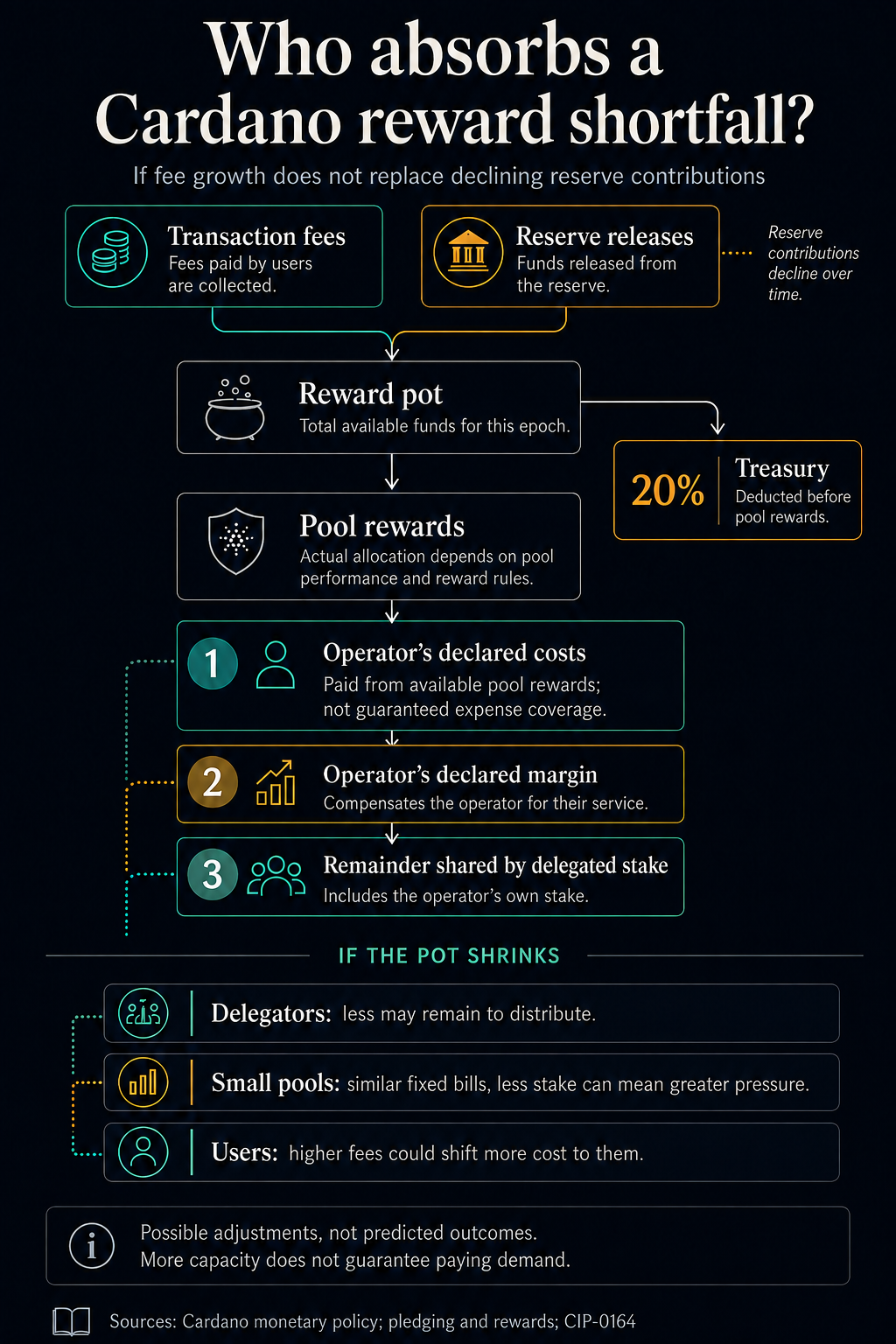
Leios does contain a protection against paying the full infrastructure cost before demand arrives. Under the proposed design, ordinary Praos blocks can continue handling low traffic without activating additional Endorser Block work, limiting some of the cost of unused capacity.
The project is now moving into the Water phase of its public testnet, where developers are testing different configurations, a redesigned mempool and production cryptographic keys.
Input Output says the goal is to make Leios mainnet-ready by the end of 2026, while acknowledging that delivering a consensus upgrade on that timetable would be unusually fast.
For stake pool operators and ADA delegators, the more consequential evidence will come after the capacity tests: sustained network transactions, the fees those transactions actually generate, and how much of the declining reserve contribution they can replace.
Source: CryptoSlate